• Welcome to Photrio!
    Registration is fast and free. Join today to unlock search, see fewer ads, and access all forum features.
    Click here to sign up

Judging Negatives

Cut

D
Cut

  • 0
  • 0
  • 15
Sacred

A
Sacred

  • 3
  • 0
  • 64

Recent Classifieds

Forum statistics

Threads
201,966
Messages
2,832,816
Members
101,034
Latest member
owk.edo
Recent bookmarks
0

RattyMouse

Member
Allowing Ads
Joined
Oct 18, 2011
Messages
6,045
Location
Ann Arbor, Mi
Format
Multi Format
From browsing the forum, it seems that the skilled people here have ways of judging the success of their negative development besides printing (or scanning). I read about negative density but have not read anyway that this is measured. Can someone explain this in a bit more detail? Now that I look at my two rolls of film developed, I think that they might be a bit "thin", but really am not sure. I have to wait 1 more week to get scans done. I can neither print or scan them at home, so am not certain of my success. I'm going to do one more roll tomorrow, and then await the results. I'm wondering about what negative density is and how it is measured so that in future, I can judge my results more methodically then just eyeballing them.

Thanks!
 

TheFlyingCamera

Membership Council
Advertiser
Allowing Ads
Joined
May 24, 2005
Messages
11,603
Location
Washington DC
Format
Multi Format
With experience, you'll know by eye if the negatives are good or not. If you want precision confirmation of your negative's quality, get a densitometer and then you can quantifiably measure the range of density from your deepest shadows to the brightest highlights. Being able to quantify the density range on your negatives by itself doesn't have meaning - different printing processes require different density ranges so what may look good for a silver gelatin print will be weak for a salt print, or too contrasty for a cyanotype.
 
OP
OP
RattyMouse

RattyMouse

Member
Allowing Ads
Joined
Oct 18, 2011
Messages
6,045
Location
Ann Arbor, Mi
Format
Multi Format
OK, maybe what I was thinking is wrong. I just think my negatives are a bit thin. I know I should be patient and wait for the scans, but it is hard. I'm reasonably confident that my developing temperatures are OK, and certainly my times are well controlled. I made my D-76 dilution in the lab at work, so that should be OK.

Should I add more time to my development stage? I have one more practice roll left. Nothing critical on it.

Thanks for any suggestions.
 

Keith Tapscott.

Member
Allowing Ads
Joined
Jun 11, 2005
Messages
1,845
Location
Plymouth. UK
Format
Multi Format
Yes, I know that. I knew that 30 years ago. I wasnt asking for the best way, I was asking for OTHER ways.
Experience. :smile:
I have never quite got to grips with judging a negative just by looking at it, but I reckon that those who print professionally for other photographers can tell if it has been exposed and developed properly.
 
OP
OP
RattyMouse

RattyMouse

Member
Allowing Ads
Joined
Oct 18, 2011
Messages
6,045
Location
Ann Arbor, Mi
Format
Multi Format
Experience. :smile:
I have never quite got to grips with judging a negative just by looking at it, but I reckon that those who print professionally for other photographers can tell if it has been exposed and developed properly.

OK, I dont have experience, but I have a boat load of professionally run negatives. If I want "thicker" negatives, should I develop longer and if so how much longer? I have a test roll that I can use for experimenting.

Thanks!
 

markbarendt

Member
Allowing Ads
Joined
May 18, 2008
Messages
9,422
Location
Beaverton, OR
Format
Multi Format
OK, maybe what I was thinking is wrong. I just think my negatives are a bit thin. I know I should be patient and wait for the scans, but it is hard. I'm reasonably confident that my developing temperatures are OK, and certainly my times are well controlled. I made my D-76 dilution in the lab at work, so that should be OK.

Should I add more time to my development stage? I have one more practice roll left. Nothing critical on it.

Thanks for any suggestions.

You can and will learn to judge negatives.

What happens is that when certain negatives give you good prints from an enlarger or a contact, and others don't, you look for the differences to see why. You start understanding the reference points. Having no enlarger or prints to reference means having no clue or way to even figure that out. (I will address scanning in a moment.)

When I first started developing film I had the same want as you, so I adjusted blind and I got prettier looking negatives, more like slides. Later, when I did start printing I found I had made my life tougher with the adjustments I had made.

In your case, where you appear to be sending them out for scanning, you will find that there will be a significant range of exposure and development possibilities that the scanning system will allow.

That system, both the people and the software, very normally will take whatever you give them and adapt/adjust without telling you. The system may not give you the feedback you need to expose or develop better. To get the info you need you will need to talk with them and learn to ask the right questions of those who scan your work.

This may take some experimentation with you providing test rolls with more or less exposure and more or less development so that you can find your limits and sweet spots.

Adding extra development for your next roll, say the next step up on the instruction sheet, probably won't hurt, the system will probably just deal with it. If one scan is better than the other you will need to ask them why and see if they can fix the bad one before you can understand.
 
Last edited by a moderator:

pdeeh

Member
Allowing Ads
Joined
Jun 8, 2012
Messages
4,770
Location
UK
Format
Multi Format
if you want denser negatives well you could give them more exposure, of course.
This is a subject that's been covered hundreds of thousands of time over in a vast number of books and articles and websites and forums!

The trouble is, there's no such thing as an "intrinsically good" negative. The point is that the negative is to be used for something, and you shoot and develop your negatives so that they can be used for that purpose. It might be for scanning, it might be for "ordinary" enlarging or it might be for alt-process, it might be for whatever.

if you only ever scan negatives, and plan only ever to scan negatives and never expect to print them in a darkroom, scanning and then digitally post-processing allows an enormous amount of leeway in how they are exposed and developed.

Unfortunately, if you then come to a point where it turns out you DO want to print them in a darkroom, you might find a lot of them are pretty tricky (for a beginner) to produce good prints from.

A scan tells you very little that's useful about a negative when it comes to printing (although it can tell you a bit with experience of both)

The best most useful single web article I ever read about exposure, development and printing was this one by Barry Thornton: Dead Link Removed ... although I realise you may not find it helpful if you are not presently in a position to print, tuck it away and read it again when or if you are.

Anyway, all just my personal opinions after spending the last couple of years relearning shooting film, learning development and printing for the first time and scanning thousands of negatives.

EDIT: Oops, markbarendt beat me to a lot of my points, and expressed them with his customary (greater) elegance.
 
Last edited by a moderator:

markbarendt

Member
Allowing Ads
Joined
May 18, 2008
Messages
9,422
Location
Beaverton, OR
Format
Multi Format
OK, I dont have experience, but I have a boat load of professionally run negatives.

So what, seriously that doesn't mean squat.

It is very possible that your "thin" negative may get you better results.
 

markbarendt

Member
Allowing Ads
Joined
May 18, 2008
Messages
9,422
Location
Beaverton, OR
Format
Multi Format
The trouble is, there's no such thing as an "intrinsically good" negative.

That is soooo true.

The world though likes specific/absolute answers, whether they exist or not.
 

mr rusty

Member
Joined
Sep 7, 2009
Messages
827
Location
lancashire,
Format
Medium Format
I have now developed about 100 rolls of film since I started. What I can say is that using only ilford film and chems* and following ilfords published times I have always found negs seem to print fine. Following the recipe in the "cookbook" exactly seems to achieve perfect results. Some negs print easier than others, but any difficulties are from my in-camera settings. It is true that some negs that look "thin" print perfectly. Perhaps it is an expectation that the highlight areas should be absolutely black on the neg, but this doesn't seem to be the case!

* I have used adonal once so far, and a few rolls of TMY
 
OP
OP
RattyMouse

RattyMouse

Member
Allowing Ads
Joined
Oct 18, 2011
Messages
6,045
Location
Ann Arbor, Mi
Format
Multi Format
OK....obviously I need to get printing experience. Sadly, that wont come for several years. So you can hopefully understand why I want to make sure that the negatives that I am making now are OK. I wont get access to a dark room for quite a long time.
 

markbarendt

Member
Allowing Ads
Joined
May 18, 2008
Messages
9,422
Location
Beaverton, OR
Format
Multi Format
OK....obviously I need to get printing experience. Sadly, that wont come for several years. So you can hopefully understand why I want to make sure that the negatives that I am making now are OK. I wont get access to a dark room for quite a long time.

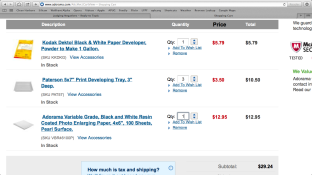
Screen Shot 2014-01-04 at 6.04.36 AM.png

That stuff plus the fixer you already have and a light bulb in a dark closet and some practice is everything you need to do a contact print.

These are essentially the same tools Weston used, albeit smaller.
 
Last edited by a moderator:

pdeeh

Member
Allowing Ads
Joined
Jun 8, 2012
Messages
4,770
Location
UK
Format
Multi Format
RattyMouse, the article by Thornton that I linked to is completely focused on making contact sheets and using them to - in effect - set your personal EI for a film + camera combination, and so create consistent straightforward-to-print negatives. It takes a few reads and a bit of practice, but I found it quite incredibly helpful.
If you can at the very least find a way to regularly make contacts, rather than peer at negatives on an iPhone or at the window or try and rely on scans, I really strongly recommend giving it a go.
Of course, it might be that other methods will be more helpful to you, as you may work or learn differently than I, but I thought it worth repeating.
 

Xmas

Member
Allowing Ads
Joined
Sep 4, 2006
Messages
6,398
Location
UK
Format
35mm RF
The rude or pithy answer to the OP is

'negatives are like purses or wallets, if they don't have enough silver (coins) at the 'bottom' they and you are poor (bad).'

They are simple ways of judging this.

First

If you look at the negative emulsion side towards you, against a dark back ground but illuminating the negative from the side and if you can see (after trying hard at lots of angles) a passable positive image then you are at least 2 stops underexposed, or way underdeveloped and it will be a hard to print, not impossible but you will need to burn and dodge and split grade variable contrast print, scanning wont be easy either.

You need to avoid negatives like this, the rule is don't underexpose and over develop, bluntly 'pushing' ISO is an invention of the devil...

Second if you cant get a positive image your negatives may still be just a little underexposed.

So to judge this degree of underexposure hold up the negative in front of a light source and look at your zone 1 shadow... but you need to know what zone 1 is...

Jump cut back to (a cine term, for a flash back) when you were taking the shot, when you meter before pushing the button, a meter on camera will give you good results 99% of the time if you take formal family shots with the sun behind the camera. But if the sun is not behind or are in streets etc. then you may need to make adjustments.

Answell Adams the doyen of beautiful prints with detail both in the shadow and clouds used a simple light (selenium) meter most of the time, when you point it at a subject it says the amount of light it sees in light units, you transfer this to a calculator which is calibrated in zones, if you point the meter at a large shadow that is just not black and set the calculator to zone 1 then zone one on the negative will just have printable detail - if you have a good meter, correct ISO, good film, good camera and good developer...

Back to your negative and more simply if you don't have detectable silver in the negative where you want shadow detail on the print you have problems, may only be part of a stop, but there is no recovery for clear film like in film rebates (e.g. 35 mm sprocket hole areas is clear film, or frame number area with 120).

To judge how much is wrong with exposure you need to shoot a whole film of relatives in line up, wiith sun behind you at 1/3 stop ISO settings 125, 160, 200, 250, 320, etc., for HP5, noting the start value, develop and print and look at prints and negatives and decide what speed you should set the film to depending on the print quality/style you like. This is paying for experience, there is no cheaper way, it also calibrates your cameras shutter. aperture ring, developing timer and thermometer, and developing solution... if you buy a new camera you need to repeat this...

The more fragile answer is to set your light meter/camera to one stop slower than box speed (for HP5 200 ISO) and shoot another film. Some people do this all the time because a stop over exposure should not be a problem for 99% or negatives, unless you name is Answell Adams and you want gossamer clouds. You need to look at a real Adam's print on a wall in an exhibition to understand how good a good a print can be, but the doyen of candid shots Henri Cartier Bresson, said 'Adams and Weston are mad they are taking photo graphs of rocks', his negatives were more difficult to print cause his subjects were more transient than rocks.

The third way is to try and print your negatives at home you only need to get printing out paper and a sheet of glass several 'clips' and some card, or post a help thread in alternative processes, or use normal paper as below... google 'printing out frame'

But dont buy one from ebay
http://www.ebay.com/bhp/contact-print-frame.

In the past the 35mm or 120 people used a 'Patterson contact printing frame' to file contacts of each film on 10x8 paper hole punching the 10x8 print, but lots of people used a 10x8 plate glass sheet (flame polished to have smooth edges) instead of buying from Patterson, and any plastic bowl...

Any of the 'printing out paper' contact printing is possible in daylight with simple bits and pieces if you have a sheet of glass, even if you live in an apartment with no dark room, as only sun light and drapes are needed.

If my English is poor PM me for email help... I do use a meter like Answell's (calculator calibrated in zones) and have to meter for (each) zone 'one' in city streets when the sun is out.

Noel

Note

Google printing out paper (PoP) and read this following copy and paste, or go to the alternative process sub forum... if you cannot get PoP normal printing paper will do.
'...
Keith Dugdale , Sep 05, 2012; 03:39 p.m.

Hi all,
My first post, hope this thread is still alive.
The answer to Nomads question is to expose for anything from 6 minutes to a couple of hours, yes really. I do not have the time for Ilford Multigrade, but Kentmere Art Classic will take two hours in sunshine. Agfa VC Premium about 15 mins.
100grams Potassium thiosulphate to 1 litre of water as a fix.
As with all photo alt the answer to most question is trial and error.

Keith Dugdale.
...'


so next time you are in photo shop buy some silver bromide paper as above, postcard size, some fix powder {Potassium thiosulphate or Sodium thiosulphate} find a one litre bottle, label it will Hazchem skull and cross bone.
Use kitchen scales for 100 gms or two heaped soup spoons, old washing bowl...

 

Bob Carnie

Subscriber
Allowing Ads
Joined
Apr 18, 2004
Messages
7,735
Location
toronto
Format
Med. Format RF
Here is what I do and I hope it helps you.

I look into the areas where there should be good shadow detail. What do you see? If you want detail then it needs to be there.
I look into the areas where there should be good highlight. What do you see? If you want detail then it needs to be there as well.
In the old kodak manuals it said that you should be able to read a newspaper through the negative highlight areas... Can you read the type?

If the negative looks thin too you , what is causing this, is it a night shot featuring a black cat, If so there will not be a lot of density overall in this negative.It will look thin. But if you want it to print , you should be able to see detail in the cat.
If the negative looks heavy to you, what is causing this, is it a white cat in a snow storm, It will look dense and if you want the white cat to separate then there must be detail in the neg.
If the original scene was a full body scene in good light, lets say a concrete building against a Mountain, with dark blue sky's and puffy white clouds, then the negative should look full body with clear areas , dense areas and a lot of mid density in between. This is the most easiest of negatives as you have lots of printing options.

Reading a negative is basically judging if all the proper elements are their proper place, yes getting out a densitometer will help, by reading the d min and d max, but for practical purposes it it important to know what you are photographing and do you see that in your negatives.

Moving further in tough lighting conditions, you will need to know how to expose and develop for those conditions... Usually a good indicator is the lighting ratio of the scene you are going to photograph.
Doing a full ring around on different lighting ratios would be very helpful.. In this day and age we are moving too fast to even consider this. With digital I doubt this is even a consideration.
A ring around will show you how to predictably estimate your process, I believe it is the basis for what is called the Zone System, but rather than plotting curves you are visually creating your parameters.

Next step is the creative process of how do you want this scene to look when printed.

For example one of my favourite photographers Nigel Dickson process was to use the same developer over , and over , and over. The the longer the soup was going the better.
His negatives looked very thin and quite un - promising, and as a printer if I was to receive them without knowing Nigel , I would pronounce them unprintable.
But he would print with grade five, with flashing and some little darkroom tricks make beautiful prints . Quite remarkable in fact.

So the moral of the story is that judging negatives is important , but you must know where you want to go with them before you really start cooking.


From browsing the forum, it seems that the skilled people here have ways of judging the success of their negative development besides printing (or scanning). I read about negative density but have not read anyway that this is measured. Can someone explain this in a bit more detail? Now that I look at my two rolls of film developed, I think that they might be a bit "thin", but really am not sure. I have to wait 1 more week to get scans done. I can neither print or scan them at home, so am not certain of my success. I'm going to do one more roll tomorrow, and then await the results. I'm wondering about what negative density is and how it is measured so that in future, I can judge my results more methodically then just eyeballing them.

Thanks!
 

Christopher Walrath

Member
Allowing Ads
Joined
Dec 30, 2005
Messages
7,175
Location
Milton, DE USA
Format
Analog
Try repeatedly comparing negatives to prints you already have. This might help you get an idea for the relations between negative density values and print values.
 

Bruce Robbins

Member
Allowing Ads
Joined
Jun 23, 2006
Messages
120
Location
Carnoustie,
Format
Medium Format
Maybe this will be of some help. I wrote about "reading" negatives a while back on my blog. It should help you identify any problems of underexposure, overdevelopment or any combination of potential cock-ups.
 

Mark_S

Member
Allowing Ads
Joined
Oct 20, 2004
Messages
563
Location
Portland, OR
Format
4x5 Format
What I do - which may or may not be of value:

I shoot sheet film, there are two sheets of film in each holder. I use a spot meter to meter on the darkest part of the image where I want detail, and expose to put that in zone IV. I then expose both sides of the holder identically.

Unless there is something really different about that particular scene (I know that it has massive or no contrast) I develop one of the sheets of film nominally, and then inspect the negative.

First thing that I do is to look at the area that I metered on and attempted to place in zone IV - If I calculated my exposure right, I will see some detail there, but that part of the negative will be pretty thin. I then look at the part of the image where there is highlight that I want to retain in the print - if it is completely dark and I can't see any detail, I develop the other sheet for less time. If it is thin, and could stand to have a bit more density, then I will develop the other sheet for longer than my nominal time, and if it looks pretty good - I develop the second sheet the same way. Once I am done, I have two negatives of the same scene, and I can pick which one is easier to print - usually the second one.
 
OP
OP
RattyMouse

RattyMouse

Member
Allowing Ads
Joined
Oct 18, 2011
Messages
6,045
Location
Ann Arbor, Mi
Format
Multi Format
Gosh....so much information here...I have lots to learn.

Thanks everyone. Rest assured, EVERY response to me is being archived on my Mac for future study. PM's too.

HUGE thanks!
 
Photrio.com contains affiliate links to products. We may receive a commission for purchases made through these links.
To read our full affiliate disclosure statement please click Here.

PHOTRIO PARTNERS EQUALLY FUNDING OUR COMMUNITY:


Ilford ADOX Freestyle Photographic Stearman Press Weldon Color Lab Blue Moon Camera & Machine
Top Bottom