
Alan Townsend
Member
Looks really nice and I am glad your making progress. I had severe trouble getting Ware's Simple Cyanotype working last year and never had a desire for NEW,
Looks really nice and I am glad your making progress. I had severe trouble getting Ware's Simple Cyanotype working last year and never had a desire for NEW,

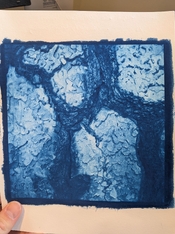
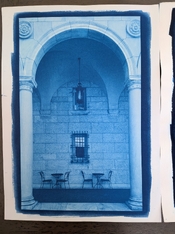
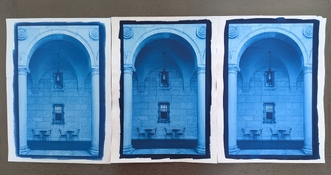
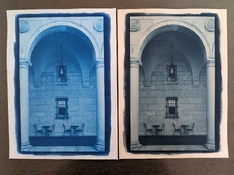
The result is a sparkly, crystal like finish when dry. The is in contrast to using the classic formula or when using the new formula on Arches Aquarelle when dry. Those tend to a matte finish.
This "sparkly" finish has a direct correlation with the properties of the final product.
-The more "sparkly" the finish, the lower the dmax and the more run-off in the wash water.
-The dmax improves with pre-humidification and the sparkly appearance diminishes.
-"Sparkly" surface papers loose much, if not most, of their denisity in plain or a citric acid first wash. Using a mineral acid such as sulfamic acid is a must. This retains the image.
-"Sparkly" surface papers appear to have much of the prussian blue sit atop the paper surface! You can feel the difference between areas of shadow and uncoated areas. The dense areas have a rough texture and tend to leave blue residue on your fingers.
What appears to be happening is the water in the solution is readily absorbed by the paper, but the contents tend to get deposited on the surface. The result is a sparkly, crystal like finish when dry. The is in contrast to using the classic formula or when using the new formula on Arches Aquarelle when dry. Those tend to a matte finish.
This "sparkly" finish has a direct correlation with the properties of the final product.
-The more "sparkly" the finish, the lower the dmax and the more run-off in the wash water.
-The dmax improves with pre-humidification and the sparkly appearance diminishes.
-"Sparkly" surface papers loose much, if not most, of their denisity in plain or a citric acid first wash. Using a mineral acid such as sulfamic acid is a must. This retains the image.
-"Sparkly" surface papers appear to have much of the prussian blue sit atop the paper surface! You can feel the difference between areas of shadow and uncoated areas. The dense areas have a rough texture and tend to leave blue residue on your fingers.
Overall printing as well as coating properties are IME best if the sensitizer doesn't soak in too deeply. I never use surfactants for this reason. They are also a liability w.r.t. clearing the highlights in heavier papers as the sensitizer embeds itself very deeply inside the paper texture and then any insoluble compounds formed there are difficult to remove through washing.Best Dmax can be obtained if the sensitizer is sitting right below or at the peaks and valleys of the paper but not too far down.

That was my first thought also. But I'm not sure what's going on hereCould the "crystal like finish" be due to residual Potassium Ferric Oxalate in the sensitiser

Could the "crystal like finish" be due to residual Potassium Ferric Oxalate in the sensitiser which crystallises on the surface of the paper after coating? During the making of New Cyanotype sensitiser, Potassium Ferric Oxalate crystals form and are removed by filtration. However, as Mike Ware notes in his writings that this separation is not always 100%:
"Of course the separation of potassium from ammonium cations is not 100%: some K+ remains in the solution and a little NH4+ will be in the crystalline product, so the conditions of time and temperature adopted for the crystallization in the following recipe must represent a compromise."
In a true solution, water can't be absorbed independently from the solute, in this case the sensitizer. All of it is absorbed or none of it. (unless there is reverse-osmosis going on which I don't think it is.)
It is fairly well known that the paper should be matte after it has been dried to get optimum result which is true even for Classic cyanotype. If it is not, it can be due to one of many reasons:
1) the viscosity of the sensitizer is too high so the as you brush it, most of it stays above the paper structure: remedy - dilute the sensitizer, moisturize the paper, add surfactant
2) there is not enough time given to the sensitizer to be absorbed into the paper before it is heat dried. Rule of thumb is to apply heat only after the paper has become matte: remedy - leave the paper in a enclosed box for a time after coating while still wet until it turns matte, only then use blow drying with or without heat
3) if there is too much sensitizer which again leaves out a film above the paper structure: remedy - use less sensitizer, brush excess off with a dry brush, don't leave any pooling of sensitizer on the paper
Indeed. When the sensitizer is fully dried, it will crystallize into its components. When those crystals are embedded within the paper, they won't sparkle due to scattering. When they are high up above the paper surface, they do. Essentially when sensitizer is sitting on top of the paper, the resulting Prussian blue collodial structure does not have any anchor to hold on to as it is formed so it can get washed away by physical forces during developing. Little UV is available to the sensitizer that might be within the paper fibers underneath so what remains is a much muted blue density.
Best Dmax can be obtained if the sensitizer is sitting right below or at the peaks and valleys of the paper but not too far down. The latter will also result in reduced density.
:Niranjan.

Re-reading through Christina Anderson's book, she has brief section about the crystals under the troubleshooting chapter. Her possible explanation is the crystals are from ferric ammonium citrate that hasn't been fully absorbed by the paper.
I ran into the same issues with splotches using more or less sensitizer on HPR. I think HPR is just difficult to coat using the new formula.
Ooops, meant to type ferric ammonium oxalate. I edited the original comment to correct that. Sorry for the confusion.But New Cyanotype doesn't have Ferric Ammonium Citrate, her explanation could be for Classic Cyanotype and not for New Cyanotype (Mike Ware does mention that traditional FAC based sensitiser is absorbed poorly: "The traditional sensitizer is poorly absorbed by cellulose paper fibres and some tends to remain on the surface or in the pores." He also says FAO based sensitiser is better in this respect: "Its solution penetrates the fibres of cellulose paper much more readily than the citrate, and it mordants better onto fabrics. It is nondeliquescent. Image substance is better retained.")
Have you tried giving HPR a rinse in plain water before using it as @Andrew O'Neill does? Or a rinse in mildly acidic water to remove any problematic additive?
Quoting Mike Ware:
"It is possible that this ‘decalcification’ treatment also brings an added hidden benefit: the small anions such as chloride or sulphamate from the acid will tend to neutralise the cationic polyelectrolytes that are present as retention aids"
Ooops, meant to type ferric ammonium oxalate. I edited the original comment to correct that. Sorry for the confusion.
"Dr. Ware in an email conversation said that if the coating is allowed to stand on the paper without being promptly absorbed, it evaporates and can leave these crystals (possibly of potassium ferric oxalate or potassium ferricyanide)."
This is what @NedL and I suspected. The chances of Potassium Ferric Oxalate forming crystals in the sensitised paper would be higher if during the preparation of the sensitiser, Potassium Ferric Oxalate didn't precipitate fully (green crystals) and some of it remained in the solution.
Yeah, papers differ in this regard.some mid-tone grain/unevenness
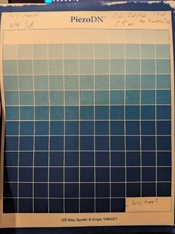
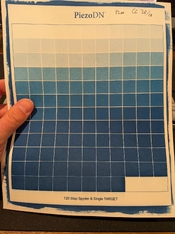
Yeah, that's a decent explanation, although the term 'edge effects' is potentially confusing due to their different meaning in other fields of photography (cf. Mackie lines).Light is then penetrating into this deeper layer, exposing it and changing how light interacts with the surface causing an apparent loss of density and change in color. Additionally I think there might be some sort of light piping effect happening here where light is penetrating and diffusing into the paper beyond its surface. This then exposes some of the solution that resides under the paper surface, even if it is being masked by the negative. This would explain some of the edge effects and why the grid between the squares appears to be getting encroached upon.
I'd call that approach "the worst of both worlds" and just not bother.I also tried combining new cyanotype with classic cyanotype (10% FAC) 1:1. [...]y work well for a different paper, but additional complexity seems hard to justify.
I'd call that approach "the worst of both worlds" and just not bother.
Several printmakers seem to have had more success with this approach than with New Cyanotype. It is discussed in Christina's book and there are some very nice prints in the same book by Sam Wang made using this approach. Peter Mrhar has high praise for Dr. Wall's Cyanotype recipe which can also be seen as a combination of New Cyanotype and Classic Cyanotype.
My results are a bit at odds with what is expected per Christina Anderson and Mike Ware. With the above combination, my exposure time is less than new cyanotype. Granted dmax is not as high as new cyanotype, I get to dmax faster. I also find that a higher concentration of 20% FAC to expose faster than 10% FAC. This is the conventional wisdom, but C. Anderson claims that she go faster results with 10% FAC. I wonder what variables are contributing to this.
Very nice print indeed! Doesn't matter in the end how you get there, as long as it works in your hands.
This is indeed quite intriguing and if you find out the reasons for the unexpected results in the future, please do share with us. In my limited experience with New Cyanotype, I have found it to be 2-3 times faster than Classic Cyanotype. Having said that, I make the sensitiser fresh everytime and I figured out a way to avoid crystallisation. In general, Cyanotype recipes with some Oxalate/Oxalic Acid in them are much faster than Classic Cyanotype. So your observations are quite interesting.
+1
I will definitely share if I ever find out! Literature doesn't seem to suggest that dichromate impacts sensitivity, but I'm wondering if my omission of the ingredient has anything to do with it. It is used as a sensitizer in carbon printing after all. Perhaps it is absorbing some of that energy and transferring it to neighboring molecules?
I don't think adding Dichromate increases the speed of Cyanotype. Its primary purpose in New Cyanotype is to prevent dark reaction in the single-bottle solution during storage.
I don't think adding Dichromate increases the speed of Cyanotype. Its primary purpose in New Cyanotype is to prevent dark reaction in the single-bottle solution during storage.
If anything, it should make it slower as it acts as an oxidizer here and it will quench a certain amount of photoinduced Fe(2) in the beginning of the exposure until it itself is all depleted, pushing the exposure curve to the right.
It is photosensitive primarily in presence of colloids such as gelatin etc which is not the case in the New cyanotype.
:Niranjan.
| Photrio.com contains affiliate links to products. We may receive a commission for purchases made through these links. To read our full affiliate disclosure statement please click Here. |
PHOTRIO PARTNERS EQUALLY FUNDING OUR COMMUNITY:  |