• Welcome to Photrio!
    Registration is fast and free. Join today to unlock search, see fewer ads, and access all forum features.
    Click here to sign up

Is there a way to get a similar image that a 4x5 with meniscus lens produces, but on 35mm?

Recent Classifieds

Forum statistics

Threads
201,679
Messages
2,828,438
Members
100,886
Latest member
Zansung
Recent bookmarks
1

xkaes

Subscriber
Allowing Ads
Joined
Mar 25, 2006
Messages
5,119
Location
Colorado
Format
Multi Format
If you want to make soft-focus lenses -- for ANY format -- check out this page. It has lots of links to how others do it, too:

www.subclub.org/fujinon/softfocus.htm

You might need to use a VPN or PRIVATE TAB to access it due to SSL issues.
 

Mr Bill

Member
Allowing Ads
Joined
Aug 22, 2006
Messages
1,524
Format
Multi Format
I've seen varying opinions online about it but the topic doesn't quite "click" for me as an optics design newbie.
About 20-some years back I did an internal company design thing on our specially designed/built portrait cameras. To project an LED number display into the gap between negatives. For the cheapest, simple setup, I used a small meniscus lens with a properly spaced aperture. Configured as reddesert describes. Mocked up on an optical bench to confirm that it worked adequately for the off-axis digits, then made a couple thousand units (worked fine).

If you were to do some crude ray tracing you would be able to see that, in this configuration, the offset lens aperture is able to block off many of the most offensive rays, greatly improving the image quality. I don't think one can really "understand" the thing without doing something like this, or perhaps rigging up a bench setup to experiment with. Fwiw I would make the opinion that it's hard to go wrong if you listen to reddesert.

FWIW I'm not a "serious" optical guy, understand just enough about image formation to be a little dangerous. Or to know when to bring in actual experts.
 

MTGseattle

Subscriber
Allowing Ads
Joined
Dec 8, 2013
Messages
1,488
Location
Seattle
Format
Multi Format
Is this all correct?


I was under the impression a meniscus lens was something akin to saran wrap.
 

reddesert

Member
Allowing Ads
Joined
Jul 22, 2019
Messages
2,599
Location
SAZ
Format
Hybrid
This is one part that confuses me a bit - I saw Andy's video from a year ago using a large format meniscus lens and his is concave toward the subject as you describe. But then I look at Holgas, disposable cameras, pretty much any single element toy camera out there and they have convex toward the subject. I've seen varying opinions online about it but the topic doesn't quite "click" for me as an optics design newbie. I guess I can always try both orientations and see for myself.

I've never examined the lens in a Holga or a disposable very closely (although I have them), but those typically have molded plastic lenses. And I think they often are not meniscus lenses, but biconvex. Plastic lenses have the advantage of different degrees of freedom in the lens design compared to conventionally figured glass. I mean I doubt that a Holga has a sophisticated molded aspheric lens, but the designer could have done something different from a single element glass lens. Years ago I used to reload a Konica panoramic single-use 35mm camera that had a 17mm lens (possibly a two-element), which one could not have made cost-effectively out of glass. It is also possible that the designers of Holgas and single-use cameras put the lens in front simply to keep fingers and dirt out of the shutter.

The optics principle of putting the aperture stop and concave meniscus towards the subject to reduce aberrations is very well established. Wollaston seems to have figured it out in the early 19th century: https://en.wikipedia.org/wiki/Wollaston_landscape_lens It is worked out as an example in optics design textbooks, because the single lens + stop is a good intro to ray tracing math and so on. I'm sure that it's in Kingslake's "Lens Design Theory," and in a different form in Warren Smith's "Modern Optical Engineering."

I found a pdf of the relevant chapter in Smith's book. Here is a screenshot where he's discussing a figure showing keeping the lens power (focal length) constant while varying the bending from concave toward the subject to concave away, and keeping the stop in a position to reduce coma. His remarks on the tradeoff between spherical aberration, field curvature, and astigmatism are interesting. The meniscus form has the field curvature compensated by astigmatism, whiile the unbent double convex lens (like a typical magnifying glass) has strongest field curvature.

smith_meniscus_lens_remarks.png


(FWIW I am not an optical designer; I'm an astronomer with some optics experience, I couldn't easily design a lens from first principles, but can mostly understand the relevant textbook.)
 

RalphLambrecht

Subscriber
Allowing Ads
Joined
Sep 19, 2003
Messages
14,914
Location
K,Germany
Format
Medium Format
Thanks all for checking the math.


This is one part that confuses me a bit - I saw Andy's video from a year ago using a large format meniscus lens and his is concave toward the subject as you describe. But then I look at Holgas, disposable cameras, pretty much any single element toy camera out there and they have convex toward the subject. I've seen varying opinions online about it but the topic doesn't quite "click" for me as an optics design newbie. I guess I can always try both orientations and see for myself.


Pinhole photography is interesting to me but not quite the same - and to get the resolution I'd want out of pinhole I'd need to go up to at least 4x5. Just not ready to add another format to my repertoire, got too many pots in the kitchen as it is.


There are indeed certain 35mm lenses wide open that will get me about 60% of the way there. I'm looking for something just a little bit more specific... kind of that 1800s lens nostalgia. I realize I am being a bit picky here.


Yep that seems right.

wide open fast lenses don't give me anything close to thiseffect. My Nikon 50mm f/1.4 aretack sharp and clear.
 

blee1996

Subscriber
Joined
Jul 25, 2008
Messages
1,467
Location
SF Bay Area, California
Format
Multi Format
Helios 44-2 is plenty sharp in the middle even when wide open. The edges are swirly but not glowing. You can't get those glowing in the highlights like the meniscus lens in large format.
 

AnselMortensen

Subscriber
Allowing Ads
Joined
Jun 9, 2020
Messages
2,752
Location
SFBayArea
Format
Traditional
Save yourself some DIY engineering...

The Sima SF lens mentioned earlier is natively a 100mm f2 meniscus lens with sliding tube focusing and T-mount interchangeability.
It comes with a set of various size apertures that go at the front of the lens.
 

reddesert

Member
Allowing Ads
Joined
Jul 22, 2019
Messages
2,599
Location
SAZ
Format
Hybrid
Is this all correct?


I was under the impression a meniscus lens was something akin to saran wrap.

"Meniscus" is from the Greek word meaning crescent. A meniscus lens has a cross-section somewhat like a crescent moon, meaning one side convex and the other concave. As opposed to a double convex or plano-convex lens. A meniscus lens can be either positive or negative (converging or diverging), depending on whether it's thicker in the center or at the edges.

Meniscus can mean a thin curved thing like the cartilage in your knee, but it's not the thinness that makes it a meniscus.
 

Arthurwg

Subscriber
Allowing Ads
Joined
Dec 16, 2005
Messages
2,953
Location
Taos NM
Format
Medium Format
How about the Leica Summar 50mm F2, shot wide open, against the light?
 

mzjo

Member
Allowing Ads
Joined
Oct 9, 2023
Messages
14
Location
France
Format
35mm
I've got a meniscus lens (plastic I think) out of a 1950's french 6x9 bakelite box camera (that I wanted to convert to pinhole). It might not clean up very well and the diameter is a bit small for playing with an slr but you're welcome to play with it if you want. Fl about 90mm I guess. Let me know if interested and I'll post it to you (free of course!).

Cheers Jo
 
OP
OP
loccdor

loccdor

Member
Joined
Jan 12, 2024
Messages
2,546
Location
USA
Format
Multi Format
Helpful responses, thank you:

I saw that this active forum member (Reinhold) makes them: https://www.photrio.com/forum/threads/120mm-wollaston-meniscus-lenses.142580/

I have a question about where to place the aperture with regards to the glass. I know it should be in front, but I'm not clear on how to select precisely how much. It seems that in the above link, it's placed very close to the glass (I found it, he says he places it 10-15% of the focal length in front of the glass) I'm finding conflicting information online.

This is what AI told me about where to place the stop, I have no idea if it's true. It was giving me a different answer yesterday.

Think of stop placement as a control knob, not a rule.

From the glass:

Stop distance Lens behavior
5–15 mm Central sharpness, poor edges
20–40 mm Transitional
40–60 mm Landscape-optimized
70+ mm Vignetting-dominated
 
Last edited:
OP
OP
loccdor

loccdor

Member
Joined
Jan 12, 2024
Messages
2,546
Location
USA
Format
Multi Format
I've got a meniscus lens (plastic I think) out of a 1950's french 6x9 bakelite box camera (that I wanted to convert to pinhole). It might not clean up very well and the diameter is a bit small for playing with an slr but you're welcome to play with it if you want. Fl about 90mm I guess. Let me know if interested and I'll post it to you (free of course!).

Cheers Jo


Thank you for the generosity! But I've got a glass one on the way to me.
 

MattKing

Moderator
Moderator
Joined
Apr 24, 2005
Messages
55,062
Location
Delta, BC Canada
Format
Medium Format
Helpful responses, thank you:

I saw that this active forum member (Reinhold) makes them: https://www.photrio.com/forum/threads/120mm-wollaston-meniscus-lenses.142580/

I have a question about where to place the aperture with regards to the glass. I know it should be in front, but I'm not clear on how to select precisely how much. It seems that in the above link, it's placed very close to the glass (I found it, he says he places it 10-15% of the focal length in front of the glass) I'm finding conflicting information online.

This is what AI told me about where to place the stop, I have no idea if it's true. It was giving me a different answer yesterday.

@Andrew O'Neill has had a bit of fun using one of @Reinhold 's meniscus lenses in large format:
Andrew13-Andrew at work-by Matt.jpg


I believe the shorts are an optional accessory!
 
OP
OP
loccdor

loccdor

Member
Joined
Jan 12, 2024
Messages
2,546
Location
USA
Format
Multi Format
Cargo shorts are definitely handy, although snow pants are now more in season!
 

Andrew O'Neill

Moderator
Moderator
Allowing Ads
Joined
Jan 16, 2004
Messages
12,870
Location
Coquitlam,BC Canada
Format
Multi Format
Cargo shorts are definitely handy, although snow pants are now more in season!
No snow here, though. Flowers are blooming!
 

reddesert

Member
Allowing Ads
Joined
Jul 22, 2019
Messages
2,599
Location
SAZ
Format
Hybrid
Helpful responses, thank you:

I saw that this active forum member (Reinhold) makes them: https://www.photrio.com/forum/threads/120mm-wollaston-meniscus-lenses.142580/

I have a question about where to place the aperture with regards to the glass. I know it should be in front, but I'm not clear on how to select precisely how much. It seems that in the above link, it's placed very close to the glass (I found it, he says he places it 10-15% of the focal length in front of the glass) I'm finding conflicting information online.

This is what AI told me about where to place the stop, I have no idea if it's true. It was giving me a different answer yesterday.

I would put the stop somewhat in front of the lens, like 10 or 20 mm (for a ~100mm focal length lens), but not more. For a given lens focal length, f-number, and bending (curvature), there is a stop position forward of the lens that minimizes/eliminates coma, which is what Warren Smith was using in the book excerpt I posted above. But for an off-the-shelf lens, we don't know the exact power and bending unless one feels like measuring the depth to curved surfaces and radius of curvature, which is overkill. It's a soft focus lens anyway, so the results shouldn't be hugely dependent on the stop location within a cm or two.

In box cameras that use a shutter in front of a meniscus lens, the aperture is often perhaps 5-10mm in front of the lens. However those lenses are also typically much slower like f/8-11 so the aperture can be physically closer to the glass; the slow lens also gives less spherical aberration soft effect.

I don't know where the AI was getting its answers. Its table seems like unreasonably confident oversimplification. It's not possible to give the answers in mm without knowing at least the focal length and probably the f-number and bending of the meniscus. If one puts the aperture 50mm in front of a fl=100mm lens there will likely be significant vignetting, unless shooting on a small format like 35mm. For a subject like this where there are probably few sources in its training set but the answers are quantitative, it might have snarfed up some information about SF lenses for large format and garbled the information.
 
OP
OP
loccdor

loccdor

Member
Joined
Jan 12, 2024
Messages
2,546
Location
USA
Format
Multi Format
Thank you @reddesert, your answers are always informative!
 

reddesert

Member
Allowing Ads
Joined
Jul 22, 2019
Messages
2,599
Location
SAZ
Format
Hybrid
Just in case anyone is still interested, I made a couple of diagrams to show how changing the aperture location matters. These are optical diagrams made with the Optical Ray Tracer program, from here: https://arachnoid.com/OpticalRayTracer/ So they are real ray traces, but they are just an example and not optimized for a specific focal length, nor has the aperture location been optimized for image quality.

I merely set up a simple meniscus lens and then put an aperture stop either forward of or behind the lens. What you can see is that depending on the stop's location, it will admit or block different rays from an off-axis subject, so the off-axis image it forms will change. This diagram isn't sufficient to tell which is better, but calculations in optical design textbooks show that the first config with lens concave toward subject, aperture in front of lens is better.

Wollaston with his landscape lens actually figured out to put the lens concave toward the subject decades before photography was invented, which is remarkable to me (he was using a camera lucida).

Aperture (blue) in front of lens (green):

meniscus_aperture_infront.png


Aperture (blue) behind lens (green):

meniscus_aperture_behind.png
 

Larry Bullis

Subscriber
Allowing Ads
Joined
May 23, 2008
Messages
1,265
Location
White Rock, B.C. Canada
Format
Multi Format
I've been messing with weird lenses since I started in photography - that was 1963. I started by taking lenses apart and seeing what the parts would do by themselves. But in the past few years, I've been buying surplus lenses and mounting them, now on my Sony cameras. Using black ABS pipe with black velour paper tubes mounted inside glued to a carved out body cap to provide a mount and whatever kind of black stuff you need for a mounting for the glass is the basic setup but by using a helicoid mount (from Rainbow Imaging) makes it able to focus. The best goo for sticking things together is Black E6000.

I just did a search on Surplushed for a PMN (positive meniscus) Lens from 6-10 mm in diameter and with a focal length of between 35 and 85 mm. I came up with a 9.3mm diameter 62mm focal length coated unit for $4.50. I believe that this is one that I actually have and have used quite successfully. I like the diameter of these lenses to be about f/8, which with this lens would be 7.75 mm. This can be accomplished with black paper.

Another thing that I have done in the past, not 35mm but 6x9, is that the old Kodak folders used to have an aperture restricting disk that can be removed. The restriction limited the usable apertures to f/11, because the image would be "acceptably sharp". If you remove the disk, you will find that the actual PMN lens that these cameras used might be around f/4. Can't remember exactly. I guess I could just measure it but I'll let you do it yourself if you want. There will be no marks to indicate the f/value, of course, but you could measure the diameter and figure it out, and make your own marks. I used slivers of tape as pointers.

For those of you who were here back in the dark ages, you may have known me as Bowzart. I'm probably best known for pinhole, but I tend to lay pretty low.
 

Attachments

  • DSC04643-2c-12-27-25.jpg
    DSC04643-2c-12-27-25.jpg
    72.4 KB · Views: 36

xkaes

Subscriber
Allowing Ads
Joined
Mar 25, 2006
Messages
5,119
Location
Colorado
Format
Multi Format
There are lots of inexpensive cameras that have very simple lenses -- not necessarily glass -- that have a simple disc to create a small aperture, as Larry mentions, that are usable for soft-focus lenses from 120 format on down. I've performed surgery on one of those give-away, keychain 110 cameras -- which was probably about f11, but became about f2.8 after the disc was removed. Pretty simple surgery.

Some would say that the results were soft (bad!) enough before the surgery, but other artistes would beg to differ. The point of focus was about 10 feet -- which is usable for a lot of subject, even with any adjustment.
 

ivan35mm

Subscriber
Allowing Ads
Joined
Mar 25, 2025
Messages
101
Location
Madrid, Spain
Format
Analog
IMG_2506.jpg


A post made by Jim Galli here on Photrio, recommending the use of a Rapid Rectilinear rear lens elements, paired with a Diopter lens up front.

IMG_2500.jpg


Another post, made by user cr2512 on the LargeFormatPhotography forum, suggests using two Rapid Rectilinear lenses of different focal lengths, and inverting the front element for more diffusion.

Additionally, you might enjoy this article on the development of the photographic objective:


Includes many illustrations of optical diagrams.
 
OP
OP
loccdor

loccdor

Member
Joined
Jan 12, 2024
Messages
2,546
Location
USA
Format
Multi Format
Thanks so much to everyone for the interesting replies, I wanted to give an update:

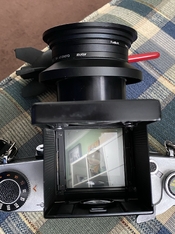
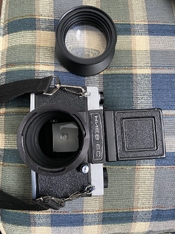
I received the materials for making this lens and started working on it.

IMG_9896.jpg


Unfortunately, the Zykkor 77mm +10 diopter filter I am using turns out to be a Plano-Convex rather than a true Meniscus. But fortunately, it seems to give a similar character, so all is well.

I did a lot of experimenting with how the rendering changes when flat side is faced toward subject vs. curved side.

Curved side toward subject doesn't give much coma, has poor center sharpness and almost nonexistent edge sharpness. Flat side toward subject gives more coma, more center and edge sharpness. All these are what I want so flat side is what I will use.

Stopped down to about f/4-f/6 (not well focused, just a rendering example picture of a viewfinder):

signal-2026-01-03-082531.jpeg


The diamond shape is a window I am shooting out of, not vignetting. But the painterly coma quality of the distant trees does at least confirm for me it's doing the rendering style I want.

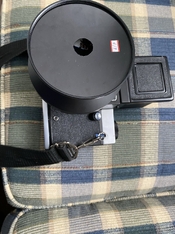
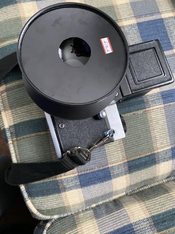
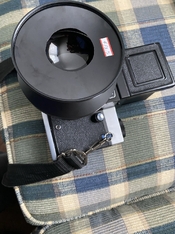
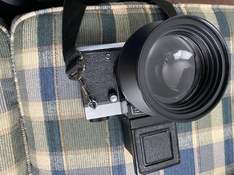
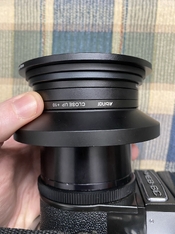
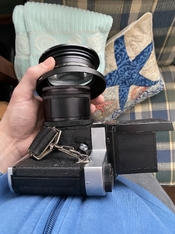
I'm using a series of step up rings, female-to-female rings, spacing rings, and a lens hood at the moment.

IMG_9898.jpg
IMG_9899.jpg


I have extension tubes on the Kiev 6C camera body that I try to make it so the lens focuses near infinity when I press the back of it to the tube.

However with this type of lens you need less extension for infinity focus as you stop it down (focus shift). So I'll need to decide on an f/stop I most want to use it at. Too bad I don't have a helicoid or bellows. Right now the plan is to "freelens" it to focus.

Also, the effective focal length turns out to be more like 150mm when assembled this way, which is significantly different from the 100mm raw mathematical estimate from the diopter strength. That's okay. When I had the curved side facing the subject, it was closer to 115mm.

The coverage is about 110mm for the image circle. Way more than I needed.

More experimentation will be required.

 
Last edited:
OP
OP
loccdor

loccdor

Member
Joined
Jan 12, 2024
Messages
2,546
Location
USA
Format
Multi Format
A few more pictures, with the stops created. I think that f/3.5 might be my favored stop with this lens, but also considering creating an f/4. f/5.6 has a very light coma effect. Wide open is f/2, too strong of an effect for most purposes, as is f/2.8.

I've added approximately 50mm of extension tube to make the pressed-against-camera focus distance about 3 meters.

f/3.5:

IMG_9913.jpg


IMG_9912.jpg IMG_9911.jpg

IMG_9910.jpg IMG_9909.jpg IMG_9908.jpg IMG_9907.jpg

IMG_9906.jpg IMG_9905.jpg IMG_9902.jpg

Time to go out and take test shots.
 
Photrio.com contains affiliate links to products. We may receive a commission for purchases made through these links.
To read our full affiliate disclosure statement please click Here.

PHOTRIO PARTNERS EQUALLY FUNDING OUR COMMUNITY:


Ilford ADOX Freestyle Photographic Stearman Press Weldon Color Lab Blue Moon Camera & Machine
Top Bottom