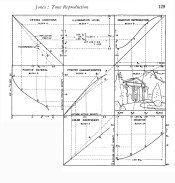
A film's characteristic curve is a construct. It is the graphic representation of the film's response to exposure and given development conditions. The X-axis is exposure and it increases from left to right. The Y-axis is density. For tone reproduction purposes, the idea is to isolate the different variables into their own quadrants (have their own curve). The following example is a multiple quadrant diagram which includes in addition to the film and paper curve, printer characteristics, viewing conditions, color efficient, illumination level, and objective reproduction.
For the sake of simplification, sometimes the variables are combined. I include flare in my paper curve by projecting a step tablet instead of contacting. To be clear, projecting a step table does not represent the paper's characteristic curve. It represents the paper curve with enlarger flare. In order to produce a true representation of how the paper responds to exposure, the step tablet would need to be contacted.
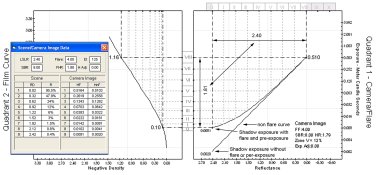
A film's characteristic curve represents the resulting densities from exposure under given development conditions. A film plane exposure, H, of 0.0032 lxs will fall at a specific point along the X-axis. Please see the below example. The resulting density for that exposure falls directly above that point. For an exposure of one stop greater, 0.0064 lxs, the exposure will fall 0.30 log-H units to the right of 0.0032 lxs. No matter how the exposure 0.0064 lxs is reached, if the film receives 0.0064 lxs, it will fall at a specific point and the resulting density will always be the same. In the below example, the density resulting from an exposure of 0.0064 lxs 0.10. Whether the extra stop is from opening up the f/stop, a slower shutter speed, flare, or pre-exposure, if the resulting film plane exposure is 0.0064 lxs, the resulting density will be 0.10. This becomes a lot clearer when using a calibrated sensitometer and a film curve with actual log-H values.
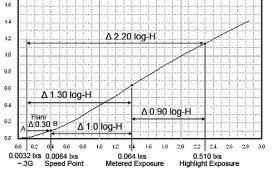
The below example shows how the camera/flare curve contains the effects of exposure from a scene luminance range of 2.40, one stop flare, one stop pre-exposure. I've included Zone references. Without flare or pre-exposure, the exposure will fall way down at 0.0020 lxs. Flare and pre-exposure bring is up to 0.0080 lxs. The scene luminance range of 2.40 becomes an effective illuminance range of 1.81. The right two columns in the Scene/Camera Image Data table shows the exposure with flare, Hf, and without, Hnf.