• Welcome to Photrio!
    Registration is fast and free. Join today to unlock search, see fewer ads, and access all forum features.
    Click here to sign up

iPhone light meter even better!

Recent Classifieds

Forum statistics

Threads
202,883
Messages
2,847,027
Members
101,529
Latest member
Flo18
Recent bookmarks
0
Hope Android users will have this app too. It's accurate and cheap. I used it shooting Friday. I was using my spot meter and the iPhone app and it's within a 1/2 stop of my Minolta meter's readings. Keep in mind that the app takes an average reading.
 
I've been using Fotometer Pro for a while now. I have shot a few rolls of transparency film (35mm Velvia 50) and I think maybe 3-4 slides have been off, usually bracketed exposures. I turned the noises off a while ago.
 
Hope Android users will have this app too. It's accurate and cheap. I used it shooting Friday. I was using my spot meter and the iPhone app and it's within a 1/2 stop of my Minolta meter's readings. Keep in mind that the app takes an average reading.

Agreed. Worldwide, there are more smartphones with android than iphones. Would be very welcome to have it on android.
Perhaps as every iPhone is very similar, it's easier to write the program and be accurate on every device; I might guess why iit hasn't been ported to android.
 
I've seen light meter apps on android platforms, but can't speak to their accuracy
 
I just downloaded it .... it looks pretty good...pretty easy to use
 
Agreed. Worldwide, there are more smartphones with android than iphones. Would be very welcome to have it on android.
Perhaps as every iPhone is very similar, it's easier to write the program and be accurate on every device; I might guess why iit hasn't been ported to android.

Yes but less android phones that can handle certain apps, only the top android phones can actually compare to iPhone and it may not be valuable to make an app like this for android, it wouldn't be as accurate because the camera phone used is different from model to model, where the iPhone camera is the same except with different models so there are 4 iPhone camera profiles but hundreds of android camera profiles to take into account.


~Stone

The Noteworthy Ones - Mamiya: 7 II, RZ67 Pro II / Canon: 1V, AE-1 / Kodak: No 1 Pocket Autographic, No 1A Pocket Autographic

Sent from my iPhone using Tapatalk
 
There are several light meter apps for Android, but I can't speak for their accuracy (you need to google around and read some reviews).

The problem with the Android platform, is that there is a much larger variety in hardware than with Apple, so from what I've seen, the Android-based meter-apps seem to only support a small list of phones.

I used my iphone while in Tokyo, shooting with my Hasselblad, was noon and sunny and very hard and contrasty light.

End result was a lot of photos with contrasty light, but not one frame wasted due to fubar exposure.
Normally I use it to get an average exposure for a scene, or to check the stop-difference between the sky and ie. water (the meter shows EI-numbers as well, so calculating the difference in stops is a breeze).

I'm still struggling to understand my Minolta Spotmeter F, as I'm having issues trying to calculate the frigging aperture 2.5 stops faster than f13 for example. (how do you do that quickly anyway?)
 
Please ignore if it's considered hijacking the thread: do they make an app (for Android) that will show the effect of different filters in B&W photography? I'm just getting back into b&w and have always had a hard time visualizing the results from filters.
 
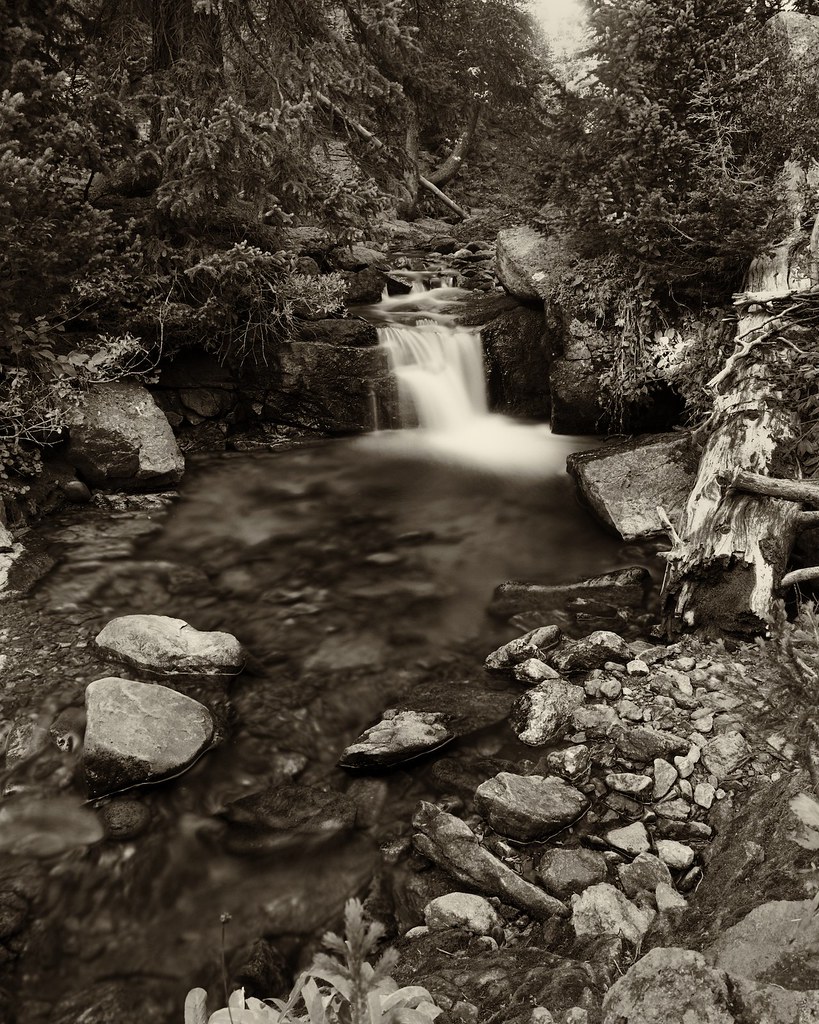
Here are a couple that I metered with the Pocket Light Meter app on my iPhone.

4x5 Korona, Fujinon 90mm f/8, Delta 100 in Pyrocat HD.

Old Fall River Road creek, Rocky Mountain National Park

Bronica GS-1 6x7cm, 110mm f/4 Macro, Delta 100 in XTOL.

Avalanche Creek 1, Glacier National Park

Since this thread is about the efficacy of the i-thingy meter, I have to ask is there any shadow detail on the negatives? Because on my screen the pictures look underexposed. I do quite a lot of very similar work under similar lighting and always get much more shadow detail. But then I have the disadvantage of using a 50+ year old LunaSix.:wink: And 100 year old lenses.
 
Since this thread is about the efficacy of the i-thingy meter, I have to ask is there any shadow detail on the negatives? Because on my screen the pictures look underexposed. I do quite a lot of very similar work under similar lighting and always get much more shadow detail. But then I have the disadvantage of using a 50+ year old LunaSix.:wink: And 100 year old lenses.

I know you're poking fun, but the 100 year old lenses themselves will help open up the shadows.
 
I know you're poking fun, but the 100 year old lenses themselves will help open up the shadows.

Well, yes and no. You still have to expose properly. The slight diffuse flare ( there's very little with a masked compendium and only two internal surfaces) will help get the film off the toe of the curve, thus opening up the shadows a bit. It's one of the reasons I use the lenses, that and the smooth tonality.
I get good shadow detail with the set of modern coated lenses which I use on 4x5, too. And then there's the possibilty that it's something to do with my monitor, or the contrast range the poster chose.
But if that's what is on the negatives, the shadows are underexposed, and the contrast range of the scene is such that it isn't neccesary.
 
Well, yes and no. You still have to expose properly. The slight diffuse flare ( there's very little with a masked compendium and only two internal surfaces) will help get the film off the toe of the curve, thus opening up the shadows a bit. It's one of the reasons I use the lenses, that and the smooth tonality.
I get good shadow detail with the set of modern coated lenses which I use on 4x5, too. And then there's the possibilty that it's something to do with my monitor, or the contrast range the poster chose.
But if that's what is on the negatives, the shadows are underexposed, and the contrast range of the scene is such that it isn't neccesary.

That's what I meant. I gain effective film speed increase of about half a stop with older lenses, compared to newer ones.
 
What's an iphone and does it have a clockwork mechanism? If so I want one.
 
Of course it's a stupid way to get a light meter, if that's the sole reason you're getting it. But if you've already got an iPhone (I don't know if there is a similar app for Android or Blackberry), then it would be stupid NOT to get the app, because you're almost always going to be carrying the phone with you, even if you forget your handheld meter. I've used the app and it is an excellent general purpose meter, and the way it works is equivalent to about a 5-degree spot meter. So you can do highlight and shadow metering to calculate the contrast range in a scene. Of course it isn't as good at that as my Minolta Spotmeter F, but that's horses for courses. The Spotmeter F (or the Sekonic 408) does me no good if they're at home or the battery is dead.
 
Of course it's a stupid way to get a light meter, if that's the sole reason you're getting it. But if you've already got an iPhone (I don't know if there is a similar app for Android or Blackberry), then it would be stupid NOT to get the app...

I just got this app and will try it out. I'm going on an overseas photo tour next month and I'm trying to carry as little gear as possible. All of the camera bodies I am taking have built in metering, but I still like to meter externally when circumstances are right. So, whether to take the spot meter, or the incident meter, or both? I usually have and use both with non-metered cameras. But, that's a lot of space in the camera bag, aside from the weight. If this app is any good - and from the reviews and this thread it seems to be - I can leave both meters and their battery requirements at home.
 
The meter works as good as any other meter as long as you understand it, just like any other meter. Be careful using the iThing as a meter, its chews through the battery life and you will need to charge it every night.

This is why I have a Mophie external battery/case for my iPhone. It adds a LITTLE bulk and weight but it about doubles the life of the battery.
 
The meter works as good as any other meter as long as you understand it, just like any other meter. Be careful using the iThing as a meter, its chews through the battery life and you will need to charge it every night.

The battery in my LunaSix was installed in 1998. My Weston doesn't have a battery/cell, just a photovoltaic cell which was factory installed. In the mid 1950s.

But by all means, go out and get an i-thingy. Don't go far from an outlet, though.:laugh::laugh:
 
Last edited by a moderator:
The battery in my LunaSix was installed in 1998. My Weston doesn't have a battery/cell, just a photovoltaic cell which was factory installed. In the mid 1950s.

But by all means, go out and get an i-thingy. Don't go far from an outlet, though.:laugh::laugh:

As previously mentioned, buying an iPhone for the purpose of installing a light meter is asinine. But if you're going to have a smartphone that is capable of also being a pretty good light meter, why not add the capability? Or are you just so bitter that you have to piss on everything that isn't to your taste?
 
As previously mentioned, buying an iPhone for the purpose of installing a light meter is asinine. But if you're going to have a smartphone that is capable of also being a pretty good light meter, why not add the capability? Or are you just so bitter that you have to @#!*% on everything that isn't to your taste?

Hardly. Were that the case I'd have no time for anything else, since quite a lot of things are "not to my taste". Mostly I ignore them. I think that smartphones/cellphones are a bane. When I'm out for the specific purpose of photography, the last thing I would bring with me is a telephone. Carrying a phone with you all the time, everywhere you go (in the absense of some sort of pending family or personal emergency) could be classified as a mild form of mental illness.
 
Last edited by a moderator:
Photrio.com contains affiliate links to products. We may receive a commission for purchases made through these links.
To read our full affiliate disclosure statement please click Here.

PHOTRIO PARTNERS EQUALLY FUNDING OUR COMMUNITY:



Ilford ADOX Freestyle Photographic Stearman Press Weldon Color Lab Blue Moon Camera & Machine
Top Bottom