
• Welcome to Photrio!
    Registration is fast and free. Join today to unlock search, see fewer ads, and access all forum features.
    Click here to sign up

Infrared with Rollei ir 400 and Lee 87

Forum statistics

Threads
203,442
Messages
2,854,757
Members
101,845
Latest member
azak
Recent bookmarks
0
Also, how does IR film differ from non-IR films; does it solve any of these concerns? Is my thinking just nonsense?

My experience with close-up IR is mostly with *D* and long lenses (birds) and the difference is small, IR cause maybe 1 inch backfocus when you are within 2-3 meters from the subject with a 400mm.
Further away with my 400mm f5.6, I got consistent and noticeable backfocus on birds, up to 20 cm when they at 5-15 meters ( at f7.1-f8)

I've also done model-photography in IR, but on those, focus seemed to be just fine with my 70-200 f2.8 (at f4).

With landscape, I've never really experiences any issues (*D* and medium-format up to 6*7)

But to compensate, you need to pull the focus-plane towards the camera a little, the red markers on the lenses may be a good aid (best suited for still subjects).
 
Ester (or anyone else) did you ever get to use the Lee 87 for the current NIR?
 
Ester (or anyone else) did you ever get to use the Lee 87 for the current NIR?

Sorry for the late reply. ;-) The other day I tried a Lee 87 polyester with Rollei Retro 400s and got absolutely nothing on the neg. So, it's transmission must be beyond these Rollei films.
 
Sorry for the late reply. ;-) The other day I tried a Lee 87 polyester with Rollei Retro 400s and got absolutely nothing on the neg. So, it's transmission must be beyond these Rollei films.
How long was the exposure?
You should get “something”, with an at least 30 min exposure.
The filter isn’t perfect and the film doesn’t stop dead at 750nm.
 
Welcome to APUG

Great choice if camera and lens.

Keep the Sun behind you and Sunlight directly on the leaves and grass. I have always used infrared film at box speed and metered through the lens with the filter mounted on the lens.


I use several different filters for a choice of effects. The exposure is adjusted for each filter with the filter factor.
R23
R25
R29
72 which is also called R72 or 720​
 
Sorry for the late reply. ;-) The other day I tried a Lee 87 polyester with Rollei Retro 400s and got absolutely nothing on the neg. So, it's transmission must be beyond these Rollei films.

That's strange that you got nothing with the 87... Rollei IR stretches up to about 830nm. Your exposure would have to be quite long, mind you to get anything. Way beyond 5 stops more than my usual filtered EI with this film (1.5 with the 720)). But really... I find the 720nm filters that I have are quite effective with this film.
 
How long was the exposure?
You should get “something”, with an at least 30 min exposure.
The filter isn’t perfect and the film doesn’t stop dead at 750nm.

Yikes! I wasn't even thinking of exposures that long. I did several exposurse up to 4 seconds. Based on what you stated I may try again to see just what it takes. Thanks.
 
Last edited:
That's strange that you got nothing with the 87... Rollei IR stretches up to about 830nm. Your exposure would have to be quite long, mind you to get anything. Way beyond 5 stops more than my usual filtered EI with this film (1.5 with the 720)). But really... I find the 720nm filters that I have are quite effective with this film.

I've purchased one of these inexpensive GTX IR 720 filters. Some indoor testing last night shows it has good throughput.
 
I've purchased one of these inexpensive GTX IR 720 filters. Some indoor testing last night shows it has good throughput.

Wow those filters are cheap! Would need to see your results.
 
Yikes! I wasn't even thinking of exposures that long. I did several exposurse up to 4 seconds. Based on what you stated I may try again to see just what it takes. Thanks.
Reciprocity failure rears it’s head after one second already with many of these weird emulsions.
 
Yikes! I wasn't even thinking of exposures that long. I did several exposurse up to 4 seconds. Based on what you stated I may try again to see just what it takes. Thanks.

My minimum exposure times with a 720 filter, and f/11 (EI 1.5) is about 8 seconds on a bright, sunny, summer afternoon. Reciprocity compensation pushes it to about 24 sec. An 87 filter would require a base exposure of about 16 second, and 32 sec with reciprocity correction.
 
I use:
R23 2 f/stops
R25 3 f/stops
R29 4 f/stops
R72 5 or 6 f/stops Edit: Loose highlights at 6 stops
I use Rollei IR 400 at box speed either starting at 1/400 second and f/16 for Sunny 16 or with the light meter at ISO 400. I have never had a problem with this method.
 
Last edited:
I have shot two rolls of Rollei IR400 (Agfa produced) in 120, and used those two settings. I liked the 5 stops (equivalent to external metering at ISO12 with the R72 on the lens ) better than the 6 stops (equivalent to external metering at ISO 6 with the R72 on the lens). Both were good, but I lost more of the highlight in NIR rich areas with the ISO 6 equivalent. I know the proper way is to meter at ISO 400 (again external, not through the lens), then open 5-6 stops, but these are equivalent. With the Gossen Luna Pro SBC you could also set to ISO 400 and then set the VF ring to 32 (5 stops) or 64 (6 stops); though IR film is usually used under sunny 16 conditions anyways, so often no need to meter. In sunny 16, I think I used f16 (get DOF due to possible small focus shifts) at 1/8s for the 6 stops and 1/15s for the 5 stops (on a tripod of course). The Lee filter may be too radical for this film (Rollei IR400), maybe more suited to Kodak High Speed IR or Efke IR820 (if you could get either!); though if the published spectral curves are correct, with enough exposure (and accounting for reciprocity) you should be able to get an image. The Rollei IR400 I have was made in Beligium by Agfa (expired 2015). The newer Rollei IR400 is probably produced by Inoviscoat, and is purportedly the same emulsion.

...R72 5 or 6 f/stops​
...

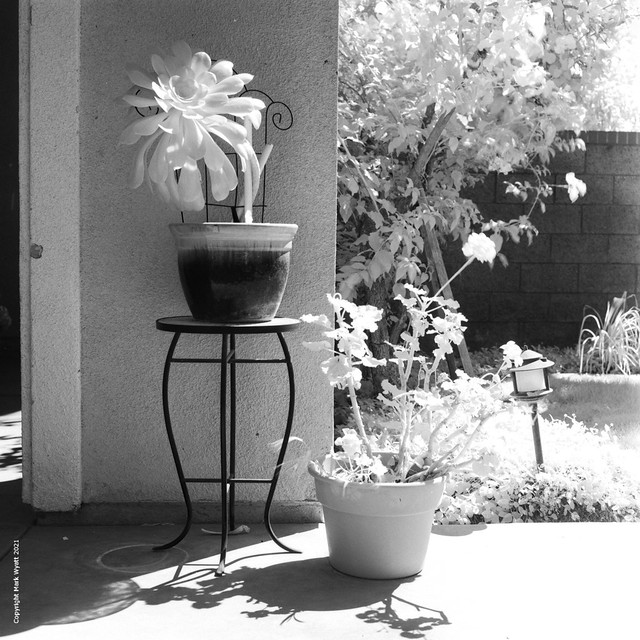
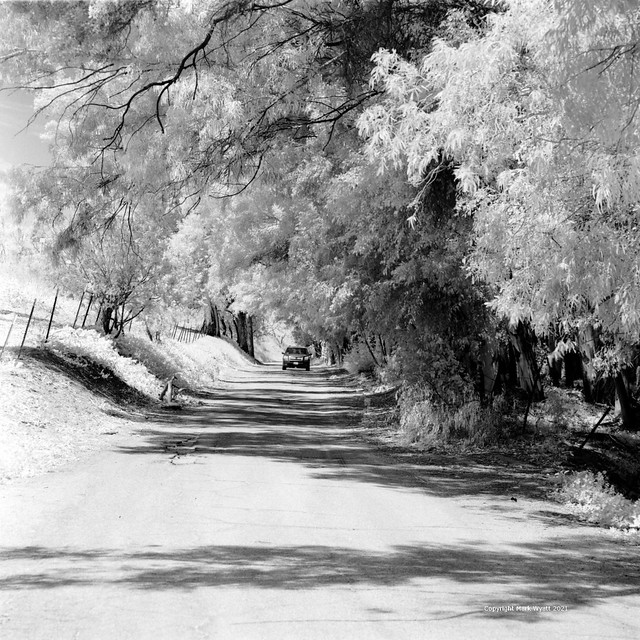
A couple of examples:

6 Stops (ISO 6 w/R72):


Potted Plant
by Mark Wyatt, on Flickr


5 Stops (ISO 12 w/R72):


Surreal Country Road, Car
by Mark Wyatt, on Flickr
 
Last edited:
I have shot two rolls of Rollei IR400 (Agfa produced) in 120, and used those two settings. I liked the 5 stops (equivalent to external metering at ISO12 with the R72 on the lens ) better than the 6 stops (equivalent to external metering at ISO 6 with the R72 on the lens). Both were good, but I lost more of the highlight in NIR rich areas with the ISO 6 equivalent. I know the proper way is to meter at ISO 400 (again external, not through the lens), then open 5-6 stops, but these are equivalent. With the Gossen Luna Pro SBC you could also set to ISO 400 and then set the VF ring to 32 (5 stops) or 64 (6 stops); though IR film is usually used under sunny 16 conditions anyways, so often no need to meter. In sunny 16, I think I used f16 (get DOF due to possible small focus shifts) at 1/8s for the 6 stops and 1/15s for the 5 stops (on a tripod of course). The Lee filter may be too radical for this film (Rollei IR400), maybe more suited to Kodak High Speed IR or Efke IR820 (if you could get either!); though if the published spectral curves are correct, with enough exposure (and accounting for reciprocity) you should be able to get an image. The Rollei IR400 I have was made in Beligium by Agfa (expired 2015). The newer Rollei IR400 is probably produced by Inoviscoat, and is purportedly the same emulsion.


A couple of examples:

6 Stops:


Potted Plant
by Mark Wyatt, on Flickr


5 Stops:


Surreal Country Road, Car
by Mark Wyatt, on Flickr
It’s an ISO 100 film. When/if EI 32 works, it’s probably because it’s an extremely sunny day and IR content is high. It’s 1.5 stops too much. For normal light.

I usually rate Aviphot 200 derivatives with an R72 around 10 - 12 for a few clouds and decent shade information.
You can preflash (two stops under) or latensify (with green light) and use Adox HR-Dev to get a flatter cure though.
Personally I’m also experimenting with a silver nitrate pre bath, astro photography style, in spring to really up the speed.
 
I tried the Lee 87 filter with Rollei IR400 years ago, and exposures up to 10 minutes still gave me blank film.
 
The strongest filter I've been using with this film is the 72. It gives me a nice effect. Six stops more exposure from box speed... and of course, reciprocity compensation added...
 
I tried the Lee 87 filter with Rollei IR400 years ago, and exposures up to 10 minutes still gave me blank film.

I have held back because I thought that the 87 filter was cutting out all the light that the film to which the film reacts. So my thoughts are correct. Rollei IR 400 IIRC cuts off at 750 nm and therefore not usable IR gets to the film.
 
According to Lee's website transmission for the 87 filter begins above 730 nm. Rollei recommends a filter from 715-730 nm. Sounds like the Lee filter is outside the films useful range to me.
 
I have held back because I thought that the 87 filter was cutting out all the light that the film to which the film reacts. So my thoughts are correct. Rollei IR 400 IIRC cuts off at 750 nm and therefore not usable IR gets to the film.

According to Lee's website transmission for the 87 filter begins above 730 nm. Rollei recommends a filter from 715-730 nm. Sounds like the Lee filter is outside the films useful range to me.

I had the numbers wrong, but the concept was correct. Thank you.
 
I have held back because I thought that the 87 filter was cutting out all the light that the film to which the film reacts. So my thoughts are correct. Rollei IR 400 IIRC cuts off at 750 nm and therefore not usable IR gets to the film.

The IR400 datasheet claims sensitivity to 820 nm, but by that point it is 3 orders of magnitude less sensitive than to visible light.
 
It’s an ISO 100 film. When/if EI 32 works, it’s probably because it’s an extremely sunny day and IR content is high. It’s 1.5 stops too much. For normal light.

I usually rate Aviphot 200 derivatives with an R72 around 10 - 12 for a few clouds and decent shade information.
You can preflash (two stops under) or latensify (with green light) and use Adox HR-Dev to get a flatter cure though.
Personally I’m also experimenting with a silver nitrate pre bath, astro photography style, in spring to really up the speed.

Consistent with me (ISO 12 preferred, ISO 6 ok).
 
I have used IR 400 a fair amount. The suggestion of using EI 12 is not bad as a starting point. But I think the expectation that can just use one EI and have it dialed in from the get-go, especially when one is first doing IR, is over-optimistic. There are a lot of variables such as time of day, quality of the light, the contrast of the subject. I think the best thing, especially at first, is to bracket exposures. I start an IR roll with a non-IR shot for reference. Realize that without a filter Rollei is not remotely a 400-speed film. Tests by Henning Serger showed was probably less than 100 speed. This is a very contrasty film with a severe "S" shaped curve. So it is easy to blow out highlights and dump shadows and the IR filter just exaggerates this. So you want to think about development methods that mitigate that. Focus is hard to achieve with IR because is not the same as with visible light. I usually stop down a lot to try to get focus. Having said all this, it can be really fun to do the IR thing.
 
I have used IR 400 a fair amount. The suggestion of using EI 12 is not bad as a starting point. But I think the expectation that can just use one EI and have it dialed in from the get-go, especially when one is first doing IR, is over-optimistic. There are a lot of variables such as time of day, quality of the light, the contrast of the subject. I think the best thing, especially at first, is to bracket exposures. I start an IR roll with a non-IR shot for reference. Realize that without a filter Rollei is not remotely a 400-speed film. Tests by Henning Serger showed was probably less than 100 speed. This is a very contrasty film with a severe "S" shaped curve. So it is easy to blow out highlights and dump shadows and the IR filter just exaggerates this. So you want to think about development methods that mitigate that. Focus is hard to achieve with IR because is not the same as with visible light. I usually stop down a lot to try to get focus. Having said all this, it can be really fun to do the IR thing.

I have mainly shot in sunny-16 (plus shadows) scenarios. I understand that on overcast days, dusk/dawn, night etc. it may be more hit and miss because it is not clear how much near IR is around, and at least I Do not have a near IR meter. At night there is probably almost none.
 
I've never attempted IR photography, but I've always wondered about one factor in particular: focusing, especially at close distances. It's well known that different colors of the visible spectrum will focus at different distances from the lens (not all at the film plane). Modern lens are corrected to bring all colors of the visible spectrum to a sharp focus at the same plane. Then there's IR, beyond the visible, that if not corrected, should focus some distance behind the film plane and thus be out-of-focus at the film plane, while the visible light in the image would be in focus. Many 35mm lenses I've seen have a "little red R" next to the infinity mark on their focus scales to allow for a correction. That correction, I'm guessing, is valid only for infinity focusing... so what does one do in a close-up situation (where relying on depth of field may be insufficient)? I no longer use 35mm or MF, only large format view cameras. Can someone explain how to use IR film with a view camera? Also, how does IR film differ from non-IR films; does it solve any of these concerns? Is my thinking just nonsense?
My experience with IR 400 is that if you try to focus on close subjects the visible light focus and IR it is NOT the same. If you want to try do close-up portrait shots at f/1.2 forget it. Some lenses have the red IR focus adjustment line. Some say that is only applicable to the extinct high IR films. But I have found it to be a little better with IR 400 than not using it. But in my experience, there is not an alternative with IR but to stop down a lot to achieve focus and the closer the subject the more the need to stop down.
 
Shooting IR really is like this crazy and sometimes wonderful "through the looking glass" effect. Things do not look like they do to the eye and do not look like they do with conventional film. For example, you might gaze upon a forest with areas of coniferous trees and areas of deciduous trees. To your eye, they seem a similar green. To a conventional film, they may seem a similar grey tone. But with full IR, WHOW, the deciduous trees are dramatically lighter than the coniferous trees. Water can be totally black. It is amazing that the camera can reveal this normally hidden IR world. You have to have patience and shoot a lot and accept a higher failure rate at first to grasp how the film is seeing things differently than you are with IR, but it is worth it.
 
Photrio.com contains affiliate links to products. We may receive a commission for purchases made through these links.
To read our full affiliate disclosure statement please click Here.

PHOTRIO PARTNERS EQUALLY FUNDING OUR COMMUNITY:


Ilford ADOX Freestyle Photographic Stearman Press Weldon Color Lab Blue Moon Camera & Machine
Top Bottom