• Welcome to Photrio!
    Registration is fast and free. Join today to unlock search, see fewer ads, and access all forum features.
    Click here to sign up

Image transfers with Fuji instant films?

Recent Classifieds

Forum statistics

Threads
202,671
Messages
2,843,872
Members
101,453
Latest member
lubowe
Recent bookmarks
0

jasonjoo

Member
Allowing Ads
Joined
Apr 26, 2007
Messages
398
Location
California
Format
Medium Format
Hey guys and gals,

Since Polaroid is no longer going to produce their instant films, I was wondering if some of you have experimented with the Fuji instant films. It just so happens that I began gaining some interest in image transfers (not emulsion lifts) after Polaroids announcement!

I'm not planning on using the Daylab copy equipment. I just plan on making an exposure with my Land camera, let it develop for 15-25 seconds, and then smacking down the emulsion on a piece of water color paper.

Has anyone tried with with the Fuji instant films? How were you results? Any tips for a noobie? Thanks!

Jason
 
Good link. So the key bits seem to be--

Transfer to dry paper.

Peel in the dark (a very small amount of light for positioning the neg is okay), but the lights can come on once the neg is on the receptor sheet.

Roll hard with a brayer for 30-60 sec. before peeling.

He describes using a small night light at the other end of the room for positioning the neg, but I'd probably experiment a bit with the various safelights I have to see if one works better than others.

As I recall, I tried it a couple of times and indeed, all I got was a green blob of not much, because I peeled in the light.
 
Any acid content in the paper will slow down any transfer. The paper should be either neutral or alkaline. Also, aluminum sizing agents will stop the transfer cold. This is true of Polaroid or Fuji products.

PE
 
A brayer is just a roller. Any crafts store has one for you. It's like a rolling pin with a smooth but firm rubber surface.

I never got good image transfers with the Fuji stuff. Even when I did it in the dark, with or without warmth or moisture. Maybe I didn't brayer it firmly enough. I did easily get remarkably (to me) sturdy emulsion transfers by simply boiling the print. I mean, you can really tug on and deform the fp100c emulsion and dry it and glue it down. Fun for the whole family.
 
You know David, that was the same result I was getting. I never thought to try Fuji Instant in the dark. Sounds weird, but I am interested in giving it a try. I have recently read about boiling Fuji Instant prints, though I have not tried it yet.

Ciao!

Gordon Moat Photography
 
That's what we called them in elementary school.
 
what did you use to glue the lifts down? and, did the "glue" show?

i found the film lifted easily but wouldn't stick to anything.
 
Last edited by a moderator:
Wow, I didn't expect so many responses so soon!

Why would light affect the image transfer? I've peeled my Polaroids (667 and 669) in broad daylight without any issues. Is there a difference in the chemistry? If I start using Fuji's instant films with my Land camera, will have to peel each "polaroid" in the dark as well?

Thanks,

Jason

Edit: BTW, do most people make image transfers from 35mm to the instant film? I'm planning on doing this directly from my Land camera, but it seems like most people are first making the image with a 35mm negative onto an instant film, THEN making the image transfer.

Also, has anyone tried an image transfer with 667 film? I just bought a few packs so I'd like to try it, but I don't want to waste too many polaroids by experimenting :X
 
Last edited by a moderator:
No, you don't have to peel normal Fuji instant prints in the dark, because normally you would peel them after they are developed. Apparently, you have to peel them in the dark for transfers, because the development is not yet completed.

I just shoot transfers with a Polaroid back on a medium or large format camera. I don't use a Daylab, but I know gr82bart uses a Daylab for making transfers from slides.
 
I've always made transfers from in-camera shots until now. Just got a PolaPrinter which transfers 35mm slides to 8x10 and I'm going to try it today.

There must something different about Fuji's process that makes their film far more light sensitive during development than Polaroid's is/was. This could be a real breakthrough to sustain the art form if it works.
 
I can see why I would want to make transfers from my slides, but I really can't justify spending the money on the hardware (especially now because polaroids are becoming extinct!).

I'll have to try this with Fuji's instant film. If it turns out well, I just may invest in one of the Daylab systems.
 
i have used both daylabs of all sizes and in camera shots as well. just depends .
 
I can see why I would want to make transfers from my slides, but I really can't justify spending the money on the hardware (especially now because polaroids are becoming extinct!).

I'll have to try this with Fuji's instant film. If it turns out well, I just may invest in one of the Daylab systems.

I'm sure the Daylab systems will turn up by the dozen on e-bay for pennies.

I'm glad to hear that the the Fuji material can be worked with.
 
If you have a 4x5" camera and a packfilm back for the Fuji instant material, you could dupe slides with it with a copy stand or a tripod with a lateral arm and a light box.
 
Good idea Renato! I'll be checking eBay from time to time, but once word gets out that the Fuji instant films work, people may not want to part with their Daylab systems :smile:

Jason
 
OK, I posted the link in reply #2 and just so I can prove it does work, I did it.

And not only did it work, it worked in spite of my bending some of the rules he set forth.

I just grabbed a piece of paper of the scrap pile, I know it is hot pressed and I'm pretty sure it was Canson but right now I couldn't tell you which. And I'm quite sure it has at least some sizing. Second I didn't use a hard rubber brayer. The one I had on had I would call medium soft. The pack film camera on had with Fuji FP100C in it was my "Frankenroid" pinhole so I just set some LF lenses on the table and guessed at an exposure, turns out 10 minutes was probably to little.

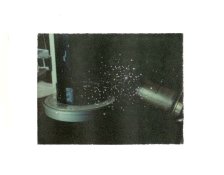
Quickly, the light/dark banding that would otherwise be considered a "bad pull" isn't. It is the water color paper rippling a bit and my craptacular scanner lid wasn't heavy enough. Also, the tonal range is better in the print than the scan (same ole' song and dance, I know). However, the large "snowstorm" in the middle isn't an artifact. It is bits of emulsion that didn't transfer. Brayer only run in one direction and possibly the work surface wasn't smooth enough. Or brayer too soft, too little pressure, too fast peel, you know the drill with transfers. Any number of things can go wrong.

But son of a gun if it didn't work!
 

Attachments

  • forAlex.jpg
    forAlex.jpg
    61.7 KB · Views: 358
what did you use to glue the lifts down? and, did the "glue" show?

i found the film lifted easily but wouldn't stick to anything.

Hi Ann. Sorry, just saw your question.

What I do with the glue is just use it to fix the very extreme corners of the emulsion. Now, the emulsion was previously sprayed with this krylon UV stuff which kinda hardens / protects it a bit. As it's drying I push the corners down a bit. Then I just tack the edges to paper with ordinary glue, I forget what kind, but something straight from a crafts store.

Ann, as I recall from previous discussion on this, you are interested in gluing it flat. There I am afraid that I can't help you. My own interest is quite different: I like that the emulsions sits some distance off the paper and thus gives a 3D / shadow effect. I don't want bubbles at all, what I want is for it too sit off from the paper and only contact it in a few spots. My feeling is that this is something I can do with the Fuji stuff because the emulsion is somewhat more durable, whereas the lifted polaroid emulsions were too fragile.

However, the large "snowstorm" in the middle isn't an artifact. It is bits of emulsion that didn't transfer. Brayer only run in one direction and possibly the work surface wasn't smooth enough. Or brayer too soft, too little pressure, too fast peel, you know the drill with transfers. Any number of things can go wrong.

See, that was the issue that I never got past; I will be interested if you find the solution. I simply never solved that problem. I tried all different kinds of brayering (hard or soft, long or short), different papers, more or less moisture on the paper or heat on the fp100c. Please... if you solve it, share your trick!

Renato, I have been enlarging 35mm slides to 4x5" fp100c, I like it a lot.
 
Last edited by a moderator:
i am not interested in gluing it flat, or rather i would rather not have to do that, but i would like it to dry flat as does the polariod. can't have everything, so it seems these days.

the best thing will be to go buy a couple of packs of fuji and see what i can come with.


rw,
did you peel the film in light, or dimmed conditons.
 
i am not interested in gluing it flat, or rather i would rather not have to do that, but i would like it to dry flat as does the polariod. can't have everything, so it seems these days.

Okay, maybe I can help you after all.

I placed the wet lifted emulsion on glossy inkjet paper. I let it dry on that. It dries quite flat and then lifts off well after it's dry. Not as flat as pola but close.

Now, after lifting it off, I felt the creative need to deform the emulsion. Ripple it and stretch it and so forth. You may not feel that need!
 
Hello all:
Peter Balazsy Here: www.pbpix.com

I'm the fellow who pioneered and developed the Fuji FP100c image-transfer technique back in 1992.

I'm glad to see that you are all anxious to try it and glad to get the technique that I've been releasing and posting lately on Flickr.com and elsewhere.

Here are a few of my Fuji transfers to show you results and variations.

Feel free to contact me if you need any help.
Good luck.

Peter G. Balazsy
Peter@pbpix.com
www.pbpix.com
973-790-7960
 

Attachments

  • tara-8-m.JPG
    tara-8-m.JPG
    25.1 KB · Views: 322
  • 921639-L.jpg
    921639-L.jpg
    25.3 KB · Views: 323
  • 921230-L.jpg
    921230-L.jpg
    18.8 KB · Views: 301
ok, where in this site do you discuss how you got the "lifts" to stick to paper?

I am not interested in doing transfer, just the lift. The film lifts easily but when it dries, it just floats away from the surface.
 
I don't use a Daylab, but I know gr82bart uses a Daylab for making transfers from slides.
I'm actually going to use Fuji and my Daylab for this round of the postcard exchange. Let's see how it goes ....

The "In the dark" thing is the real big change from the Polaroid transfer process. Means I have to move from the kitchen to the bathroom!

Regards, Art.
 
Photrio.com contains affiliate links to products. We may receive a commission for purchases made through these links.
To read our full affiliate disclosure statement please click Here.

PHOTRIO PARTNERS EQUALLY FUNDING OUR COMMUNITY:


Ilford ADOX Freestyle Photographic Stearman Press Weldon Color Lab Blue Moon Camera & Machine
Top Bottom