
• Welcome to Photrio!
    Registration is fast and free. Join today to unlock search, see fewer ads, and access all forum features.
    Click here to sign up

I just don't get the 35mm vs bigger format thing.

MIT. 25:35

MIT. 25:35

  • 0
  • 0
  • 45
Lutheran Cemetery Angel

H
Lutheran Cemetery Angel

  • 0
  • 0
  • 37

Recent Classifieds

Forum statistics

Threads
202,950
Messages
2,848,042
Members
101,553
Latest member
JasonGoh
Recent bookmarks
1
Here's an interesting discussion written by Tim Vitale (I'm not familiar with the name) about this topic that I just happened to run across....primarily focused (groan) on film resolution but also touching on all the components of an imaging system which affect the final resolution seen in a negative.


http://cool.conservation-us.org/coo...itale/2007-04-vitale-filmgrain_resolution.pdf

It was written up a few years ago so you may find yourself sadly reminiscing about some of the films mentioned.

From the article :

The image circle of a 35 mm lens is about 43 mm, while a 4 x 5 view camera has an image area of 160 mm; almost 4 times larger.

There is a little error here. Increasing the diameter with 1.4 ( square 2 ) doubles the area. Doubling the image circle gives you an image are 4 times as big. So in the case of the 35mm vs 4x5". The large format 4x5" has an image area almost 16 times as large as 35mm.
 
From the article : "The image circle of a 35 mm lens is about 43 mm, while a 4 x 5 view camera has an image area of 160 mm; almost 4 times larger".

There is a little error here. Increasing the diameter with 1.4 ( square 2 ) doubles the area. Doubling the image circle gives you an image are 4 times as big. So in the case of the 35mm vs 4x5". The large format 4x5" has an image area almost 16 times as large as 35mm.

The author of that paper mistakenly used the terms "area" and "image circle" when he should have used "diameter" instead.
 
If you do not make a large enough print, you might not be able to appreciate a difference in 'detail'...the relatively poor visual acuity of the human eye would likely not see any 'detail' difference in an 8x10 (8x) photo of the same subject in two format sizes.
In projecting both 135 format and medium format slides onto a projection screen, the medium format images carry much more emotional impact to the viewing audience...past observable reactions, not merely speculation!

Ditto. You will definitely see the difference when projecting. I use very good lenses on both the 35mm and 120 projector, and the difference is definitely visible.
 
Ditto. You will definitely see the difference when projecting. I use very good lenses on both the 35mm and 120 projector, and the difference is definitely visible.

Welcome to APUG.

+1 My father would win the monthly contests in his camera club because the judges liked the 2 1/4" x 2 1/4" slides better than the 35mm. He would joke about the unfair advantage.
 
Ditto. You will definitely see the difference when projecting. I use very good lenses on both the 35mm and 120 projector, and the difference is definitely visible.

of course it is:wink:human visual acuity is actually pretty amazing.with normal eyesight you can make out a dark human hair on a white sheet of paper at a distance of 10m!That's pretty good I'd say:wink:
 
of course it is:wink:human visual acuity is actually pretty amazing.with normal eyesight you can make out a dark human hair on a white sheet of paper at a distance of 10m!That's pretty good I'd say:wink:

Which illustrates how important contrast is in that perception...
 
On 6x8 prints there is a difference between 35mm and medium format (even 645). Supprising but true. You woul meed to compare the scene e.g. Wedding photographs.
 
Wedding photographers used to shoot medium format for all their formal wedding shots. Some would bring out a 35mm for candid shots at the reception. I guess they figured the candids would not be blown up.
 
Just read the 1st post.I know what you mean, and have had the same issues. If you are using a high quality medium format lens you need to compair it to a tip top lens on 4x5.
 
Just read the 1st post.I know what you mean, and have had the same issues. If you are using a high quality medium format lens you need to compair it to a tip top lens on 4x5.

You also need to compare the lens on the enlarger, the effort to keep these big negs clean and a few other variables that larger format film shooters assume are well known to everyone. :D

and when we get to storage or archiving film -- 99% of any format shooters are perpetually unprepared for the future.
 
The results are in and I found something thought-provoking.

We are missing the details as we focus on the big picture.

Or... We can't see the trees for the forest.

Emotionally, I wanted this statement to stand without any qualification: "A Minox negative and an 8x10 negative produce the same amount of detail in a 20x24 silver gelatin enlargement."

Of course, it is a patently false statement.

But with one qualification it becomes true.

"Just walk in closer to the subject with the Minox."
 
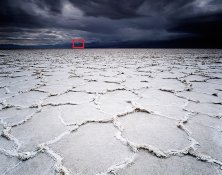
Move in closer with the Minox?:smile: I stole this image from another website... shot on 8x10 film. I suppose if I had to move in closer with the Minox then I'd shoot the part of the image in the red rectangle and print it to 2x3". Oh, but man, that would be a very l-o-o-o-n-g walk to crop with my feet.:D
attachment.php
 

Attachments

  • Untitled.jpg
    Untitled.jpg
    113.7 KB · Views: 253
And if you also walk closer with a larger format camera, its print will again trump the print from 135 format.
 
The results are in and I found something thought-provoking.

We are missing the details as we focus on the big picture.

Or... We can't see the trees for the forest.

Emotionally, I wanted this statement to stand without any qualification: "A Minox negative and an 8x10 negative produce the same amount of detail in a 20x24 silver gelatin enlargement."

Of course, it is a patently false statement.

But with one qualification it becomes true.

"Just walk in closer to the subject with the Minox."

Must be your small format technique :laugh::laugh::laugh:
 
And if you also walk closer with a larger format camera, its print will again trump the print from 135 format.

In what way?
 
In what way?

In terms of the detail which may be revealed upon close inspection of the print.

I have examples from my recent run of prints to illustrate how the advantage depends upon how well you take care of the factors which affect critical sharpness.

It has been a wonderful and revealing exercise to try to prove the point. I learned a lot and can't wait to share it.
 
It has been a wonderful and revealing exercise to try to prove the point. I learned a lot and can't wait to share it.

Bill Burk, why are you holding back? Share now. Now.

Are you acquainted with John Williams' book Image Clarity?
 
I get the smaller vs. bigger negative thing. Generally, I'll make larger prints from larger negatives. Often, trying to go to a larger size (20x24+) from a smaller negative just doesn't hold up to my own scrutiny, although there are exceptions depending on equipment, film, developer.
Detail, and sharpness, aren't always my goals, though, so I find all formats (even half-frame) beneficial to what I'm trying to achieve.

What I don't get is people thinking that going to a larger format will make them better photographers. Bad composition is bad composition, whether through a half frame viewfinder or an 8x10 ground glass.
 
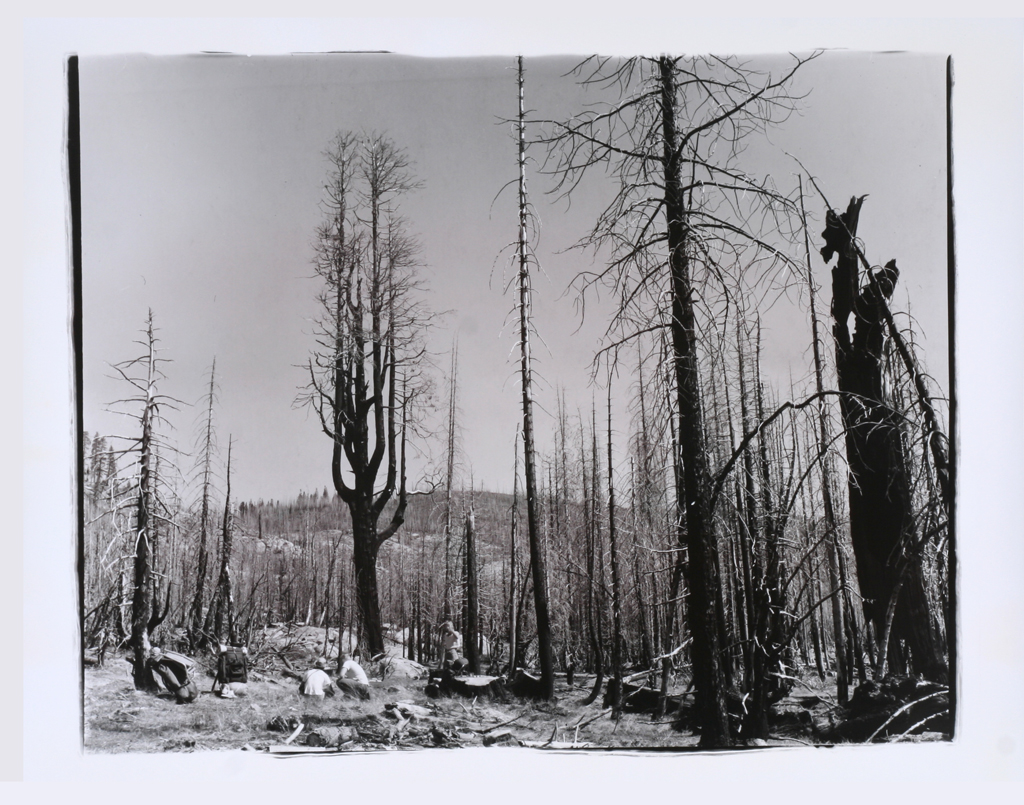
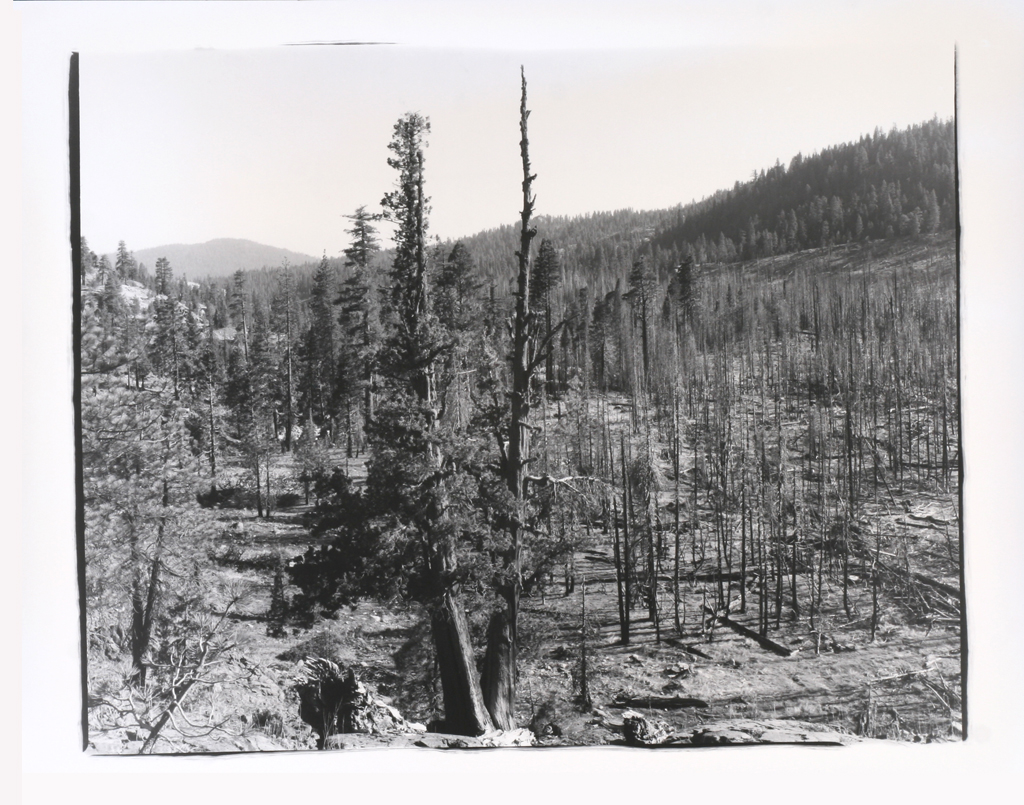
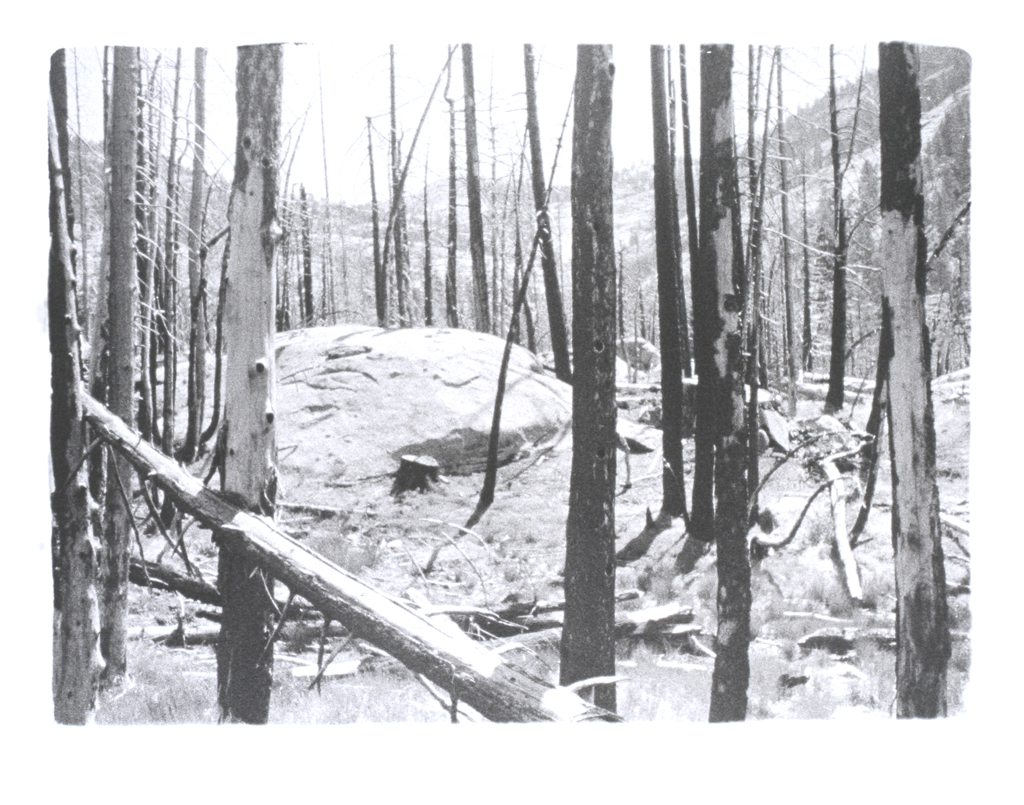
The following three prints came from one trip to Dinkey Creek after a fire in 1981 wiped out the forest. On the trip I shot 4x5 and Minox. The 4x5 shots are clear and sharp with such detail that your eye can drink in. You can literally count every tree in the forest.

It wasn't until after I started looking at the prints that I realized there was detail I could see in the Minox shot that isn't in the 4x5 shots. Simply because it was taken from a position closer to foreground subject matter. You can see every knot in the tree to the left of the boulder.

Dinkey_45_PS.jpg


High Resolution Close-Up of 4x5

Dinkey_4x5_PS.jpg


High Resolution Close-Up of 4x5

Dinkey_Minox_PS.jpg


High Resolution Close-Up of Minox
 
As far as image quality, I'm perfectly happy with 35mm film and APS-C digital. Over the years I've learned to stop fretting over image quality and just shoot and enjoy. The reason I have a Pentax 645 is because I like looking at the bigger slides on the light table.
 
I get the smaller vs. bigger negative thing. Generally, I'll make larger prints from larger negatives. Often, trying to go to a larger size (20x24+) from a smaller negative just doesn't hold up to my own scrutiny, although there are exceptions depending on equipment, film, developer.
Detail, and sharpness, aren't always my goals, though, so I find all formats (even half-frame) beneficial to what I'm trying to achieve.

What I don't get is people thinking that going to a larger format will make them better photographers. Bad composition is bad composition, whether through a half frame viewfinder or an 8x10 ground glass.


Nobody here thinks that. That's your projection.
 
It wasn't until after I started looking at the prints that I realized there was detail I could see in the Minox shot that isn't in the 4x5 shots. Simply because it was taken from a position closer to foreground subject matter. You can see every knot in the tree to the left of the boulder./QUOTE]

Cheater!
 
It wasn't until after I started looking at the prints that I realized there was detail I could see in the Minox shot that isn't in the 4x5 shots. Simply because it was taken from a position closer to foreground subject matter. You can see every knot in the tree to the left of the boulder.

Cheater!

But wait! There's more. I have a 4x5 shot exact same composition as one on Pocket Instamatic, where the Pocket Instamatic shot is better.

And if that isn't enough. Try to solve my riddle how I got hundreds, maybe thousands of negatives represented on one Minox negative.
 
Photrio.com contains affiliate links to products. We may receive a commission for purchases made through these links.
To read our full affiliate disclosure statement please click Here.

PHOTRIO PARTNERS EQUALLY FUNDING OUR COMMUNITY:


Ilford ADOX Freestyle Photographic Stearman Press Weldon Color Lab Blue Moon Camera & Machine
Top Bottom