
• Welcome to Photrio!
    Registration is fast and free. Join today to unlock search, see fewer ads, and access all forum features.
    Click here to sign up

Hydroquinone Tanning Experiment

Tree of a kind

H
Tree of a kind

  • 1
  • 0
  • 0
Two Horses

A
Two Horses

  • 10
  • 2
  • 41

Recent Classifieds

Forum statistics

Threads
202,803
Messages
2,845,720
Members
101,541
Latest member
ΦÆdon
Recent bookmarks
0

Alan Johnson

Subscriber
Allowing Ads
Joined
Nov 16, 2004
Messages
3,421
https://www.photrio.com/forum/threads/catechol-and-hydroquinone-stain.128555/
My previous experiment, posts 19 and 24, produced faint tanning with HQ at pH 10.Here I used Glycol-Metaborate to produce a 1-shot developer, diluted 1:50. The same 2008 Tri-X film was used.

MGQ
Monopropylene Glycol.............................65ml
Ascorbic acid............................................5g
Hydroquinone............................. .............10g
Phenidone.................................. ............0.4g
Sodium Metaborate Tetrahydrate..... ......40g (3 different tested , note below)
Monopropylene Glycol to make...............100ml
Dissolve each completely in order given ~190F (Hazardous). pH 1:50 ~9.7

Sodium Metaborate tested was 10g, 20g and 40g per 100ml giving 1:50 working solutions (pH paper)~ pH 8.3, 9.0, 9.7.
Staining was noted only at pH 9.7, and prints from pH 9.7 solution appeared slightly sharper than those from pH 9.0.
pH 9.7 negatives bleached and fixed showed a very faint relief image (tanning) as per previous experiment post 24.
The slight sharpness increase at pH 9.7 may be due to faint tanning or a natural effect of pH with Acutance developer.
Development time was around 15min 20C.
MGQ is not a tanning developer in the same league as Pyrocat or 510 Pyro.
 
The problem here is that the ascorbic acid acid competes with the hydroquinone reducing the amount of tanning. Then too if sodium sulfite were present it must be present at a far less amount than for catechol or pyrogallol.
 
pH of Metaborate vs. Carbonate is not very relevant, since you didn't match molar amounts and there are plenty weak acids in the mix. There is a chance, that HQ needs higher pH than Catechol to develop, and as a result Ascorbic Acid would interfere more with HQ and thereby reduce overall tanning with HQ.
 
It is the oxidation products(s) of the hydroquinone that do the tanning. If hydroquonone does less of the developing.ie ascorbic acid is a developer in its own right, then there will be less tanning.
 
Advice taken, I mixed the formula from post 1 leaving out the ascorbic acid. At 1:50 the ph (paper) was~ 9.8.
The same film was developed 15min 20C @1:50, and was stained brown (pic-also shows a Delta 100 negative in Xtol for reference black).
A negative bleached and fixed showed more relief image than that obtained using the formula with ascorbic acid included.
A print from a small area showed better acutance.
This confirms that if wanting tanning using HQ instead of pyro it does work, it may not be as good,
However, I am now convinced that making the glycol solution is quite unnecessarily hazardous ( It's like dealing with boiling Rodinal concentrate but is also flammable).
So it is suggested to get hydroquinone tanning it is safer to replace pyro by hydroquinone in the water based PMK Pyro formula:
http://jeffreysoper.com/node/124


HQ Metaborate stain color.jpg
 
Will HQ dissolve in TEA? If so, you could replace the metaborate with TEA, creating a PQ-TEA (instead of the popular PC-TEA). But your PQ-TEA would be staining. Nice. If it works.
Mark Overton
 
Last edited:
You could mix Metaborate into Glycol/Glycerin, this should give you the necessary pH.
 
Gainer's Q-P-TEA. :smile:
You're right, there is such a thing! Here's a remark about it in photo.net:
Pat Gainer's QP-TEA is a staining developer based on hydroquinone, which is very closely related to pyrogallol and pyrocatechin [...]​

Does anyone have the formula for QP-TEA? I could find almost nothing about it on the Internet.
Mark Overton
 
Kodak did extensive experiments into tanning, as obvious from the dye transfer process. They published a number of articles on tanning by HQ.

PE
 
Does anyone have the formula for QP-TEA? I could find almost nothing about it on the Internet.

Please see https://www.photography-forums.com/threads/staining-metol-developer.93136/
"From an earlier e-mail from Pat: "Adding a little ascorbic acid to
the PQ-TEA helps. I think that, since PC doesn't need sulfite for
synergism, the PC acts as a catalyst to get the PQ going. Anyway,
it is a staining developer unless you add sulfite. Add 4 g/l to the
working solution and it's a pretty hot developer. My basic recipe
for this brew is 10 g hydroquinone, 1 g ascorbic or erythorbic
acid, 0.2 g phenidone in TEA to make 100 ml. Without sulfite, I use
it at 1+25 dilution for 9 minutes at 70 F. Add the sulfite and you
can use it 1+50 for 8 minutes at 70 F."
 
This thread talks about a PQ staining developer that is apparently fast working and produces very fine grain:
https://groups.google.com/forum/#!topic/rec.photo.darkroom/IU9CZJ6BeFM

"
10gms (1TBS + 1/4tsp) of Hydroquinone
.25gms (1/8tsp) of Phenidone
Heated to dissolve in 100mls Propylene Glycol (use a water bath)

Dilute 1:50 to make working solution with
4gms of Borax (1tsp) &
5gms of Sodium Carbonate (1tsp)
per litre of working solution.

5 1/2 minutes with Apx 100 gave soft-ish looking but contrasty printing
negatives. 1min initial agitation, 5 inversions every minute thereafter."
 
There exists an article "Comparison of Laurentian Fulvic Acid luminescence with that of the hydroquinone/quinone model system: Evidence from low temperature fluorescence studies and EPR spectroscopy" by Ariese et al., and in this article the HQ/Q system is allowed to form humic acid in the presence of aerial Oxygen at pH 4 and pH 10. In both tests the HQ/Q system formed humic acids, but at pH 4 these humic acids interacted with light only in the UV range, whereas at pH 10 light interaction was pronounced also in the visible range of the light spectrum.

It would be interesting if you could place a test clip you developed at lower pH into an alkaline bath and see whether it darkens.
 
I think my results are consistent with those reported in James where the rate of development by HQ falls off rapidly below pH 10:
https://babel.hathitrust.org/cgi/pt?id=mdp.39015016032883;view=1up;seq=132
So those developed at lower pH are mostly phenidone-ascorbate development as I was told earlier and would not be expected to show any response to being immersed in alkallne solution.
 
If there is Phenidone present, then HQ will develop at pH much below 10.
 
I would not expect the same amount of density after first developing at different pH, then bathing both in alkali. It would already be an interesting observation, if density changed after such an alkaline bath.

BTW it would be pretty bad if it did, since such an effect would completely kill any hopes we ever had regarding archival properties of this stain.
 
Using 2008 Tri-X developed in HQ-PMK, pH ~ 10 and in the same with metaborate replaced by borax pH ~ 9.2 I found that the acutance was slightly higher at pH 10 and the grain slightly larger .After bleaching and fixing I examined the residual tanned image,.which was not visible by eye but could be seen using a scanner (IIRC it can also be seen by printing with an enlarger).There was moderate tanned image visible at pH 10 but very little at pH 9.2.
Using fresh Delta 100 developed in HQ-PMK for the PMK time plus 30% gave a bleached and fixed image which on scanning was less than the Tri-X but visible on a scan.
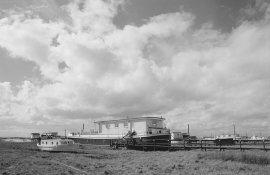
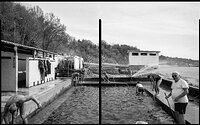
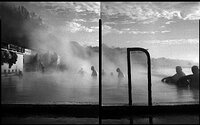
It appears from this that HQ does tan at high enough pH, I attach a pic on Delta 100 taken with an inexpensive 28-90 Canon zoom together with a pic from 1/10 the negative width, the results are quite useable for my purposes.

.Mersea Houseboats .jpg View attachment 198238
 

Attachments

  • One tenth width-1.jpg
    One tenth width-1.jpg
    243.8 KB · Views: 127
Photrio.com contains affiliate links to products. We may receive a commission for purchases made through these links.
To read our full affiliate disclosure statement please click Here.

PHOTRIO PARTNERS EQUALLY FUNDING OUR COMMUNITY:


Ilford ADOX Freestyle Photographic Stearman Press Weldon Color Lab Blue Moon Camera & Machine
Top Bottom