

• Welcome to Photrio!
    Registration is fast and free. Join today to unlock search, see fewer ads, and access all forum features.
    Click here to sign up

HP5+, Rodinal, Minimising Grain ?

Recent Classifieds

Forum statistics

Threads
202,850
Messages
2,846,537
Members
101,567
Latest member
FilmByJasper
Recent bookmarks
1

Ming Rider

Member
Allowing Ads
Joined
Jul 5, 2012
Messages
112
Location
District of
Format
35mm RF
Hi all,

I was hoping to draw on the wealth of experience here.

I like to shoot HP5 and process in Rodinal (substitute) because I love the 'age' that it gives the images. Only problem is that I tend to get quite noticeable grain, (I previously processed FP4+ in Rodinal with great results).

Have read on many sites that this is common for this combination, but is there a preferred method to at least minimise the grain clustering?

Have consulted the 'Darkroom Cookbook' and 'Film Developers Cookbook'.

My method has always been Rodinal 1:25, 20c, 6 minutes, agitation first minute, 10s every minute after.

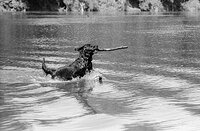
This is the result. Cheers :-

ImageUploadedByTapatalk1371717421.740576.jpg
 
Last edited by a moderator:
The combo is what it is.

Minimizing exposure and development may help.

Switching up to medium format will help. Similarly getting closer to your subject may help, say head and shoulders portraits instead of full length, helps make subject details more prominent than grain.

Switching to Delta 400 or TMY or TX or back to FP4 may help you refine your results too.

But, part of the 'age' or look or feel or whatever you want to call it is the grain. And, nice sharp grain actually helps photos look sharper.

Everything in the system affects the perceived graininess. Lighting, lens contrast, flare, how its printed...

My advice though, before you change anything, is to put the print on the wall (thumbtack or frame) above the sofa, get back off the sofa and with your feet on the floor and standing up straight look at the print and ask yourself does it look good? Leave it there for a week. If the grain still bothers you after a week, try one of the fixes above.
 
It's an inherently grainy combination. If you insist on that film+developer combo, then try developing at 18C and using less agitation, e.g. 30s at start then for 5s every 3 minutes. Obviously you will need to develop longer, and it will change the tonal curve somewhat, maybe to something you don't like any more.
 
You can also use grain to your advantage, found this this morning, not HP5 (it was shot on TX) but close enough to get the idea across. Dead Link Removed
 
If you don't like grain then I can't think of a worse combination. HP5+ is by nature a grainy film, grainier than 400TX. You have at least two options. Switch to FP4+ and Rodinal or HP5+ and a fine grain developer such as Ilford ID-11.
 
Grain and Rodinal

Hi

I don't have a direct comment, but you might try Spuersinn HCD-2 and HCD-S developer, available from www.ag-photograhic.co.uk or www.keyphoto.com (both of whom will ship abroad). HCD-s produces bright, crisp iamges on a wide range of films, with good tonal range. but you can vary the degree of graininess you want by varying dilution, temp and whther you use it as one or two bath. Full instructions included..and it does push and pull process well. It is German-made, so they understand the Rodinal users, and if it suits your photography might be an interesting alternative.

Dave
 
You can shoot it on medium format. You can salt the Rodinal which will soften grain. You can enlarge with a Dichro. You can print on matt paper.

But it may be better to get in bed with XTOL at 1:2 or 1:3.

Rodinal is what you call a honest grain developer.
 
Last edited by a moderator:

Hi

I don't have a direct comment, but you might try Spuersinn HCD-2 and HCD-S developer, available from www.ag-photograhic.co.uk or www.keyphoto.com (both of whom will ship abroad). HCD-s produces bright, crisp iamges on a wide range of films, with good tonal range. but you can vary the degree of graininess you want by varying dilution, temp and whther you use it as one or two bath. Full instructions included..and it does push and pull process well. It is German-made, so they understand the Rodinal users, and if it suits your photography might be an interesting alternative.

Dave

Welcome to APUG Dave.
 
That is from me. If you have any questions do not hestiate to ask.

For short: Use Rodinal at 16°C, with longer development time. The factor is around 1.6.

Lower temperatures have no effect on a film's grain size with any developer, nor do higher temperatures of up to about 28-30°C it's a total myth and been proved many times by research at the major film companies.

However because of the free Hydroxide in Rodinal poor temperature control across the process cycle can result in micro reticulation, the hydroxide softens the emulsion, it can be worse at higher temperatures as the swell of gelatin is also temperature related working a lower temperatures can cover up bad technique. The results of micro reticulation which is a surface effect is more apparent graininess in prints and scans, but the actual film grain is normal.

Agfa used to recommend mixing up Rodinal with a weak sulphite solution if you needed to prolong the life of a working solution this also helps give finer grain.

Ian
 
Wow, thank you all for the tips and advice. I couldn't believe my eyes when I checked the thread tonight. :smile:

For the record, I like grain. It gives my photo's a look that I like. Just slightly smaller than golf balls would be nice though. :wink:

Changing to another film would be a bit awkward at the moment as I just spent 50 quid on a 30m roll of HP5+. Another developer would be interesting though.

Now going to have a read of the links.

Cheers,
 
If you're open to changing developers, I will suggest Xtol 1+1 or 1+2. Much less grainy than Rodinal, but with less loss of resolution/sharpness from solvent effects than you would get with D76. You'll also get at least one stop more film speed. It's definitely a different look than Rodinal and you may not like it, but it WILL help reduce the obtrusiveness of the grain. Or you might like it; who knows.

Using Xtol doesn't make the grains smaller, it reduces their intensity. If you think of grain noise as being a wave (variations in density with respect to position), then Xtol reduces the amplitude of the wave, not the wavelength.
 
I do think there are probably some "improvement" to be had by switching to XTol, DD-X, D-76, or Perceptol BUT it isn't even close to what a film change would get you AND finer grain means less sharpness, you can have one or the other. Only you can decide which is more important.

So, onward to considering the example shot you provided, why not just step closer to your subject?

Cut the distance by half or 2/3 (with the same focal length) and you have instantly reduced the size of the grain in relation to your subject matter by half or 2/3.
 
Finer grain doesn't mean less sharpness, in fact it often means better definition and sharpness on a macro level, but a grainy print might have more apparent sharpness from a distance.

Ian
 
Stand development is definitely going to be the way to go here. I'd try 1:100 for an hour. 15 seconds of slow agitation, then swoosh it (like you would a glass of fine wine) three times at the 20 and 40 minute mark. Temperature doesn't matter too much with stand, but keep it in the 20 degree celsius range. I've never done HP5 with stand, but I can imagine it'll work similary to Tri-X.
 
So Ian, it was my understanding that for a given film, fine grain developers essentially make a slightly softer images than high sharpness developers. For example that XTol used straight would produce finer grain than XTol at 1:4 because at 1:4 it has less solvent effect to smooth the edges. Am I off in that thinking?
 
That is from me. If you have any questions do not hestiate to ask.

For short: Use Rodinal at 16°C, with longer development time. The factor is around 1.6.

How do you agitate?
 
So Ian, it was my understanding that for a given film, fine grain developers essentially make a slightly softer images than high sharpness developers. For example that XTol used straight would produce finer grain than XTol at 1:4 because at 1:4 it has less solvent effect to smooth the edges. Am I off in that thinking?

It's a balance, Xtol at Full strength and replenished gives the best all round qualities in terms of fine grain, sharpness and tonality, better than fresh unused Xtol which is still good but I'd use at 1+2 for the best balkance if used dilute. I used to do that with ID-11/D76.

If I went for a true fine grain developer like Perceptol or Microdol-X I'd again use at 1+2 and that combination does give the best balance of speed, sharpness, fine grain and tonality. I have a friend who uses Perceptol like this.

So yes in the example you gave above you're right but I was referring to the differences between a fine grain developer like Perceptol and a standard like ID-11/D76.

Ian
 
All the things people mention about temperature, minimizing exposure, etc will not substantially effect the grain size.....smaller golf balls. If you like the classic look, try another classic developer like HC110 or D76 or Ilford's equivilents. HC110 is much less grainy than Rodinal and a little more than D76.
 
>> For short: Use Rodinal at 16°C, with longer development time. The factor is around 1.6.
> How do you agitate?

I gave the factor for longer dev time, because you may use your ususl agitation scheme. Simply multiply the time for 20° with 1.6.

I agitate continuously.
 
>> For short: Use Rodinal at 16°C, with longer development time. The factor is around 1.6.
> How do you agitate?

I gave the factor for longer dev time, because you may use your ususl agitation scheme. Simply multiply the time for 20° with 1.6.

I agitate continuously.

For how long? How many times per minute?

For eg, @mono suggests:


Go with 1:50 and lower temperatures.
HP5+, 400 ASA, 23 min at 16 C.
There is an article (http://home.arcor.de/piu58/fotoweb/aufsaetze/Rodinal.pdf) about Rodinal development with lower temperatures, but only in German.


What kind of agitation would one use?

X sec continious initial, then x sec every y minute?
 
>> I agitate continuously.
> For how long? How many times per minute?

I turn the tank top down, wait a second or two, turn it back, wait a second or two ... continuously. But that plays not a lage role. Keep your way of agitation and multiply the times for 20° with 1.6.
 
If you like that look and do not want to see as much grain, use thornton. If the chems are not found locally, B&H will ship internationally.

Thornton is a high acutance developer, especially when used standing. Being 2 step developer the dev times are short enough not to have any of the typical streaking associated with stand. The recipe is posted on this site.

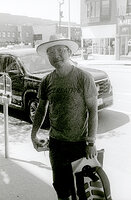
Here is something shot with neopan 400. Sorry I have no samples for hp5+, but you would be in the same ball park.

8864450999_e35503c9c6_z_d.jpg
 
Photrio.com contains affiliate links to products. We may receive a commission for purchases made through these links.
To read our full affiliate disclosure statement please click Here.

PHOTRIO PARTNERS EQUALLY FUNDING OUR COMMUNITY:


Ilford ADOX Freestyle Photographic Stearman Press Weldon Color Lab Blue Moon Camera & Machine
Top Bottom
