• Welcome to Photrio!
    Registration is fast and free. Join today to unlock search, see fewer ads, and access all forum features.
    Click here to sign up

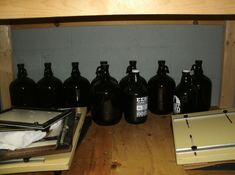
Glass bottles / beer growlers for storing chemistry

Recent Classifieds

Forum statistics

Threads
203,555
Messages
2,856,480
Members
101,902
Latest member
MrCroket_
Recent bookmarks
0
Do you think this presumption is not right?

Yes, I think so.

As to the growlers: if these are the ones with the swing top and a rubber ring to create a seal between a ceramic (or plastic) plug and the bottle: my experiences with this kind of system are poor. It's not very suitable for stuff like developers as the seal isn't all that good, at least not upon reuse and the fact that some chemistry may make the rubber seal brittle or otherwise degrade it. Screw caps, on the other hand, generally work extremely well. The kind that @chuckroast mentioned, the polycone ones, sound particularly nice, but I also have good experiences with plain plastic screw-on caps.

Wine bags.

I'm trialing these, but so far, I find them inconvenient to handle. The advantage is that they are very space-efficient, but even with an outer cardboard box (which eliminates part of the space savings argument), it's just a flappy and unwieldy piece of ... stuff... to handle. It's a personal thing.
 
I asked this question many years ago about standard, clear, Mason jars sold for home canning. Gerald Koch, a well known photo chemist who hasn't posted in a long time, answered that they would be fine if kept in a cabinet. He cautioned to watch the lids. I've used them now for about 15-years. The only chemical I've seen really attack the lids is amidol.
 
Yes, I think so.

As to the growlers: if these are the ones with the swing top and a rubber ring to create a seal between a ceramic (or plastic) plug and the bottle: my experiences with this kind of system are poor. It's not very suitable for stuff like developers as the seal isn't all that good, at least not upon reuse and the fact that some chemistry may make the rubber seal brittle or otherwise degrade it. Screw caps, on the other hand, generally work extremely well. The kind that @chuckroast mentioned, the polycone ones, sound particularly nice, but I also have good experiences with plain plastic screw-on caps.


I'm trialing these, but so far, I find them inconvenient to handle. The advantage is that they are very space-efficient, but even with an outer cardboard box (which eliminates part of the space savings argument), it's just a flappy and unwieldy piece of ... stuff... to handle. It's a personal thing.

What about these in the link? I'm not sure if there is a rubber ring or plastic ring but if it is a plastic ring, maybe it's this kind of bottle is also an option for storing photography chemicals?

Also thank you for replying.
 
What about these in the link?

They look great.

Btw, I use these:
1702898519241.png

With a generic white cap:
1702898542673.png


Unit price, consumer retail, is €0.71 for a 150ml size.

No need to make things overly complicated.
 
They look great.

Btw, I use these:
View attachment 357106
With a generic white cap:
View attachment 357107

Unit price, consumer retail, is €0.71 for a 150ml size.

No need to make things overly complicated.

Thank you so much. And thanks to everyone else who participated in this topic. I like that we can discuss and share our opinions.

If anyone else want to share their thoughts then I would like to read them too.

Have a nice day!
 
I buy Kombucha Brown Growlers because they have good sealing lids and come in a good size. They cost a bit, but are durable and seal quite well.
Might not need the brown color for most chemistry, but it does not hurt.

 
The technical and engineering college in my town constructed a new building for chemistry and dumped the contents of the old building. I was able to salvage a number of glass amber bottles from gallon sized on down. The smaller ones from quart to smaller are fitted with glass stoppers. I've used these for storing chemicals for the past 50+ years.
 
What about soft drink and sparking water bottles? As I understand it Polyethylene terephthalate is not permeable to air. But with time, how many years for Polyethylene terephthalate bottle to degrade? Not that it is issue for me, I use my brown glass bottles, with all the moves I've made time storage when I was working overseas, then more moves, have not broken or lost any. Currently I'm using Rodinal and HC 110 so I don't have developer to store.

Water bottles and food bottles can cause accidental poisoning of others. When PE [Photo Engineer], who was a retired Kodak engineer who designed and developed film products such as Kodachrome, would post warnings against using soft drink, water bottles and food bottles for darkroom chemistry. Do a website search on PE and the subject for more detailed responses.
 
I use StopLossBags™ from www.StopLossBags.com. I use the 1 liter bags and I strongly recommend that one buy their funnel to avoid spillage. The bags are clear and allow one to push out all the air. While most photochemicals are not sunlight sensitive, I keep mine out of the reach of sunlight. I have been using the same bags for over 5 years and never hand a leak or other problem with the bags.
 
Water bottles and food bottles can cause accidental poisoning of others. When PE [Photo Engineer], who was a retired Kodak engineer who designed and developed film products such as Kodachrome, would post warnings against using soft drink, water bottles and food bottles for darkroom chemistry. Do a website search on PE and the subject for more detailed responses.

This is easily dealt with if one uses normal prudence when handling and storing the bottles. Clear labelling is important as well.
 
Never found amber glass to be important. Air space is another matter, huge difference using marbles to keep air space at minimum for developers.
 
May I ask what are your thoughts on reagent amber glass bottles when storing chemistry for longer term? They are even more expensive than amber glass growlers but do you believe that they provide better chemical resistance than amber glass growlers? Has anyone used them?
I use them. They are not that expensive if you buy a box from a lab equipment supplier. I use wide mouth 1L bottles both for long-term storage (phenidone in propylene glycol) and for my working solutions. They are convenient for quickly dumping the content into the developing tank and most importantly back into the bottle without any funnels. The caps can be purchased separately if lost/damaged.
If you are on a budget try finding a lab that purchases analytical grade chemistry which usually comes in very nice bottles. I have a few from Sigma-Aldrich.
 
I think that might be true, the brown glass bottles I have were used for liquid chemistry in our college chem lab. Our darkroom used the same bottles as they were on contract with the school. I was able to buy a set of 3 at the time. They have frosted glass stoppers and ground inner necks to seal. Saying that they are not airtight by any means and mixed developer does last much beyond what the manufacturer recommends. D76 about 6 months. For long term storage I would wine bags, wine bottles with values that allow air to to sucked out creating a near vacuum. Or buy Rodinal and HC 110 and mix as needed, that is what I do. I do miss D76 and MCM 100, but as few rolls that I develop too much cost for not much reward.
 
I have quite a few 100ml, 250ml, 500ml, and 1l brown bottles in my cupboard, all used for alt process chems. Then I have 8 one gallon browns plus several half gallon growlers (four of them are filled in the fridge). I don't use my growlers for chems, they make their way to the local brewery to be refilled, but I really have no need for the one gallons.
GEDC7223.JPG
 
Hello,

I want to ask about glass bottles for storing chemistry. Is it very important that glass bottle or beer growler would be amber? Or it doesn't matter for storing chemistry if glass bottle or beer growler is clear? I find amber beer growlers 10 x more expensive than clear ones so maybe anyone who has used clear ones for storing chemistry could share their opinion?

I also found reagent amber bottles which can be used for storing light-sensitive chemistry. As I know photography chemistry is light sensitive, so is it true that simple amber / reagent amber glass bottles are way better for storing chemistry? Or it depends on the place where that bottle will be stored? Lets say that I will store bottle filled with chemistry in complete dark for most of the time and I would only expose it to light for a short time when I need to use chemistry. What are your thoughts about it?

By the way, I wish you merry upcoming Christmas!

I find any food containers questionable, because of the possible confusion. Chemistry containers should look like chemistry containers and not like food containers or an accident will happen one day.
 
Whatever you use, a good, clear label, possibly with hazard notes, is really advisable. This is particularly important with strong acid or alkali solutions. I also note which ones are sink-safe, and which need to go to hazardous waste.

Just because I know, and I have data sheets on file, does not mean that the person who eventually disposes of them will know!
 
So if were to use a 2 liter soda bottle with the label removed, glued on label D76 in my darkroom, locked away under the sink cabinet, I will get up in the middle of the night find the key, open the cabinet, and take a long drink of D76?
 
So if were to use a 2 liter soda bottle with the label removed, glued on label D76 in my darkroom, locked away under the sink cabinet, I will get up in the middle of the night find the key, open the cabinet, and take a long drink of D76?

You could have a Tri-X sandwich with it and see what develops...
 
I found my stash of brown bottles behind an apothecary/natural herbs store. They bought their product in bulk and put it in tiny bottles. The gallon jugs went into the recycling bin. I asked the merchant if she could save a few for me and now I have a lifetime supply.
The products were alcohol-based so the caps seal very tightly (to avoid evaporation).
 
Thank you so much. And thanks to everyone else who participated in this topic. I like that we can discuss and share our opinions.

If anyone else want to share their thoughts then I would like to read them too.

Have a nice day!

I have used(no longer do) 250ml glass cans, made to sell green olives. They have a metal top, which is rubberized on the inside. They twist on or off in a quarter turn and are free after you eat the olives.
 
I find any food containers questionable, because of the possible confusion. Chemistry containers should look like chemistry containers and not like food containers or an accident will happen one day.

I never take or allow food, drinks, or cell phones in my darkroom, any bottles in there are for chemical use and are labeled as such. I have several 1L and 500ml Fiji water bottles on my shelf, I started using them because they are heavier plastic than regular plastic bottles, and cheaper than Jobo bottles (I have a bunch of those too).
 
To add an extra note of pessimism I don't admit any glass containers to my darkroom: plastics only. Glass tends to be heavy, slippery when wet with water or (worse!) with developer, and a drop and shatter event is always a total spill with chemistry and lots of sharp edges to clean up.
 
To add an extra note of pessimism I don't admit any glass containers to my darkroom: plastics only. Glass tends to be heavy, slippery when wet with water or (worse!) with developer, and a drop and shatter event is always a total spill with chemistry and lots of sharp edges to clean up.

I too do not use glass containers.
 
I've contacted Amazon seller who sells glass growlers and asked him what is his opinion about storing photography chemistry in one of these bottles. Also I explained that I'm trying to find the main differences between glass growlers and reagent glass bottles in terms of chemistry resistance. He replied: "I wouldn’t trust them to something as reactive. The lids will most likely be the problem". Later I've noticed that some reagent glass bottles (and plastic bottles) have a plastic protection on the bottle neck which is perfectly visible when the lid is removed. After I've noticed it I made a presumption that this additional plastic material on bottle neck which connects with lid/cap of the bottle might be the reason for better air sealing. Do you think this presumption is not right?

Those are called "polycone" style caps and they work great with the bottles I use here. The seller is naturally going to push you toward more expensive glass. It's simply unnecessary for monochrome chemicals. Growlers and boston brown bottles have worked without issue for me here for years.
 
To add an extra note of pessimism I don't admit any glass containers to my darkroom: plastics only. Glass tends to be heavy, slippery when wet with water or (worse!) with developer, and a drop and shatter event is always a total spill with chemistry and lots of sharp edges to clean up.

Yes, glass bottles are slippery when wet and require care in handling. But plastics are mostly air permeable to some degree and will sometimes leak. I used to store fixer in the plastic gallon jugs that I buy full of distilled water ... until one day, one of them leaked on a seam. Never again.
 
Photrio.com contains affiliate links to products. We may receive a commission for purchases made through these links.
To read our full affiliate disclosure statement please click Here.

PHOTRIO PARTNERS EQUALLY FUNDING OUR COMMUNITY:


Ilford ADOX Freestyle Photographic Stearman Press Weldon Color Lab Blue Moon Camera & Machine
Top Bottom