Stephen you might want to enlighten us about what those assumptions are. In my case in as relatively non technical terms as are commensurate with proper understanding.
I must admit that never having noticed from my experience the extent of over-developing that he believes is built into most developer tables this has always been one facet of Barry's articles that I wonder about.
Of course this may not be one of the "bad assumptions" to which you refer
Thanks
pentaxuser
Thornton:
"Typically, standard ISO 400 emulsions work out at about 160, and 125 at 50 or 64 (I exclude T-Max from this). Skeptical readers are probably right now saying, "Oh yeah" So why do I say this? I mentioned earlier that exposure meters are set to read any scene as if it were 'average' or 'middle' grey: the standard 18% reflectance which manufacturers like Kodak reproduce in their commonly available grey card. I have a question. Who says that the average of a typical scene is 18% grey? Nobody I have asked has been able to tell me how this assumption arose. If it is incorrect, then we immediately have an error effectively in the nominal film speed. I believe the correct 'middle grey' should, in fact, be more like 9%. There is much confusion about this 'average' or 'middle' terminology as well. When asked, many of my clients say they visualise it as the exact mid-point between black and white; the reading given by a meter pointed at, say, a chessboard with an exactly equal number of equally sized black and white squares. In fact, such a scene would give a reading, theoretically, of exactly half the reflected light of a totally white board. Half the light means the same as one stop less or one zone less; so, if pure white is zone X, then the chess board would indicate zone 1X on the meter, not the stipulated zone V for middle grey. To get a zone V reading, the chessboard would have to have around 80% of its area black. Try it with a mock up and you will see this is so. But is this 18% right anyway? If the luminance range of a typical photographic scene is around seven stops - and a surprisingly large proportion do seem to be - then that is 2.1 in log terms. Half of this is 1.05, which translates to a reflectance value of around 9%."
This section is pretty much all questionable on some level. The ISO statement is dead wrong. ISO, middle gray, and Thornton's following point are covered in the Defining K document. In addition, from Jack Holm's paper
Speed Relationships and Tone Reproduction,
"
Scene Statistics
Two significant assumptions which are often neglected in exposure determination concern the scene range and mean 'reflectance. They are as follows:
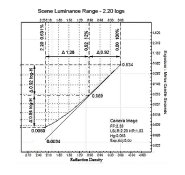
That the luminance range of a statistically average scene is 160:1 (log range 2.2), and the resulting exposure range on the image capture medium is 80:1 (log range 1.9), corresponding to a camera flare factor of 2.
That the mean log luminance of a statistically average scene is approximately 0.95 log units below the highlight log luminance (edge of detail in white) and 1.25 log units above the shadow log luminance (edge of detail in black), and that this mean luminance is assumed to be the luminance metered, directly or indirectly, for exposure determination. These values result in the mean luminance correlating with a Lambertian scene reflectance of 12% for 100% highlight reflectance or 14% for 128% highlight reflectance. Values ranging from 10 to 18% have resulted from various experimental determinations. The 14% value is used throughout this discussion as it is assumed that the highlight reflectance in a statistically average scene will contain some specular elements. Flare results in the mean log exposure being halfway between the highlight and shadow log exposures."
Note: 12% is generally used in exposure models and is used with exposure meter calibration. Also note the part about flare.
Thornton:
"Nevertheless exposure meters are supposedly set to render anything they read as standard 18% grey, which is zone V in the zone system."
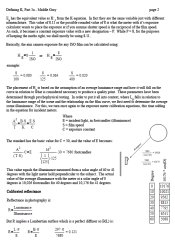
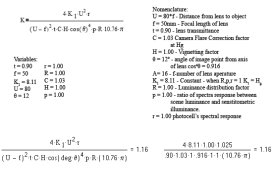
Exposure meters are not designed to render tones. They use luminance and the exposure calculator to determine the exposure settings necessary to produce a log-H of 8 lx / ISO at the film plane. A detail explanation is in Defining K. Here is an excerpt:
Thornton:
"For instance, have you ever checked your meter? I have two different spot meters, a Pentax and a Soligor. The Pentax reads 2/3 stop faster than the Soligor at low levels and 1/2 stop faster at high levels. My Weston and various camera meters all give different readings from the same subject under the same light, but vary differently at different light levels. Similarly, the llford digital thermometer I use is 1'C adrift from my Kodak mercury version. When all the other possible variables in taking and processing, such as shutter speeds, real lens light transmission compared to marked aperture, flare factors, lens extension, agitation technique etc, are taken into account it's not surprising that practice deviates from laboratory theory."
While materials and equipment are tested and calibrated under controlled conditions, these conditions are designed to reflect working conditions or to present an an average of those conditions. Allen Stimpson's paper, "An Interpretation of Current Exposure Meter Technology" has an excellent explanation of light source calibration and photo cell spectral sensitivity (available in the Defining K link). There will be variance but for most conditions it's not sufficient enough to affect quality. In many cases many of the elements Thornton lists can actually cancel out the affects of each other and they are part of the equation that calculates K.
Thornton:
"Theoretically it's possible that all the factors could pull in one direction to give a higher than nominal speed. But I have never come across it in hundreds of cases. It is also true that some film makers have stopped quoting rigid ISO speeds in favour of an EI (exposure index) figure. The basis for this isn't always clear, but Kodak's own publications state that a four stop subject brightness range for full detail in shadow and highlight is considered normal."
His use of the term "film speed" is incorrect. Most of the factors he has listed will influence exposure, not the effective film speed. The films that manufacturers have stopped quoting ISO speeds were T-Max P3200 and Delta 3200. This is for a different reason than Thornton is implying. Not sure what Kodak publication states a four stop subject "brightness range" (should be luminance range) is from, but if the quote exists than there's a question of what "full detail" defines. The statistical subject luminance range is 7 1/3 stops and this excludes accent black and specular highlights.
Thornton:
" In describing how to determine your true film speed, Kodak actually say that most people generally find they need a number slightly lower than the film's rated speed (Kodak Workshop Series, Advanced Black-and-White Photography)."
I haven't read this source but Thornton's use of the term "true film speed" is specious. What he should be using is exposure index (EI). The only true film speed is the film's ISO speed. If sensitometrically tested without following all of the ISO guidelines, the term effective film speed can also be used.
Thornton:
"Since each zone above zone 1 is achieved by doubling the exposure (i.e. increasing by one stop), we can move back down from the meter indicated exposure for zone V in the same way to reach the theoretically correct exposure to produce zone l for the claimed film speed. "
Problem is the ISO speed point is 3 1/3 stops from the metered exposure point and Zone I is 4 stops. The two systems are different and not comparable. Thornton's assumption that his testing method somehow determines the true film speed is erroneous. It is a way of determining Zone System EI. Something to keep in mind is that film speeds changed with the 1960 ASA standard, effectively almost doubling, but the Zone System testing method has not changed. Before 1960 the two systems would have shown a correlation, but not after.
The rest of the article appears to be basically a how to.
Mostly what I disagree most with is the insinuation that the scientists that design and manufacture film are wrong about it's use. I react the same way when some guy off the streets claims that evolution can't be true because it violates the second law of thermodynamics.







 .
. 