• Welcome to Photrio!
    Registration is fast and free. Join today to unlock search, see fewer ads, and access all forum features.
    Click here to sign up

FP4+ Mushy Grain

Recent Classifieds

Forum statistics

Threads
202,831
Messages
2,846,141
Members
101,554
Latest member
Stalk3r
Recent bookmarks
0

SodaAnt

Member
Allowing Ads
Joined
Jul 4, 2023
Messages
429
Location
California
Format
Digital
Tried my first roll of Ilford FP4+ this past weekend in my 35mm camera and developed the roll in HC-110 B for the time recommended in the Ilford datasheet. The resulting grain is more prominent than I'd expect for an ISO 125 film. More mushy as well.

Would I get better results using a different developer?
 
Tried my first roll of Ilford FP4+ this past weekend in my 35mm camera and developed the roll in HC-110 B for the time recommended in the Ilford datasheet. The resulting grain is more prominent than I'd expect for an ISO 125 film. More mushy as well.

Would I get better results using a different developer?

How did you identify the grain and mushyness and to what did you compare it ?

Thanks

pentaxuser
 
How did you identify the grain and mushyness and to what did you compare it ?

Viewing the negatives on a light box with a 15x loupe. Compared it to negatives of the same subject on TMax 100 (also developed in HC-110 B).
 
FP4 will always have larger grain than T Max 100, it is a conventional emulsion vs a T grain emulsion. Delta 100 would be a closer match to T Max if fine grain is your goal.

Xtol would give finer grain and better acutance than HC110 would.
 
Thanks I am sure that you developer is not at fault per se However I'd expect FP4 to have bigger grain than Tmax 100 per se. When this would show on, say a print, in terms of size of print I couldn't hazard a guess. Fairly large print I'd have thought Not at all sure about what constitutes mushyness

How about showing us a digital photo of the two negatives on a light box at 15x? It might help others who know more about grain, mushyness and HC110 dilution B to decide on whether another developer will make an appreciable difference


pentaxuser
 
Viewing the negatives on a light box with a 15x loupe. Compared it to negatives of the same subject on TMax 100 (also developed in HC-110 B).

There is a huge difference in grain, resolution and sharpness between old emulsion type films like FP4+, Kentmere 100, Fomapan 100, CHS 100 II on the one hand, and modern technology emulsion type films (T-Grain; Delta; Sigma) like T-Max 100, Delta 100 and Acros 100 II on the other hand.
And by looking at the negatives with a 15x loupe you see that difference very clearly.
With the modern emulsion film you come much closer to medium format quality with 35mm: Comparing e.g. Kentmere 100 in 4.5x6 to TMX in 35mm, there is not much difference anymore.
 
You need to see how they print. A diffuse lightbox with a high power loupe might give a misleading impression. Dil B HC-110 should give very crisp distinct grain with HC-110. TMax 100 would have less distinct grain, not more. But for sake of more grain growth, if needed, you could dilute the HC-110 more, and use longer dev time.

But simply scanning a neg and posting it on the web won't be definitive either. Ya gotta print and compare, to find out how the paper itself sees these things before coming to judgement.

I certainly disagree with Film-Niko that differences between FP4 and T-grain films will give you approximation with MF film results. If you want medium format quality, then shoot medium format film. Neither a fox terrier nor a bulldog is a match for a mountain lion.
 
You need to see how they print. A diffuse lightbox with a high power loupe might give a misleading impression. Dil B HC-110 should give very crisp distinct grain with HC-110. TMax 100 would have less distinct grain, not more. But for sake of more grain growth, if needed, you could dilute the HC-110 more, and use longer dev time.

But simply scanning a neg and posting it on the web won't be definitive either. Ya gotta print and compare, to find out how the paper itself sees these things before coming to judgement.

I certainly disagree with Film-Niko that differences between FP4 and T-grain films will give you approximation with MF film results. If you want medium format quality, then shoot medium format film. Neither a fox terrier nor a bulldog is a match for a mountain lion.

All of this.

There isn't a single film that's made to be viewed on a light box with a 15x loupe. The grain might seem big and mushy with the loupe, the end result when printed might be absolutely glorious. I have prints I'm very proud of whose neg looked might of looked grainy and mushy, but that's not what I, or others, see when they look at it: they see the whole, the composition, the tonality. Nobody looks at a print to see how big, or small, the grain is.

Not saying that grain too big cannot be distracting — I was just watching a fantastic documentary on Ben Bradlee on HBO and some of the photos of the 60s, obviously shot at high ISO in the Washington Post Newsroom, had gigantic grain — but in the end, it's still the print that counts, and a grainy powerful shot is first and foremost a powerful shot.

Would I get better results using a different developer?

HC-110 is a solvent developer that acts as a non-solvent developer because of the high level of dilution. If you want less grain, you need to use a solvent developer — D-23, Xtol, D-76/ID-11, Microphen, etc. You won't get better results, you'll get different results, as there is also a price to pay when using solvent developers. Any developer you use, you make a sacrifice. It's a question of which sacrifice you prefer making.

My beef with HP4+ in HC-110 (actually Ilfotec HC) is less grain than finding the whole a bit too contrasty. Haven't found the perfect development time for that combo yet.

 
I certainly disagree with Film-Niko that differences between FP4 and T-grain films will give you approximation with MF film results.

I have given an example: T-Max 100 in 35mm vs. Kentmere 100 in 4.5x6.
And I have written that there is not much difference anymore. I did direct comparisons test (same subject) and presented them in my local photographer group to several experienced photographers in a blind test. Result: Most had difficulties to say which is from which format, and several thought the 35mm pictures were medium format.

Have you done that tests of these two films, too? No, you have not.
 
I have given an example: T-Max 100 in 35mm vs. Kentmere 100 in 4.5x6.

But wouldn't a more rigorous test be comparing T-Max 100 in 35mm with T-Max 100 in medium format? Comparing a T-grain film with a regular, and bigger, grain film is comparing apples and oranges in this case. And it also depends on the developer: T-Max 100 in 35mm in Rodinal 1+25 would probably appear less like medium format when opposed to Kentmere 100 in 4.5x6 in Microphen.
 
But wouldn't a more rigorous test be comparing T-Max 100 in 35mm with T-Max 100 in medium format? Comparing a T-grain film with a regular, and bigger, grain film is comparing apples and oranges in this case.
That is not what @Film-Niko was trying to say. His point was that modern t-grain emulsions improve on granularity so much that a 35mm t-grain negative begins to approach a 6x4.5 classic emulsion negative such as Kentmere 100. The Kentmere is certainly a great example as it's one of the roughest classic emulsions on the market, I can easily see how a 35mm T-Max 100 can be compared to a 6x4.5 Kentmere.
 
I have always found HC110 produces oatmeal grain. You might try D76 1:1 1-shot for sharp salt-and-pepper grain.

I must be hungry...

If you go the TMax 100 route you might try Microdol-X 1:3 (the name of the Ilford equivelant escapes me). Some think M-X works better full strength with this film. You can also use home brew Microdol (D-23 + pickling salt); modern TMX seems to be quite resistant to dichroic fog and the secret 'X' ingredient may not be needed.
 
Oh, OK, Steven. Thanks for clarifying that. I don't shoot 645, but 6X7 and 6X9. But because I often print MF shots 16X20, and mix them into the same portfolios as 4X5 and 8x10 shots, I religiously only shoot films like TMax or Acros in 120 for such purposes. I like other films too, but any example taken with Tri-X or Delta 3200 or HP5 would stand out like a sore thumb. Those are fine as stand-alones framed, or segregated into their own portfolios, but would a mismatch along with large format film prints.
 
Make prints and find out. Enlarge your questionable negs to say 8-3/4x13 (full frame on 11x14 paper) and see what you really have. Until then you're just opinionating.
I find that XTOL 1:1 provides the best compromise between speed/grain/sharpness when shooting FP4+.
Your results may vary- but only the print can tell you.
 
No enlarger. The best I can do at the moment is scan and view on a monitor or print on an inkjet.

I have four rolls of FP4+ left. I’ll develop one in Xtol, one in Rodinal, one in D-76, and one in D-23 and compare the results.
 
No enlarger. The best I can do at the moment is scan and view on a monitor or print on an inkjet.

I have four rolls of FP4+ left. I’ll develop one in Xtol, one in Rodinal, one in D-76, and one in D-23 and compare the results.

If you’re going to use Rodinal, reduce the ISO by one stop. Also remember, Rodinal is an acutance developer. It doesn’t devolve the grain, so it’s more prominent. Try a 50:1 dilution, gentle agitation for the first minute then a couple of inversions every minute.
 
Describing FP4 as an 'old' film gets a bit absurd when other aspects of the process are far older, and age doesn't seem to hold Rodinal (1891) back. So it can't be as simple as being old. Ilford refer to FP4 as an 'exceptionally fine grain film' and I believe them. But what is 'mushy' to some is tonality to others and this is where FP4 fits as a modern film, as an alternative to the tyranny of sharpness in T-grain films. Not saying it can't be sharp, but expectations need adjusting so as not to confuse it with T-Max or Delta films. It's a long time since I used FP4 in 35mm with HC-110 or D76 etc. and I'd choose D76 if that was all I had, but I don't see any particular un-sharpness using 510 Pyro, and this also retains the tonality of the film. No developer is likely to be unique so I'm willing to believe there is also an alternative to 510 Pyro that will work well in 35mm.
 
Tried my first roll of Ilford FP4+ this past weekend in my 35mm camera and developed the roll in HC-110 B for the time recommended in the Ilford datasheet. The resulting grain is more prominent than I'd expect for an ISO 125 film. More mushy as well.

Would I get better results using a different developer?

It develops to a very decent modest grain with D76 1+1. still has the 'real' B&W look!
 
Ilford refer to FP4 as an 'exceptionally fine grain film' and I believe them.

Well, Kodak refer to Tri-X as a fine grain film and I certainly don't believe them. 😁

Decades ago, these characterisations might have been reasonable, but in this day and age they sound funny.
 
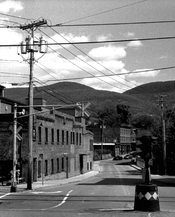
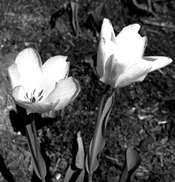
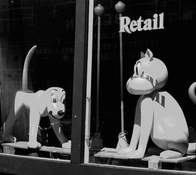
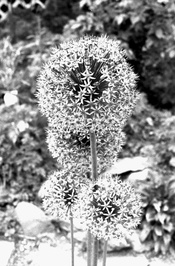
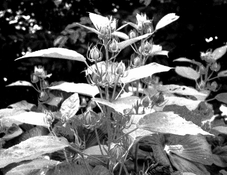
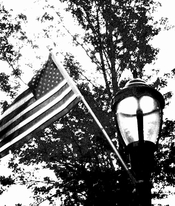
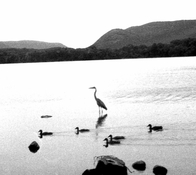
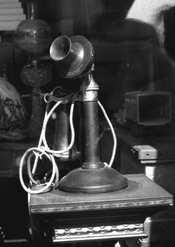
My own personal, decidedly un-scientific results. I've been shooting half-frame with a Pen F for nearly four years. Multiple rolls of Tri-X, FP4 Plus, and Double-X (FFP X2). Everything developed in D-76 1:1 (with a side trip to Ilfosol for some of the FP4) and scanned at 2400dpi. I use an old GE PR-1 light meter sometimes, but mostly just estimate exposure.

And for the second time - after testing it in a Minox submini back around 2000 - I was disappointed with FP4 Plus. It came out just SLIGHTLY finer-grained than Tri-X, and with harsher contrast. I ended up settling on Double-X as my preferred half-frame stock. While it also has only slightly less grain than Tri-X, it has beautiful contrast and gradation, with rich, deep blacks. Both the Tri-X and Double-X results have a nicer look to my eye than FP4 Plus.

Tri-X:
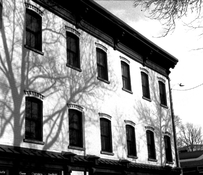
EastMainStreet.jpgBeaconTulips.jpgRetail.jpgStarFlower.jpg

FP4 Plus:
buds.jpgflag+light.jpgLongDockBirds.jpgBeaconChamberEns1rescan.jpgMechBank.jpg

Double-X:
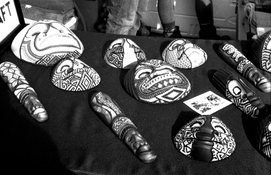
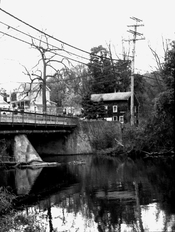
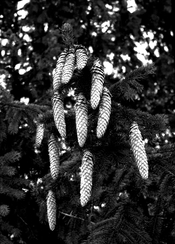
CandlestickPhone.jpgfacadeDouble-X.jpgbeadworkDouble-X.jpgglenhambridgeDouble-X.jpgpineconesDouble-X.jpg

This is no knock on folks who enjoy using FP4 Plus. All I'm saying is that - for ME - FP4 Plus has been disappointing compared to great, long-gone medium-speed films like Plus-X and (especially) Agfapan APX 100.
 
Due to the size of modern film grain, a 15X view of a back-illuminated negative won’t tell you much about grain size. For that you need a microscope. Few home darkroom users have a microscope.

About the closest we can get to a microscope with the equipment we’re likely to have on hand is viewing portions of the enlarged negative through a grain focuser (the view looks better resolved when the aperture is closed about 1 stop).

The image magnification we see this way = the product of enlarger magnification and loupe magnification of the focuser. So, for a 35 mm negative magnified 9X, typical for making an 8” x10” print, and using a 10X Peak Model I focuser, we see the image of the negative at 90X.

Using a Bestwell Instruments Microsight with its 25X loupe gives 9*25 = 225X. You could increase the magnification further by raising the head of the enlarger.

Here is an article about film grain and the size range of individual particles of silver in various emulsions. It gives some useful information regarding the magnification needed to see film grain.

The comments on page 6 under “3 Film Grain” are useful as are the example photos and comments on page 17.

https://www.tmax100.com/photo/pdf/film.pdf
 
I just zoomed waaaaaaay in on a 4x5 sheet of CMS 20 II developed in Adotech IV, and all I saw was mush. Mush, mush, and more mush. I also checked Pyrocat-HD developed sheet, Caffenol, Xtol, POTA, D-23, and CD4-LC.... mush! Prints from all these developers look eye-poppingly sharp, though 🤔 😄
 
Tried my first roll of Ilford FP4+ this past weekend in my 35mm camera and developed the roll in HC-110 B for the time recommended in the Ilford datasheet. The resulting grain is more prominent than I'd expect for an ISO 125 film. More mushy as well.

Would I get better results using a different developer?

FP4+ responds beautifully and with low apparent grain in Pyrocat-HD
 
My own personal, decidedly un-scientific results. I've been shooting half-frame with a Pen F for nearly four years. Multiple rolls of Tri-X, FP4 Plus, and Double-X (FFP X2). Everything developed in D-76 1:1 (with a side trip to Ilfosol for some of the FP4) and scanned at 2400dpi. I use an old GE PR-1 light meter sometimes, but mostly just estimate exposure.

And for the second time - after testing it in a Minox submini back around 2000 - I was disappointed with FP4 Plus. It came out just SLIGHTLY finer-grained than Tri-X, and with harsher contrast. I ended up settling on Double-X as my preferred half-frame stock. While it also has only slightly less grain than Tri-X, it has beautiful contrast and gradation, with rich, deep blacks. Both the Tri-X and Double-X results have a nicer look to my eye than FP4 Plus.

Tri-X:
View attachment 349003View attachment 349004View attachment 349005View attachment 349006

FP4 Plus:
View attachment 348998View attachment 348999View attachment 349000View attachment 349001View attachment 349002

Double-X:
View attachment 348993View attachment 348994View attachment 348995View attachment 348996View attachment 348997

This is no knock on folks who enjoy using FP4 Plus. All I'm saying is that - for ME - FP4 Plus has been disappointing compared to great, long-gone medium-speed films like Plus-X and (especially) Agfapan APX 100.

Try it in Pyrocat-HD and see what you think. Both D-76 and some dilutions of HC-110 can produce more noticeable grain in these smaller formats.

With D-76, the excessive contrast problem can sometimes be attributed to D-76's tendency to have rising alkalinity as it is stored over time.
 
Photrio.com contains affiliate links to products. We may receive a commission for purchases made through these links.
To read our full affiliate disclosure statement please click Here.

PHOTRIO PARTNERS EQUALLY FUNDING OUR COMMUNITY:


Ilford ADOX Freestyle Photographic Stearman Press Weldon Color Lab Blue Moon Camera & Machine
Top Bottom