• Welcome to Photrio!
    Registration is fast and free. Join today to unlock search, see fewer ads, and access all forum features.
    Click here to sign up

Found 126 film and flashcubes under a shelf at home!

Forum statistics

Threads
203,366
Messages
2,853,536
Members
101,805
Latest member
itsallart
Recent bookmarks
0
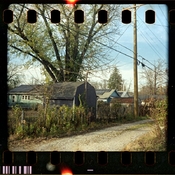
I had to avenge the C-22 Kodacolor, so I exposed an ad-hoc load of Vision3 250D a bit earlier. It went in before some 35mm & 16mm, so the chemistry was fresh.

insta500_250Ds.jpg


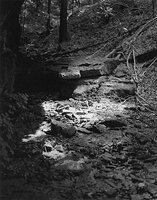
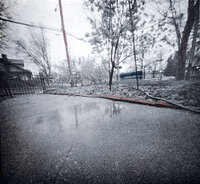
The results seem mushier than the b&w but I still like the rendering.

clip0s.jpgclip1s.jpg
 
This C-22 Kodacolor had a silver based antihalation layer which would further complicate b&w processing.

You can get color images from that if you mix your own CD-3 based color developer, use C-41 bleach and fixer, and get a hexamine or formalin based stabilizing bath. I've heard of people getting useful development with unaltered C-41 at 80 F -- but the formalin or hexamine stabilizer is crucial for C-22 dyes.

The silver layer in that film, AFAIK, is actually the yellow filter layer below the blue-sensitive color layer. Careful treatment with Farmer's Reducer after B&W processing can reduce this layer's density with only slight loss of image silver.
 
You can get color images from that if you mix your own CD-3 based color developer, use C-41 bleach and fixer, and get a hexamine or formalin based stabilizing bath. I've heard of people getting useful development with unaltered C-41 at 80 F -- but the formalin or hexamine stabilizer is crucial for C-22 dyes.

The silver layer in that film, AFAIK, is actually the yellow filter layer below the blue-sensitive color layer. Careful treatment with Farmer's Reducer after B&W processing can reduce this layer's density with only slight loss of image silver.

I tried a frankenstein C-22 process: CD-3/metaborate developer (minus the benzyl OH), hardening stop, ferricyanide bleach, regular fix. There was zero dye formation, even fog, from this 50+ year old film.

As you say, the stabilizer must be this sticking point.
 
the stabilizer must be this sticking point.

What I've read is that C-22 dyes don't become colorful until they've had that little interaction with formaldehyde. If you still have that film, a bath in Cinestill C-41 final rinse might fix it...
 
I just tried a dip into the hexamine-based stabilizer from a disused Arista C-41 kit to no avail. Presuming that hexamine was still intact (and is a suitable substitute for formaldehyde), this step probably needs to happen prior to bleaching and fixing.

I'm all out of C-22 film so I'll never know, but I don't feel too badly about it šŸ˜›
 
this step probably needs to happen prior to bleaching and fixing.

Not to my understanding. This is called "Final Rinse" for good reason; it's also the wetting agent and antifungal, and should be the last bath for the film (equivalent to PhotoFlo).

It's also possible your CD-3/borate developer didn't develop anything (we can rule out exposure because of the pre-exposed frame lines and numbers on Kodak 126 products). No easy way to tell with the result you got.
 
Photrio.com contains affiliate links to products. We may receive a commission for purchases made through these links.
To read our full affiliate disclosure statement please click Here.

PHOTRIO PARTNERS EQUALLY FUNDING OUR COMMUNITY:


Ilford ADOX Freestyle Photographic Stearman Press Weldon Color Lab Blue Moon Camera & Machine
Top Bottom