

• Welcome to Photrio!
    Registration is fast and free. Join today to unlock search, see fewer ads, and access all forum features.
    Click here to sign up

Fomatone MG Classic edge frilling

Recent Classifieds

Forum statistics

Threads
202,919
Messages
2,847,540
Members
101,533
Latest member
jasonfrags81
Recent bookmarks
0

AnselMortensen

Subscriber
Allowing Ads
Joined
Jun 9, 2020
Messages
2,828
Location
SFBayArea
Format
Traditional
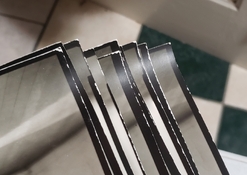
I printed on some of this paper today and noticed some edge frilling... loss of emulsion along the edges.

Anybody have a recommendation on how to avoid this?
Thanks!
 
Last edited by a moderator:
No one will want to hear this. Hardener in the fixer. Same for other Foma fiber base paper. No big deal just use hypo clear. Followed by washing in 20 C water for 20 minutes (minimum)

I use Kodak rapid fix film strength with Hardener for a couple minutes. If you want to check for adequate fixing check with selenium toner.

No hard science to back this up, but Foma paper seems to have softer gelatin, which is (possibly) damaged slightly when the paper is finished at the factory.

MHOFWIW YMMV
 
I didn't get frilling, but fine indentations (not exactly scratches) in the emulsion from ordinary handling. Seems more fragile than other papers.
 
Could this be due to poor storage/distribution conditions before it makes its way to the customer?

With respect to processing Foma doesn’t indicate anything special for this paper. If there was no user error this isn’t acceptable.

I’m hoping to be able to switch from Ilford papers to Foma but this sort of problem or other defects are a no go.
 
Could this be due to poor storage/distribution conditions before it makes its way to the customer?

With respect to processing Foma doesn’t indicate anything special for this paper. If there was no user error this isn’t acceptable.

I’m hoping to be able to switch from Ilford papers to Foma but this sort of problem or other defects are a no go.

It's not a big problem at all. No reason to switch from Ilford to Foma or vice-versa. Use both.
 
@AnselMortensen you're not the first (and probably not the last) to run into flaking problems along the edges of Foma papers. I've personally never seen it happen. However, this recent thread on Fomabrom (a different paper of course, but same mfgr) at least shows you're not alone: https://www.photrio.com/forum/threads/fomabrom-variant-iii-emulsion-flaking.213430/ Sadly, I don't think it ever resulted in clear causes or solutions of the problem.

The problem has been discussed several times over the years IIRC. It's very rare for people to post examples, sadly. Perhaps you could be the change....the linked thread has one illustration which I think is the only one I ever saw. It would be useful to be able to see what it looks like on your end so that we at least can determine whether it's the same problem.
 
It's not a big problem at all. No reason to switch from Ilford to Foma or vice-versa. Use both.

If it’s a batch issue or something then I agree but if it happens fairly regularly then I would call that a big problem. I’d like to move away from Ilford but not if it’s a crapshoot regarding potential problems and not if I have to switch to ancient hardening fixation.
 
Thank you for all the comments.
I love the olive tones I'm getting from the paper, I'm hoping I can find a workaround to eliminate the issue.
I am using it for contact printing 8x10 negs, and the black border makes the frilling pretty obvious.
I'll post a pic in a couple days.
 
Thank you for all the comments.
I love the olive tones I'm getting from the paper, I'm hoping I can find a workaround to eliminate the issue.
I am using it for contact printing 8x10 negs, and the black border makes the frilling pretty obvious.
I'll post a pic in a couple days.

I contact print 8x10 negs on Fomatone as well, but I use 11X14 paper for this, so there's always lots of room to cut the paper down if I need to.
 
I contact print 8x10 negs on Fomatone as well, but I use 11X14 paper for this, so there's always lots of room to cut the paper down if I need to.

Thank you, that would be a viable workaround for me.
I can use the 8x10 paper for contacting my 5x7 negs.
 
If it’s a batch issue or something then I agree but if it happens fairly regularly then I would call that a big problem. I’d like to move away from Ilford but not if it’s a crapshoot regarding potential problems and not if I have to switch to ancient hardening fixation.

It demands slightly more careful handling, and chucking a bunch of sheets into a tray and slamming them into each other isn't a great idea, but the only times I've had real issues were with a slightly less than fully sharp guillotine leaving a bit for a squeegee to catch on on some cut down pieces (and even then it was not a big deal) - and that sulphide toners can soften it a bit if used at stronger dilutions and longer times. I'd say Foma's papers are hardened to about 70s/80s levels, rather than with vinyl ethers. Major thing to keep an eye on is the longer fixing times needed.
 
Thanks, Lachlan. I have some Foma papers to try so I guess I will find out. I’ve always been extremely careful handling / processing / washing paper anyway so maybe it will be ok.
It demands slightly more careful handling, and chucking a bunch of sheets into a tray and slamming them into each other isn't a great idea, but the only times I've had real issues were with a slightly less than fully sharp guillotine leaving a bit for a squeegee to catch on on some cut down pieces (and even then it was not a big deal) - and that sulphide toners can soften it a bit if used at stronger dilutions and longer times. I'd say Foma's papers are hardened to about 70s/80s levels, rather than with vinyl ethers. Major thing to keep an eye on is the longer fixing times needed.
 
The issue is a lot more evident for me when handling test strips, which might get cut and potentially bent and so forth less carefully than my actual full print pieces. I've certainly had some edge frilling in those cases.
 
I'll chime in here because @koraks referenced the thread I started on a similar subject several months ago.

Freestyle did replace the first package I bought and I haven't had an issue since. In fact some other sheets from the first box haven't exhibited the issue either. So it seems like it was an isolated case. The paper is very nice and I'll continue to use it, but I'll exercise additional caution while handling it wet just in case.
 
Just my 2 cents if for archive work or prints for sell a border of say five cm. all-around is useful.
prints can be handled W/O touching the print surface --ect-ect-
 
Sometimes the leftovers of frilling can get stuck elsewhere in a soft emulsion if one is not careful. This was more likely to happen to old school thick emulsion films in too warm developer than with paper - but still, something to be aware of.

If it does happen, and you detect specks in your dried image, you can re-soak the paper and gently coax off this kind of unwanted gelatin residue.
 
Is this simply a matter that Foma needs to sharpen their blades.

Regarding hardener, there's a Kodak pre-development special hardener for tropical development (100°F). For old tyme films. Used a splash of 37% formaldehyde 🤢

I think not!
 
It demands slightly more careful handling, and chucking a bunch of sheets into a tray and slamming them into each other isn't a great idea, but the only times I've had real issues were with a slightly less than fully sharp guillotine leaving a bit for a squeegee to catch on on some cut down pieces (and even then it was not a big deal) - and that sulphide toners can soften it a bit if used at stronger dilutions and longer times. I'd say Foma's papers are hardened to about 70s/80s levels, rather than with vinyl ethers. Major thing to keep an eye on is the longer fixing times needed.

While not wanting to derail the thread...how long are you fixing for and with what fixer?
 
Reporting back....
Attached is a photo of the 8x10 contact prints with edge frilling.

However....yesterday I used @retina_restoration 's technique and contact-printed 5x7 negs with a white border on the SAME box of paper with the SAME processing regimen.
NO frilling.
Success!
 

Attachments

  • 20251219_072918.jpg
    20251219_072918.jpg
    1.5 MB · Views: 52
Oh, that's pretty bad alright. I've never seen this, but I doubt I've ever printed all the way to the border on this paper, so maybe it did happen and I just didn't notice it.
contact-printed 5x7 negs with a white border on the SAME box of paper with the SAME processing regimen.
Did the exposure extend all the way to the edge of the paper; i.e. black borders right up to the factory-cut edges?
 
Photrio.com contains affiliate links to products. We may receive a commission for purchases made through these links.
To read our full affiliate disclosure statement please click Here.

PHOTRIO PARTNERS EQUALLY FUNDING OUR COMMUNITY:


Ilford ADOX Freestyle Photographic Stearman Press Weldon Color Lab Blue Moon Camera & Machine
Top Bottom