• Welcome to Photrio!
    Registration is fast and free. Join today to unlock search, see fewer ads, and access all forum features.
    Click here to sign up

Flic Film has made a B&W developer that advertises the same dev time for any B&W film. What's the catch?

Procession

A
Procession

  • 2
  • 0
  • 70
Millers Lane

A
Millers Lane

  • 5
  • 2
  • 93

Recent Classifieds

Forum statistics

Threads
202,905
Messages
2,847,291
Members
101,532
Latest member
aduvalphoto
Recent bookmarks
2
Standard Diafine-type two bath developer, so not really a new thing, but an interesting choice for a small manufacturer. Such developers are convenient and usually consistent, but you get what you get from them, so you sacrifice some control over the result.

I don't understand why that would be. exp for shadows and dev for highlights should still work.
 
Woot!

I did not know that. I can find D-76 1+1 times for almost anything. I've bookmarked your comment and I've made a table of D-76 1+1 times for a few film stocks.


Yeah. You know, I'm just gonna buy D-76. I wanted to stay away from powder developers cause you have to mix them all at once and they eventually die. But a D76 pack to make 1L is just $10. I'm going to use the D-76 1+1 solution one-shot and also try PC-TEA 1+50 and I can compare the results.

Thanks!

like to see the results.
 
Ok, not Lith, not Xray, not Techpan, not Microfilm but all my other films get developed in the same developer for the same time at the same temperature.

The developer is replenished Xtol, years old and of unknown composition but with predictable consistency.
Negative densities come out similar because exposure indices are calibrated with this developer in mind.
Negative contrasts are similar with small deviations easily accommodated by printing on variable contrast paper.
For the record the protocol is: 11 minutes 15 seconds at 20 Celcius.

Years ago when I worked in a D&P lab most of the work was colour but occasional black and white films went into a deep tank all at the same time.
The developer got changed maybe twice a year but the results were good enough for nobody to complain.
 
When a working PJ I carried a quart size kit of Diane, a packet of fixer, and small bottle photoflow that I could mix in the field when I needed to develop in a hurry. Not my favorite, at the time I was dedicated D76 person. When I moved to a townhouse in Arizona without a water chiller for wash I returned to Diafine as I could wash at 80+ and develop at room temp. I evidently made a water chiller as I did not like the tones, sort of soft, had print 1 grade higher than normal. About 6 months ago I bought an old 1 quart kit from Ebay and have been using it with Foma 100 and 400. With Foma films I can shoot at box speed, grain is good, but still print a bit higher grade 3 to 3/12. I bought a second kit, the new version from Omega Brands, I used to replenish, but once gone will move as it is too expensive. Both AA and Minor White recommend using divided D23 for high contrast scenes.
 
When a working PJ I carried a quart size kit of Diane

Most working PJ's in my experience carried their "Diane" in smaller, more easily camouflaged bottles.
Ain't auto-correct grand? :smile:
 
Years ago when I worked in a D&P lab most of the work was colour but occasional black and white films went into a deep tank all at the same time.
The developer got changed maybe twice a year but the results were good enough for nobody to complain.

What developer did the lab use?

I've read similar stories about labs developing all rolls together by leaving them overnight in a deep tank and negatives being printable. Did they use any special developer to avod the usual pitfalls of stand development like bromide drag, uneven development, excessive base fog etc?
 
What developer did the lab use?

I've read similar stories about labs developing all rolls together by leaving them overnight in a deep tank and negatives being printable. Did they use any special developer to avod the usual pitfalls of stand development like bromide drag, uneven development, excessive base fog etc?
I was the Lab Junior so the boss wouldn't let me mix up the developer but I think (?) it was Edwal FG7 but diluted way more than recommended, maybe 1+10, to save money and make it go further. Once the new developer was seasoned with a big dash of the old stuff it became very "soft working" and developing times were not critical as long as they were enough or a bit more. Over night in winter wasn't a problem. The large volume deep tanks were made of PVC pipe and were surprisingly long to keep the films well above the sludge level at the bottom of the tank. Only the boss was allowed to play with the lab densitometer and he used it to judge when to add a bit of fresh developer to the tanks. I was allowed to add water to the tanks to make up for evaporation. The tanks had floating lids when there was no films in them.

My job classification was gofer but I got to do the black and white enlargements and contact sheets. I did not see problems with fog or uneven development.
Nearly all problems were from our amateur clients who suffered the usual misadventures of underexposure, missed focus, and bad film loading.
 
Woot!

I did not know that. I can find D-76 1+1 times for almost anything. I've bookmarked your comment and I've made a table of D-76 1+1 times for a few film stocks.


Yeah. You know, I'm just gonna buy D-76. I wanted to stay away from powder developers cause you have to mix them all at once and they eventually die. But a D76 pack to make 1L is just $10. I'm going to use the D-76 1+1 solution one-shot and also try PC-TEA 1+50 and I can compare the results.

Thanks!

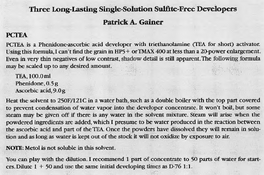
PCTEA is a remarkable and convenient invention, even though it was founed relatively recently (around 2004), there isn't as much test data as D-76. The equivalent information was provided by the inventor, Pat Gainer (R.I.P), and the screenshot is from The Darkroom Cookbook, 4th edition. Gainer actively participated in discussions on the forum and might answer you himself at past. What I want to convey is most that consulting documentation from inventors and salers can resolve many problems.....I may start with PCTEA 1:50 for 8:45, comapre with D-76 1+1, and then make slight adjustments as mentioned above.
 

Attachments

  • PCTEA.png
    PCTEA.png
    837.7 KB · Views: 128
What developer did the lab use?

I remember back min the early 1980s, I worked in a wholesale photofinishing lab and the B&W was a hand line, deep tank replenished. I remember using Ilford PQ and ID11 on different occasions. (a log book was kept with all data recorded). I remember there were two developer times, 10 mins for 100/125 speed films and 12 mins for 400.

It was a long time ago, so the memory is a little hazy.
 
The meter doesn't know what it is being pointed at. So it measures the amount of light bouncing back to it, and tells the photographer what settings to use to make the subject that the light is bouncing back from appear to be a particular medium tone - roughly the appearance of an 18% gray card.
If you want the black subject to look dark black, rather than gray, you have to give it less exposure than the meter suggests.
If you want the white subject to look white, rather than gray, you have to give it more exposure than the meter suggests.
Why 18% gray you ask?
It is because, on average, scenes with a wide variety of tones and reflectances tend to average out to being about 18% reflective, so a reading from most mixed scenes averages out pretty well, giving good results with both the darkest and lightest parts.
I believe that Kodak had a brief and helpful write-up on how to use both incident and reflective light meters? Try: https://www.scantips.com/lights/kodak.html
If I understand the current discussion, the OP need only really concentrate on how to use a reflective light meter (assuming the OP has no access to an incident meter) and perhaps the discussion on how to use multiple readings to determine “average” exposures.
 
Back to the original question. I’m a fan of 2-bath developers, but not for the reason stated in the OP. As others have already said, it’s unlikely that different emulsions will be equally good given the same development time. What a 2-bath developer does do is help you get decent results from a mixed bag of photos on one roll, where those photos have been taken in very different lighting conditions. Most shots will at least be printable. So it’s helpful for someone like me who knows what the last shots were but can’t remember what else is on the 36-exp film!

The reason I’ve refrained from chipping into this thread up to now is because using a 2-bath developer will teach you nothing. As others have said, you (mostly) relinquish the control of contrast that with single solution developers you get by adjusting development time.

So it depends what your photography consists of. What format do you use? Do you tend to take a whole roll of one subject, or do you accumulate many different subjects on one roll? You have told us that you don’t want to risk a week’s photography through having used the wrong film/developer combination. I’d humbly suggest that until you are willing to take risks and discover through failure what doesn’t work, you will learn little. But maybe all your photos are mementos of precious, never-to-be-repeated moments? In that scenario, a 2-bath developer could actually be your best friend for pragmatic reasons - but not for learning the trade.
 
So it depends what your photography consists of. What format do you use?
Half frame.

Do you tend to take a whole roll of one subject, or do you accumulate many different subjects on one roll?
Many different subjects. Takes me 3 outings to fill one roll. So there might be a hike, a trip to the farmers market, and a trip to a museum.

You have told us that you don’t want to risk a week’s photography through having used the wrong film/developer combination. I’d humbly suggest that until you are willing to take risks and discover through failure what doesn’t work, you will learn little.
I am comfortable with slow learning. This is a hobby. It's supposed be relaxing, not make me stress about whether I am mastering the craft quickly enough. In any case, I wasn't really planning to buy the 2-bath developer. I just wanted to understand it because it was a new concept for me.
 
I wasn't really planning to buy the 2-bath developer. I just wanted to understand it because it was a new concept for me.

OK, understood. If you do a search, you’ll find a lot of discussion here on Photrio about 2-bath developers, especially Thornton’s, also about divided developers, which are a related concept.
 
Instead of messing about with two part developers Rollei Supergrain one shot developer does pretty much the same job for most popular films. So Tri-X, HP-5, Delta 400, Delta 100, FP4, are all six minutes at the 1+9 dilution. It's a compensating developer as you'd expect and with only minor variations in time covers just about any common B&W film.

https://camerafilmphoto.com/product...7pcinQpMYroXHdY7dH7OBF&variant=23634886721636
 
OK, understood. If you do a search, you’ll find a lot of discussion here on Photrio about 2-bath developers, especially Thornton’s, also about divided developers, which are a related concept.

Yeah! Thanks! I've been reading about this the last couple of days. It's a whole class of developer I didn't know about.
 
OK, understood. If you do a search, you’ll find a lot of discussion here on Photrio about 2-bath developers, especially Thornton’s, also about divided developers, which are a related concept.

Looking back at your suggestion about taking risks, the obvious solution is for me to designate a sacrificial roll from time to time for the explicit purpose of testing. Can't believe it took me a day to think of that.
 
I don't want to lose a roll. Photography is a hobby for me, but that doesn't mean that I'm ok losing a week's worth of pictures because a roll was over or under developed.

I know the feeling. But be reassured you can be off by 30% and still get good prints.

Unless you push.

If you give the film 2/3 stop greater exposure than the rated speed, you’re ahead of the game.

When you’re unsure of any developer you can just drop the tail end, that you cut off when you put the film on the reel, in the beaker of developer. After about five minutes if it’s as dark as a pair of sunglasses you’ll be good to go.
 
My god. We’re telling a beginner to mix his own developer from scratch and to do a replenishment process. It took me 15
Years to do that.
 
My god. We’re telling a beginner to mix his own developer from scratch and to do a replenishment process. It took me 15
Years to do that.
DIY mixing isn't very difficult, evidently. In fact, it used to be a very normal way to start out. My dad started out with photography probably in the late 1940s. He'd walk down the street to a druggist, pick up some hydroquinone etc. and mix up a developer. I bet he used teaspoon measurements instead of a scale, too, as I doubt he had access to scales accurate enough to weigh out a few grams of this or that.

Now, replenishment is another matter. I'd not really recommend that in a low-volume situation and when someone's just starting out. Gradual failure and/or drift take some time to recognize and by that time the harm is done - but figuring out what happened can be somewhat confusing/challenging.
 
Now, replenishment is another matter.

Gradual failure and/or drift take some time to recognize and by that time the harm is done - but figuring out what happened can be somewhat confusing/challenging.

I agree in general but I'm curious to know if you would say the same for replenished XTol which uses XTol stock itself as the replenisher and in relatively higher volume (70-100 ml per roll) than other replenished developers.
 
Well, it's kind of personal, but yes, I would still say the same for replenished XTOL. It may work fine with most XTOL variants you buy, but the complaints about XTOL and XTOL clones performing oddly (or not at all) and people swearing to only stick with brand X because they bumped their head too many times with brand Y are just too numerous. Combine this with the fact we don't know how frequent or intermittent OP's use will be, and I'd frankly not trust a replenished batch of XTOL if it has sat around idle for a few months (hey, life gets in the way, things happen etc.) Then there's the inherent issue of different films affecting a replenished developer differently (the halide buildup is different, after all) - and yes, the relatively high rep rate of XTOL will offset this largely, but still, I would expect that replenished XTOL will behave significantly differently if you only run Delta 3200 through it vs. let's say Kentmere 100 or so.

Again, it's personal, and keep in mind when reading the above that in general I steer clear of replenished developers to begin with and prefer one-shot, mixed-fresh whenever possible. It gives me consistency and peace of mind. When advising someone who just starts out, I'd consider reducing the number of possible parameters so that any troubleshooting they may (will) have to do, will be easier. Replenishment adds a layer of complexity at the technical but also psychological level - if you have a big jug of replenished XTOL sitting in the corner, there may be a threshold to get rid of it or at least consider its possible failure if or when problems arise.

Finally, OP has indicated (here or elsewhere, I don't recall) that he likes to experiment. I'm going to go against the grain here a little and argue that that's perfectly fine (and in any case, it's his God-given right to decide what he does in his own darkroom anyway), and then a replenished system wouldn't make much sense as it's going to be a constant factor - and there'll be that big jug of months-idle XTOL sitting in a corner; see above. When I started out with B&W processing, I was much in the same boat and while the usual advice of 'stick to one film and one developer for a year' would undoubtedly have taught me many things, I chose a different route involving a multitude of film and developer combinations, and I really cannot say that it was any better or worse from a didactic viewpoint. I just learned different things at different moments in time - but after a few years, I think it all evens out anyway. What I found the most important is to remain attentive to anomalies and only move on once you've definitively explained/understood what's happening.

 
My god. We’re telling a beginner to mix his own developer from scratch and to do a replenishment process. It took me 15
Years to do that.

I can’t even keep up.

Ok so Pentax 17. Take advantage of the exposure compensation dial. Even when the scene isn’t backlit, if you keep it at + 2 marks (plus 2/3 stop) you get a little insurance.

We don’t agree much as a community but I bet everyone here hates an underexposed negative.

Keep in the back of your mind that the real speed of film, where you get the technically best exposure, is with exposure compensation at zero.

And if you dial anywhere between +2/3 stop and -2/3 stop (sometimes I say -1/3 stop) you can mix and match on a roll. It only means some negatives will have a little more shadow detail than others. Develop it all normal
 
Photrio.com contains affiliate links to products. We may receive a commission for purchases made through these links.
To read our full affiliate disclosure statement please click Here.

PHOTRIO PARTNERS EQUALLY FUNDING OUR COMMUNITY:


Ilford ADOX Freestyle Photographic Stearman Press Weldon Color Lab Blue Moon Camera & Machine
Top Bottom