I couldn't disagree with you more, but that is why we have APUG to express these things.

The whole reason for doing film testing is to remove those very type dicrepancies-----it is a major reason for testing using the same equipment that is used in making the photograph. The book "The Negative" has been invoked a few times so I'll chime in with it. I would refer you to Appendix 1, Film Testing Procedures. But perhaps you don't have it so I'll write the quotes that make my point:
IMO, it basically boils down to whether you choose to believe these statements or not. But the very act of testing film to gain control over the extremes of the negative contrast range you are testing for eliminates the concerns that you are mentioning. The mathematics of lens flare are rendered mute by proper testing and subsequent consistency in your own procedures.
Testing is important, but there's good testing and bad testing. One of the primary concerns within any testing procedure has to do with controlling the variables. Step Tablets are contacted in order to eliminate such variables as flare. The higher the degree of accuracy, the more stringent the controls. As P.E. states, Kodak uses a carbon step tablet. They also use densitometers that read to 0.0000. There's a big difference between a value of 2 and a value of 2.00 or 2.0000. And as we all know from personal experience, the more accurate something has to be, the harder it is to achieve and usually the more expensive it is to do. With film, the best testing is done with a sensitometer which produces repeatable known exposures with a known color temperature. A camera, not so much. And the concept of personalizing to your equipment, mostly myth.
There's more out there then just The Negative and ZS related material. Zone System is a simplified version of tone reproduction and a flawed one at that. Yes, Adam's has many mistakes in his reasoning. I want to make this perfectly clear, just because he's wrong on much of the reasoning, the technique can and does produce good results. Let's take an absurd example, but one that is true. A photographer had built a new darkroom. He then proceeded to retest his materials. Test upon test wasn't producing the desired results. He eventually concluded that the table was two inches too high. Another example, I could claim that the most accurate processing only happens on nights with a full moon. While the quality of the processing may indeed be excellent, is the moon really a factor?
So it is with most ZS testing. It doesn't factor in flare. 80% of flare comes from the subject. The test card is a single tone. It has limited flare. I've done testing with a variety of cards. Some had a small black square in the middle surround by white. Some were all black, all white, all gray, or a combination of the three. I included a sensitometric strip with each of the tests. Believe me flare is a factor. These tests were part of a article I wrote for PHOTO Techniques a few years back. They cut the manuscript down by 2/3 with much of that being test data.
A sensitometric test doesn't incorporate flare as anyone who has seen a film curve knows. You need to factor it in when interpreting any results. ISO film speed includes a flare factor. As any person familiar with the ZS knows, you meter the subject and stop down four stops. The ISO speed point falls 3 1/3 stops down from the mid-tone. (note: The statistically average subject luminance range is 7 1/3 stops.) Why place the speed point at one stop above the shadow placement? The answer is flare. Without flare, film speed would be one stop slower. How is the ZS wrong? It doesn't assume any flare and uses a point 2/3 stops lower to calculate speed. Ever wonder why most ZS "personal" film speeds are 1/2 to 1 stop slower than the ISO speed? There you go. In effect, most photographers who use ZS testing are overexposing their film 1/2 to 1 stop, but that won't detrimentally affect image quality. Consider ASA speed prior to 1960. Every film was one stop slower - Tri-X was 200, Plus-X was 50. And not every scene has the same amount of flare even if they have identical luminance ranges. Still, in general, low luminance ranges have lower flare and high luminance ranges have higher flare. A high flare situation will produce a higher shadow placement which in effect means a higher film speed. A scene with a low flare factor will effectively produce a lower film speed. No matter how much testing you do, there's really no way to guarantee exact shadow placement. There's a lot more to film speed theory and exposure theory than you might think. (I've written a diatribe over at Understanding ISO Setting thread that covers more).
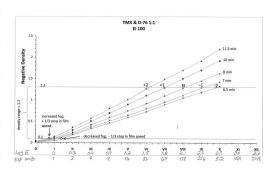
I've also attached a graphic illustration of this point. The quadrant on the right is the camera image. One curve represents a no flare camera image and the other a one stop flare factor. You can see how the camera image interacts with the film curve. As you can see there is a 2/3 stop difference in shadow placement between the ZS testing approach and 0.10 speed point.
Because flare brings the shadows up approximately one stop, it also reduces the apparent subject luminance range one stop. So a seven stop scene will have the appearance of a six stop range at the film plane. How can the ZS test which doesn't incorporate this factor still produce negatives that print on a grade two paper which according to the ISO standards should be around 1.05 to 1.15 for diffusion enlargers? For this, we need to use a little math. (note to P.E.: This is why I like to use math. It's a good way to avoid the "no it isn't - yes it is" back and forth argument)
The slope of a curve is calculated by using the equation rise over run. Contrast Index is calculated in a similar manner. To determine the aim CI for a given subject luminance range, the equation is:
CI = Desired Negative Density Range / Log Subject Luminance Range - Flare
For the statistically average scene with the statistically average flare, it would be:
1.10 / 2.2 - .34 = 0.59
Kodak's 0.58 comes from a negative DR of 1.05 and flare of 0.40. I've used a 1 1/4 stop flare factor since AA shot mostly large format and LF lenses have fewer elements.
Zone System testing figures a 7 stop subject luminance range, no flare, and a desired negative density range of 1.25 (1.35-0.10). That comes to:
1.25 / 2.1 = 0.59
Conclusion? You get the same results, but one has flawed reasoning. Check the curves in the back of The Negative. Find Zone VII and see if the negative density range is around 1.10 or 1.05.
For any testing, you need to know and understand the many variables and factors.