• Welcome to Photrio!
    Registration is fast and free. Join today to unlock search, see fewer ads, and access all forum features.
    Click here to sign up

Efke's Direct Positive Paper

Forum statistics

Threads
203,265
Messages
2,852,090
Members
101,752
Latest member
Frederic CHICHE
Recent bookmarks
0
Great timing,

I have been looking for a positive paper or a way to process paper to create a positive. It's worth a try. I just ordered some in 5x7 to give it a shot. I'll report back in a few weeks on how it works. Thanks for the heads up.
 
You can process almost any negative paper to give a positive image. I have done it repeatedly. You just have to work out the right process conditions and the right paper to use. Don't use VC paper, for starters.

PE
 
What exactly would be the useful application for something like this? I understand a one off strait to paper image, but why choose that?

I really am new to a lot of this, but to me it seems a little pricey, more of a novelty than anything else. $34 for 25 sheets of 8X10? I dunno maybe I'm missing the point. I suppose it could be fun in the RC version for "instant" portraits or something like that.
 
The main interest is for pinhole photographers. No more paper negatives...they can have paper positives. :smile:
 
Or for that odd negative that you want to print as a negative image.

And compared to the price of doing a 8x10 contact print, this might be a bargain for the budding LF photographers.
 
I suppose in hindsight this really could be a bit cheaper when you figure that Arista 8X10 film is ~$2 a sheet plus $.50-1.00 for cheap non-AZO paper as well as only needing one set of chemistry. So not counting chemistry you are looking at about $1.50 a shot vs. $2.50-$3.00, so about half price. I guess my thought is that if I take the time to make an image I would like to be able to reproduce the prints. All that being said when I get to fixing up my 8X10 I might order a pack of this and see what I get.
 
Well, I saw many people asked how to make b/w reversal (slide), so I think same people who want to make b/w slide would use this paper. I can't say I wouldn't try it...
 
It seems like what one would use to make those instant tourist photos that are done without Polaroid in some parts of the world. The camera is kind of like a view camera with a dark box on the back containing the processing chemicals (monobath?). They always look like homemade contraptions.
 
It seems ideal for those who would like to print alternative processes from paper negatives. I have some on order to experiment with in several ways.
 
This is great news, I have about a half dozen projects that have been sitting on the shelf for something like this because I don't have time to make internegs.

I'll start experimenting with the Efke materials ASAP.
 
It seems like what one would use to make those instant tourist photos that are done without Polaroid in some parts of the world. The camera is kind of like a view camera with a dark box on the back containing the processing chemicals (monobath?). They always look like homemade contraptions.

I think I just acquired a new project. Please forward your physical address, so I can tell my wife whom to beat up when she finds out about it. :smile:

-NT
 
There have been previous discussions about reversal processing of paper and films. My interest in this would be a reversal processed paper 'positive', which would function as a one-of-a-kind original image, from a large format camera.

I was alerted to the availability of a direct positive paper, made by Efke and sold through Freestyle. Here's the blurb from the Freestyle site:

Product Details:
A totally unique B&W paper product that yields a postive B&W image. Yes, you can use this paper in a large format camera or pinhole camera and shoot original photographs with no negative involved. The possibilities are endless!

Available in medium-weight RC Glossy or Matt paper as well as single-weight (140 gsm) fiber base matt surface paper.

Process in standard B&W paper developer.

Shoot in camera at a speed rating of approximately ISO 1 - 6.

Use under red safelight conditions only!


I'd like to know if anyone here has used this paper, and if so how the image quality fares. There may be some degree of image manipulation possible with various paper developers and dilutions, as well as the possibility of preflashing the paper prior to exposure to improve shadow details. I won't know until I try it, of course. I'm assuming that it's orthochromatic in tonal range, so portraits will look, um, 19th century. Or folks will have to apply powder to their faces!

Also, this paper was listed in Freestyle's site under 'graded papers', but I don't see a paper contrast grade listed. I also visited Efke's site, and this media wasn't listed either. It may be too new for them to have updated their site.

I'm assuming, from the Freestyle blurb, that this product develops in standard paper developer, no bleach or re-exposure necessary.

My interest in this would be in combination with a one-shot developer/fixer, which may permit public portraits be taken, via large format camera, and processed to the rinse stage in a few minutes directly on the spot, by transfer from film holder to a developing tank. With the right equipment I can see doing everything, including a quick rinse and rinse-aid, at the public location. One would need to figure out how to quickly dry the print with minimal surface contamination while outdoors, after which the customer can choose to keep as-is, or re-rinse at home.

With the possible demise of Polaroid materials, this sounds like an interesting alternative process for near-instant images.

~Joe

 
Last edited by a moderator:
I remember I posted some paper negative/glass lens images over on F295, so here are the links. They were shot using an old Polaroid Model 800 Land camera, with the Arista grade 2 glossy paper negatives taped to the film platen.

There's this link, of exposure tests in my courtyard, in direct sun and shade. The metering looks linear.

There's this link, taken in shade, of my grandson. He's a bit tanned from summer swimming, but the ortho media really darkens the skin tones further. Again, exposure was metered using my Gossen, and I used the old Polaroid's shutter on bulb for exposure, due to the low light. The paper media looks pretty linear.

I'm hoping to be able to see similar results using this Efke direct positive paper.

Edit: There's also this link, about a possible camera lens I have that may be fast enough to warrant sub-1-second, shutter-timed portrait exposures with paper media.

~Joe
 
Last edited by a moderator:
I'm assuming that it's orthochromatic in tonal range, so portraits will look, um, 19th century. Or folks will have to apply powder to their faces!

You're confusing "ordinary" (i.e. blue-only sensitive) with "orthochromatic" (i.e. "correct" color rendition). A portrait on ortho film doesn't look too different from that which is made on panchromatic film:

ortho.JPG

(J&C Ortho in Rodinal)

With redder complexions, it can be a problem, though.
 
Yes, right you are, Michel. Graded paper media is primarily UV/blue sensitive, although VC paper has some green sensitivity but the contrast is hard to control, as daylight predominates in the color spectrum that activates VC paper's high-contrast emulsion. I have to remind myself that 'ortho' relates to 'green'.

So, rather than referring to paper negs as 'ortho' in tonal response, should I refer to them as 'actinic', as EW did? I don't think they would properly be termed 'gas-light' paper, either, since they'll fog under a flame's illumination.

I guess I'm just seeking the proper terminology that can be agreed upon.

~Joe
 
Joe,

I have tried using the paper in a 4x5 camera, in bright sunny f16 daylight, as well as in a home-made coffee can pinhole camera with an undetermined aperture size. I've even tested it with a studio flash just to get ballpark effective ISO speeds. Best as I can make it, it's about ISO 1 or 2. Image quality: good enough for a sneek preview of what it is you're shooting. Has the look of the first generation Kodak Polycontrast. Rather contrasty material with a slight fogginess to it. I processed my test sheets as if they were ordinary RC paper. Certainly not as convenient as a good B&W 'roid, but the material does open up some possibilities. Hope this helps.
 
FYI this is the third post about this paper in the past few days - perhaps a moderator should merge them as they all say much the same things....
 
Threads merged.
 
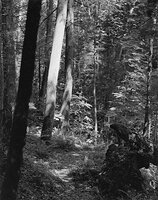
Most films that deliver a direct positive image with standard black and white processing have either had extremely high contrast or fairly high fog levels. The example shown above seems to have reasonable contrast, decent gradation, and low fog. That seems to be quite a breakthrough. Any information on how it's done?
 
Photrio.com contains affiliate links to products. We may receive a commission for purchases made through these links.
To read our full affiliate disclosure statement please click Here.

PHOTRIO PARTNERS EQUALLY FUNDING OUR COMMUNITY:


Ilford ADOX Freestyle Photographic Stearman Press Weldon Color Lab Blue Moon Camera & Machine
Top Bottom