
• Welcome to Photrio!
    Registration is fast and free. Join today to unlock search, see fewer ads, and access all forum features.
    Click here to sign up

Double-X Film

Recent Classifieds

Forum statistics

Threads
202,847
Messages
2,846,465
Members
101,564
Latest member
swedafone
Recent bookmarks
0
The only time you need full darkness is when you first put the bulk roll into the loader, and it's pretty-much fool-proof with normal care.

I'm still wondering about those last exposures on the roll. If you take the leader in the light to the spool before winding the rest you're going to have 3-5 exposures toward the end of the roll that were exposed to light.
 
I'm still wondering about those last exposures on the roll. If you take the leader in the light to the spool before winding the rest you're going to have 3-5 exposures toward the end of the roll that were exposed to light.

You compensate for this by spooling enough extra frames with the loader. You do need them and a leader for loading the film in the camera. Even commercially loaded cassettes have several frames slack at the end.
 
Last edited:
I'm still wondering about those last exposures on the roll. If you take the leader in the light to the spool before winding the rest you're going to have 3-5 exposures toward the end of the roll that were exposed to light.

On many cameras the fogged portion doesn't affect the last usable frame, as long as you are careful when you assemble the cassette and don't pull out more than the minimum needed to tape the film to the spool, etc.
The Lloyds loader is a little better for this than the Watson type.
 
I'm still wondering about those last exposures on the roll. If you take the leader in the light to the spool before winding the rest you're going to have 3-5 exposures toward the end of the roll that were exposed to light.

Using the AP/Konica-type loader which I mentioned above, I've never had the fogging intrude into the last picture on the film. Just don't try to squeeze extra frames on at the end, i.e. if you load a 36 exp length, stop shooting when your camera counter reaches that number. (And, obviously, don't use the loader in bright sunlight, subdued room illumination is best.)
 
I'm still wondering about those last exposures on the roll. If you take the leader in the light to the spool before winding the rest you're going to have 3-5 exposures toward the end of the roll that were exposed to light.
The cassette is loaded closer than that to the light trap. Some people are able to load them so close to the light trap that no frames are lost in the trailer. With the Lloyds model, I can reliably do it with just one frame lost. With the Watson style loader, I count on losing two.

The images in the instructions I linked to mislead slightly, because in order to get good photos of the process, you need to have the cassettes an unusually long distance away from the film gate - the trailer isn't normally that long.

At the other end, the leader is just as long as in a factory loaded cassette.
 
Since we're talking about Double-X and bulk loading, I'll bring up something unusual about this film - it is incredibly flat in all dimensions. That's great after it's been processed when you want to put it in an enlarger, but it can cause problems in bulk loaded cassettes, if you do like I normally do and wind on a generous extra few inches of film in order to take care of the light-struck-trailer issue. It starts to not all fit in the cartridge! It's trying to be straight, not curled up on the cassette, so if you try to cram in a few extra frames it starts getting tight, you run the risk of scratching the outer couple of winds of film, etc. So I just load the standard amount and try to stop at 35 or 36 shots no matter what. I use Shirley-Wellard cassettes, which might actually exacerbate the problem (I think they're a tiny bit smaller inside because of the two layers of metal), but something to keep in mind while bulk loading.

The flatness thing also makes it a little trickier to get it on the reel when developing too - the spool of film wants to unwind and jump out of your hand while you're winding it on the developing reel, so just be aware of that too!

Duncan
 
That is a video of someone who does not use a bulk loader. There are a few people around who do it that way, but basically that is the HARD way to do it.

The only reason to do it that way is if you are the type of photographer who shoots many different types of bulk film, and don't want to have a separate loader for each.

Or if you're a casual shooter who doesn't want to spend the money for a bulk loader because you might not buy a bulk roll again.
 
Eastman 5222 is on a slightly thicker and stiffer base than still films. If you try to load more than say 30 exposures in a cassette you run the risk of the film jamming in the cassette. It's not written in stone that you must have 36 exposure rolls. It's something that you must put up with to use this film. Well worth the fact that this film remains completely flat in glass-less carriers.
 
Ok I'll bite. What is the difference between XX and say FP4 and HP5 and for that matter XP2? I'm referring to differences in how a print looks. It's hard to tell from net images. And just so you know I don't give a rats behind about published curves and such. I'm a show me guy.
 
I have a hard time these days(unless on some exotic vacation spot) shooting 36 exposures so, that's no problem loading a 24 exposure roll. In fact anymore, that's what I prefer. If after I get those two rolls I ordered and it turns out I really like it I see no reason why not invest in a good $50 reloader. You'd pay nearly that for a B+W filter these days.

While I'm thinking about it, I think a 24 exposure roll is right at 46-48" long. That's nearly or right at four feet. I don't know without mulling over the reloader instructions how you'd know when you got to that point.
 
I have a hard time these days(unless on some exotic vacation spot) shooting 36 exposures so, that's no problem loading a 24 exposure roll. In fact anymore, that's what I prefer. If after I get those two rolls I ordered and it turns out I really like it I see no reason why not invest in a good $50 reloader. You'd pay nearly that for a B+W filter these days.

While I'm thinking about it, I think a 24 exposure roll is right at 46-48" long. That's nearly or right at four feet. I don't know without mulling over the reloader instructions how you'd know when you got to that point.

The bulk loaders either count frames for you (my Watson style ones), or tell you how many turns of the crank you need to use for different lengths (my Lloyds style ones).

And be careful with using "reloader". The hunters might get confused :smile:.
 
Being a reloader for many years seemed like a good term for "rolling your own" and one I could readily identify with. :smile:
 
I don't know if it is the same film but the last time I used XX film was in 1964. I found it to be dreadful stuff and once the couple of cassettes had been used I never went back to it. The developer I was using, I forget exactly but probably was D76 or Beautler, I cannot be sure. Whatever the combination was it was grainy almost to the level of the old Kodak High Speed Infra Red without all the benefits.
 
That could have been Super XX...not sure but doubt it was the same film. Come to think of it, I think XX was discontinued in the early '60's...maybe '62.
 
post deleted
 
I received my first rolls of this film today and had to give it a try. I just shot mox nix things around the yard, porch, etc. both in sunlight, cross light and shade to see how it would handle both. I'm going to develop later with a fresh batch of ID-11 I made up yesterday. Pics forth coming.

They came in a super nice cassette marked "Eastman Doulble-X 5222 Film" with black and silver lettering.
 
I don't know if it is the same film but the last time I used XX film was in 1964. I found it to be dreadful stuff and once the couple of cassettes had been used I never went back to it. The developer I was using, I forget exactly but probably was D76 or Beautler, I cannot be sure. Whatever the combination was it was grainy almost to the level of the old Kodak High Speed Infra Red without all the benefits.

5222 in Beutler developer (non-solvent) is NOT pretty!
 
5222 in Beutler developer (non-solvent) is NOT pretty!

The Beutler formula is intended for slow speed films ISO < 125. Whatever did you expect.
 
I knew what to expect; I was just passing along the results in case someone else was thinking about using Beutler's.

Sorry the intent of the post was not clear to me. I apologize again the NOT in my post somehow got omitted.
 
Last edited:
I load my film into the brass Leica cassettes. I have a Watson loader, but never have liked it, I just pull out a length of film between my outstreched arms, for me about 32 exposures of 5222 film. I have a closet which is totally dark, no problems with fogging the film. I trim the end to go into the cassette and wind by hand. It takes only a few minutes and has worked quite well for me.


m
 
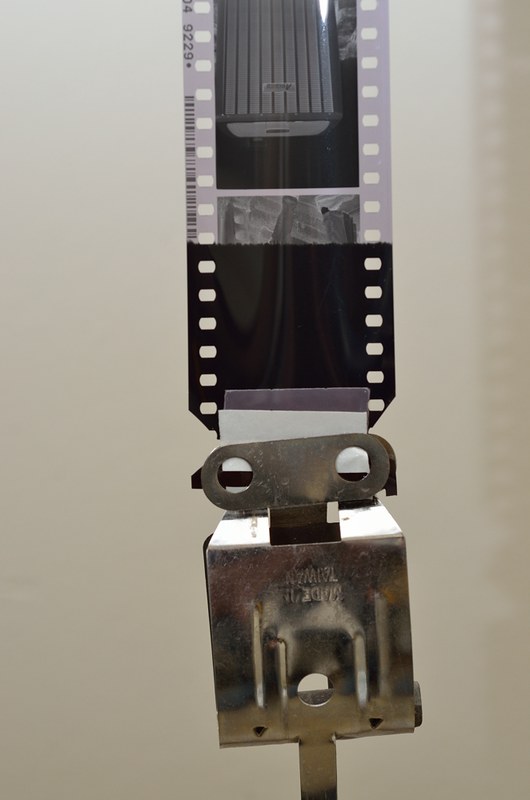
I just developed the roll in ID-11 for 8 min at 75 degrees...look pretty good. However, I'm not sure what happened at the end. I had taken #23 and knew I had one left so advanced the lever-no resistance, took the picture and advanced again but it would only go about 1/8th the distance so, I knew that was it. I rewound and developed. That #24 shot was cut off by more than half. I'll try and take a pic of it before I cut the negatives after drying.
 
OK-I couldn't wait. This is what happened on shot #24. There should have been a complete negative.

_1DF4495 by David Fincher, on Flickr
 
OK-I couldn't wait. This is what happened on shot #24. There should have been a complete negative.

_1DF4495 by David Fincher, on Flickr
Yep, that's what the last frame looks like with bulk loaded film. Someone already mentioned stopping short of the maximum number of frames so this doesn't happen.
 
Photrio.com contains affiliate links to products. We may receive a commission for purchases made through these links.
To read our full affiliate disclosure statement please click Here.

PHOTRIO PARTNERS EQUALLY FUNDING OUR COMMUNITY:


Ilford ADOX Freestyle Photographic Stearman Press Weldon Color Lab Blue Moon Camera & Machine
Top Bottom