• Welcome to Photrio!
    Registration is fast and free. Join today to unlock search, see fewer ads, and access all forum features.
    Click here to sign up

Double-X Film

Venice

A
Venice

  • 0
  • 0
  • 20
Train

A
Train

  • 3
  • 2
  • 43

Recent Classifieds

Forum statistics

Threads
201,786
Messages
2,830,198
Members
100,951
Latest member
HamelP
Recent bookmarks
0
OP
OP
ColColt

ColColt

Member
Allowing Ads
Joined
May 26, 2015
Messages
1,824
Location
TN
Format
Multi Format
Anytime you photograph under different lighting conditions, it's always a compromise when it comes to development. All things considered, I think they turned out quite well!


Not to shabby considering first time with this film and not for sure of the developing time. I'll do a little modification next time. I shot this roll at ASA 250 which seems to do well. Dropping back a tad on the developing time may be the key.
 

frobozz

Subscriber
Allowing Ads
Joined
Feb 19, 2010
Messages
1,458
Location
Mundelein, IL, USA
Format
35mm
If you think this is high contrast you should see the same shots with Tri-X and HC-110 Dil H. Looking back over the negatives, I think they could stand a slight reduction in developing time...maybe half a minute or so. that could reduce the perceived contrast as well.

It sounds like you think the negatives are a bit too dense? I'll say again, I metered at a higher ISO (i.e. gave it less exposure) rather than decreasing the development time. Try it developed just like you did, but meter at 400. I can't see enough of your negatives to know for sure, but the rebate printing looks about right, while the images look a bit too dense, which is exactly what I got when shooting at 250, which is why I kept the same development and used 400 instead.

I assume you're scanning the negatives directly? If so, be prepared to be even more impressed if you're ever able to print them optically on real paper.

Duncan
 

bergytone

Member
Allowing Ads
Joined
Sep 8, 2014
Messages
168
Location
Grand Haven,
Format
Multi Format
Film Photography Project probably used a bulk loader to manually load your cassette.

I would be very surprised if their operation is big enough to have the sort of film packaging equipment that the manufacturers use.

I think they gave you too little film, but not by much.

Matt King is right. I listen to the Film Photography podcast and that is exactly what they do. They bought a large roll of Eastman film and package it themselves. The host Mike Rasso said he does it by hand. So I'm sure he's using a bulk loader. I get the same thing, It's inevitable when you are done with a roll you have to have the lights on to get then next spool taped up. Normally you would compensate by giving a little extra film...
 
OP
OP
ColColt

ColColt

Member
Allowing Ads
Joined
May 26, 2015
Messages
1,824
Location
TN
Format
Multi Format
The negatives look and scan a bit contrasty so, it's a matter of cutting back developing time rather increase the ASA to 400. Shadow detail is adequate. I have to scan as I closed down my dark room long ago but I'm sure a wet print of some of these negatives would yield surprising results.
 
OP
OP
ColColt

ColColt

Member
Allowing Ads
Joined
May 26, 2015
Messages
1,824
Location
TN
Format
Multi Format
I took a closer look at the film cassette and it says, "Hand rolled by The Film Photography Project. FilmPhotographyProject.com

One aspect of this film I failed to mention. It is absolutely the flattest film after drying I've used to date and a sheer joy to scan in light of that. No "C" curling like Tri-X.
 
Last edited:

Xmas

Member
Allowing Ads
Joined
Sep 4, 2006
Messages
6,398
Location
UK
Format
35mm RF
It was Eastmans best mono film after they cancelled the others.
The base is thicker and won't necessarily load 36 frames depending on cassette and spool types.

You can avoid the preexposed end with tear drop - if you load the cassette with less than 1inch of film protruding from trap.
Then dark bag the loader and seat the cassette in dark with trap open.

My box shaped loaders (both) do have a felt light trap but it opens when you insert the wind on handle, don't insert the handle with door open with bulk film loaded to confirm.

If you are ever going to wet print then exposing as 400ISO is untoward. This is a very hard thing to have to learn in school of hard knocks.

If you are going to scan then yes DMax is a problem.

5222 is way finer grain than Tx...
 

Gerald C Koch

Member
Allowing Ads
Joined
Jul 12, 2010
Messages
8,131
Location
Southern USA
Format
Multi Format
As far as I can determine the differences between cine and still films are mechanical and not emulsion related. Such things as cine films needing a lubricating and antistatic layer, being somewhat more robust due to the stress in cine cameras, etc.
 
Last edited:

michaelorr

Member
Allowing Ads
Joined
Oct 26, 2009
Messages
218
Location
Jersey Shore
Format
8x10 Format
As far as I can determine the differences between cine and still films are mechanical and not emulsion related.
I was going to remark on the grain, though. It does seem so much different in "texture" or "shape" from what I have seen on still film, but I have little experience with tri-x in any format. Col. "Ray" photos of especially the hose reel and the gas meter especially. I can almost "see" a similarity to BW movies graininess, which is mostly not visible at 24pfs.
 
OP
OP
ColColt

ColColt

Member
Allowing Ads
Joined
May 26, 2015
Messages
1,824
Location
TN
Format
Multi Format
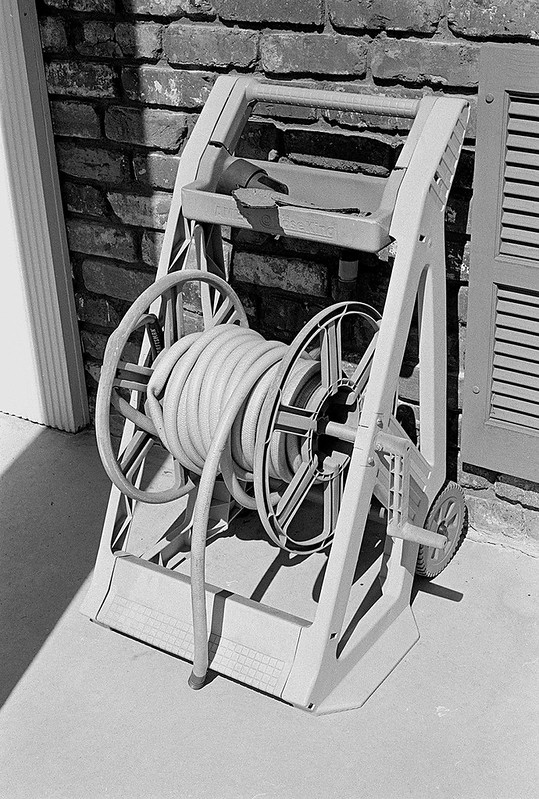
If you look at the first one(5222) and then the second one (Tri-X) you can see texture to the far left on the door facing with Tri-X. On 5222 it looks burned out. I think this is a result of contrast/developing time. I'll cut back to 7 minutes next time. Both were shot at nearly the same time of day, same bright sun and exposure at ASA 250.

5222 Film (ASA 250)
Double X film developed in ID-11 1:1 for 8 minutes. Shot at ASA 250 with Leica M4 and 50 f2 DR Summicron lens. by David Fincher, on Flickr
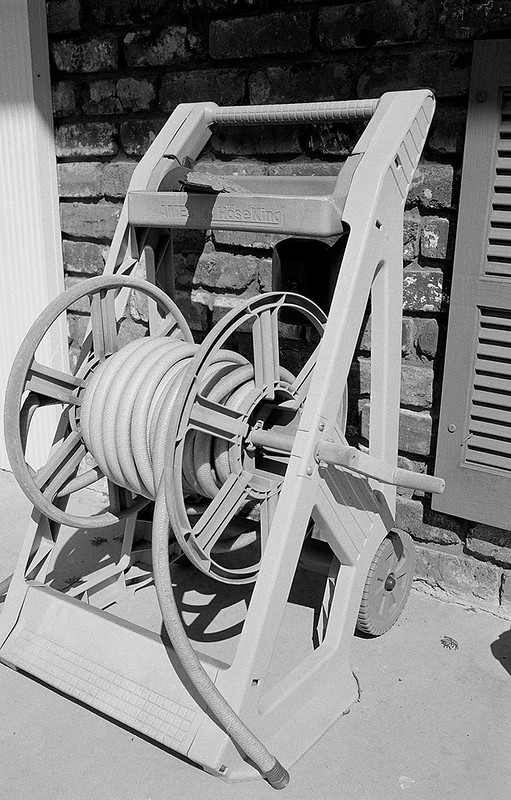
Tri-X(ASA250)

LeicaM4 and Tri-X with HC-110 Dil H by David Fincher, on Flickr
 

Gerald C Koch

Member
Allowing Ads
Joined
Jul 12, 2010
Messages
8,131
Location
Southern USA
Format
Multi Format
I was going to remark on the grain, though. It does seem so much different in "texture" or "shape" from what I have seen on still film, but I have little experience with tri-x in any format. Col. "Ray" photos of especially the hose reel and the gas meter especially. I can almost "see" a similarity to BW movies graininess, which is mostly not visible at 24pfs.
Having used quite a bit of 5222 and making wet prints I have never noticed any difference in the grain structure. Some prints have been as larger as 16x20.

That being said how would someone describe a cine film look.
 

michaelorr

Member
Allowing Ads
Joined
Oct 26, 2009
Messages
218
Location
Jersey Shore
Format
8x10 Format
Honestly, there seems to me at first glance at the Col. scans a hint of looking at photos through a frosted glass, but without losing definition. It is difficult to defend using the word "granularity" to describe a characteristic of grain, it is rather redundant. So i don't know really how to describe what i see. Maybe i perceived in the photos the Col. put up as having a texture of grain that seemed to have a bit of a softer or rounded/pebbled look and a more uniform distribution over an area of coating, compared to a more random edged graininess. It wouldn't make sense to say it is "finer grained" as that relates to a size attribute where the grain seems to diminish as it gets finer. And again, to me watching old b/w films when the grain is perceptible - it has a quality that is different than looking at old b/w photo journalist images. So, i don't know. I can't imagine either that the emulsions, chemistry should be so different. Whatever it is i like the look, and look forward to more developed to a lower contrast. I do also appreciate Col. putting up both the 5222 and Tri-X samples side by side.
 

Gerald C Koch

Member
Allowing Ads
Joined
Jul 12, 2010
Messages
8,131
Location
Southern USA
Format
Multi Format
Perhaps this may help. From other threads relating to the "look" of B&W films, particularly older one, it appears that lighting was a major factor. Older film makers were masters of using lighting. Then too 5222 has finer grain than Tri-X and the samples were developed in ID-11 (D-76) a fine grain developer. Remember older films were probably filmed using Eastman Plus-X (5231 ISO 80T), Eastman Pan XT (5220 ISO 32T) or even Eastman Background X (5230 ISO 25T).
 
OP
OP
ColColt

ColColt

Member
Allowing Ads
Joined
May 26, 2015
Messages
1,824
Location
TN
Format
Multi Format
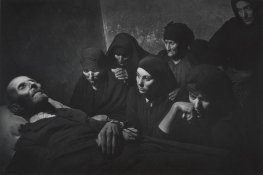
I guess in my mind I'm still looking for that "look" I see in books on Eisenstaedt and HCB's photos and I'm just not getting there. Something about them I like a lot but neither HP-5, TX or 5222 seems to be the one. Take the photo Gene Smith did on his essay "Spanish Village" and his photo he called "The Wake". Marvelous lighting, subject composition and just the look I like. No idea as to the film used, perhaps the old Super XX that the other two used a lot but I'm not sure. Maybe I'm seeking the illusive butterfly.
 
OP
OP
ColColt

ColColt

Member
Allowing Ads
Joined
May 26, 2015
Messages
1,824
Location
TN
Format
Multi Format
I know it's an entirely different subject with different lighting conditions but I shot this with HP-5 at ASA 250, HC-110 Dil H. I love it. Maybe that's what I should use primarily as I haven't found anything to date that to my eye looks any better.

Dntwn+012a by David Fincher, on Flickr
 

MattKing

Moderator
Moderator
Joined
Apr 24, 2005
Messages
55,156
Location
Delta, BC Canada
Format
Medium Format
I guess in my mind I'm still looking for that "look" I see in books on Eisenstaedt and HCB's photos and I'm just not getting there. Something about them I like a lot but neither HP-5, TX or 5222 seems to be the one. Take the photo Gene Smith did on his essay "Spanish Village" and his photo he called "The Wake". Marvelous lighting, subject composition and just the look I like. No idea as to the film used, perhaps the old Super XX that the other two used a lot but I'm not sure. Maybe I'm seeking the illusive butterfly.
That "look" has almost nothing to do with the film.

It is the lighting, and Eugene Smith's printing choices.

I find your comments interesting, because the examples of your photos that you have posted seem to be very different in mood and lighting than "The Wake".

And of course, you scan and display digitally, so the end result requires some differences in approach at the "post-processing" stage.
 

Arvee

Member
Allowing Ads
Joined
Aug 23, 2006
Messages
976
Location
Great Basin
Format
Multi Format
I guess in my mind I'm still looking for that "look" I see in books on Eisenstaedt and HCB's photos and I'm just not getting there. Something about them I like a lot but neither HP-5, TX or 5222 seems to be the one. Take the photo Gene Smith did on his essay "Spanish Village" and his photo he called "The Wake". Marvelous lighting, subject composition and just the look I like. No idea as to the film used, perhaps the old Super XX that the other two used a lot but I'm not sure. Maybe I'm seeking the illusive butterfly.
David,

I believe the 'look' was realized through a combination of exposure and printing.

I have a print of Smith's “Walk to Paradise Garden” and it is pretty obvious that Smith and photographers from his era weren't nearly as obsessed about shadow detail as photographers are now and they were also likely to push their film a stop or so when the need arose. I believe photographers of Smith's era were far more concerned about the 'message' than the tonal distribution, as evidenced by the quality of their work.

Both of these practices, pushing and burning in distracting shadows during printing, led to prints displaying rich blacks with minimal shadow detail, if at all, and crisp whites. In school, I was taught to burn in the shadows to the point where there was just discernible detail but not burn to empty black.

Take a look at Ralph Gibson's work and you'll see similar tonal gradations except he achieved the 'look' with overexposure and overdevelopment. He trained under Dorothea Lange.

I have a lot of books from photographers from that era and they all (mostly) produced the kinds of prints that you are hoping to achieve.

Also, the Tri-X of that era, which virtually everybody used, was a much different film than the one you are shooting today. That film was made to produce the well known 'gritty' look of the 60s and 70s and was a favorite of the photojournalists. Sadly, it met its demise when the bean counters came on the scene.
 
Last edited:
OP
OP
ColColt

ColColt

Member
Allowing Ads
Joined
May 26, 2015
Messages
1,824
Location
TN
Format
Multi Format
Perhaps that was a bad example of what I'm getting at. As for "The Wake", I know he did some manipulation via the darkroom in that photo as he did on quite a few of his photos and was known to spend a week on one print until he got what he wanted from it. I have two of his books that have that photo of “Walk to Paradise Garden” and it was pretty obvious he burned in the edges of the print. Maybe tone would be a better word as to what I'm getting a lot and the many photos I've poured over in "The Europeans" and "The Decisive Moment" where little if any manipulation was done as compared to Gene Smith's work.

I would be most curious to see how a wet print would look that I've had to scan instead. I'd venture to say somewhat if not bordering on very different but, I'm not afforded that luxury at the time. Tri-X, even back in the 80's, was to me was different that today. I did have very good luck with Agfapan 400 and it became my most used film in the late 70's through the time till it was no longer available. Hence, I look for something similar that I apparently haven't found yet.

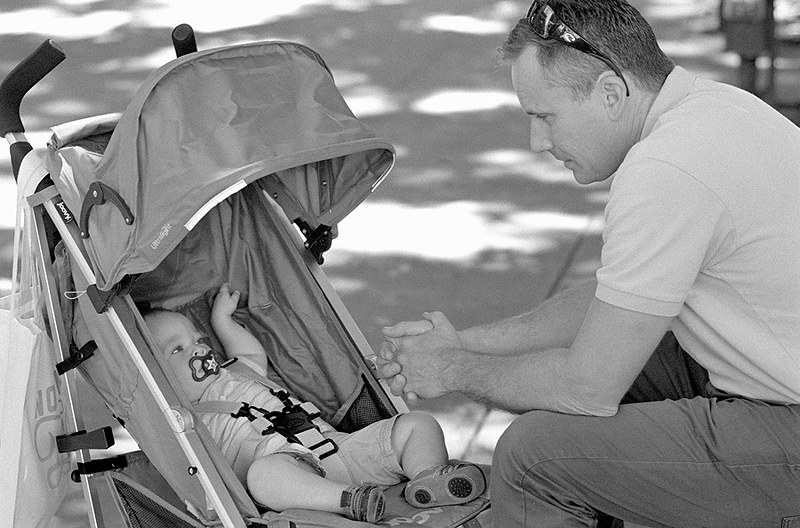
The look I've been seeking had nothing to do with those examples of the garden hose. I was showing them to show the similarities of those two films. The one shot in the shade of the guy and his son I was most pleased with, however. What I have noticed on every book I have on HCB, Smith and many shots from Eisenstaedt is maybe 90% of them, especially HCB, are in overcast or flat conditions. Seldom have I seen a bright sunny 3:00 in the afternoon shot from HCB. Maybe it's where he was-there is no sunshine in some parts of the world compared to here and he traveled extensively over his 40+ years.
 
Last edited:

MattKing

Moderator
Moderator
Joined
Apr 24, 2005
Messages
55,156
Location
Delta, BC Canada
Format
Medium Format
Books can also distort our perceptions.

I've seen a few "famous" photos in original print version. In almost all cases, the published versions of those photos are different - usually more dramatic.
 
OP
OP
ColColt

ColColt

Member
Allowing Ads
Joined
May 26, 2015
Messages
1,824
Location
TN
Format
Multi Format
You're right about books and whoever or however they publish the photos. I've never seen an original print.
 

Arvee

Member
Allowing Ads
Joined
Aug 23, 2006
Messages
976
Location
Great Basin
Format
Multi Format
Books can also distort our perceptions.

I've seen a few "famous" photos in original print version. In almost all cases, the published versions of those photos are different - usually more dramatic.
I agree!

When I was a member of the Center for Photography at the University of Arizona one of the special benefits it afforded was the privilege to request a private showing of the original works of the photographers whose work was archived there. Generally we could privately view up to 20-40 original prints for an hour. My wife and I took full advantage of this privilege and we viewed a number of notable artists.

I will say this: Viewing original prints by the artists gives one a rush like no other!
 
OP
OP
ColColt

ColColt

Member
Allowing Ads
Joined
May 26, 2015
Messages
1,824
Location
TN
Format
Multi Format
I'd love to see some of those originals. When at the Eastman House in Rochester many years ago I got to view what I thought to be some originals but my mind has gone blank and can't recall a one of them. We had been on a tour of the Kodak Park and then went to the Eastman House and then down the street to Light Impressions. It was a good day.

I'd love to see the original of "The Wake" as it's one of my top three favorites of Gene Smith. One thing you'll notice about much of his photos is they are dark and somber. Perhaps this was a reflection of his life and the hard times and physical/emotional problems he had. Reading about him reminds me of Vincent Van Gogh...or even Poe.
 
OP
OP
ColColt

ColColt

Member
Allowing Ads
Joined
May 26, 2015
Messages
1,824
Location
TN
Format
Multi Format
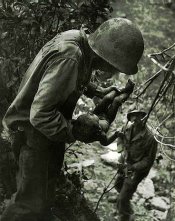
Speaking of W. Eugene Smith, these are examples of what I meant. In actuality, I find more moving and iconic photos with him than anyone else.
 

Attachments

  • USA.-1956.-NYC.-New-York-City-Harbour.-Medical-and-relief-aid-being-given-to-the-survivors..jpg
    USA.-1956.-NYC.-New-York-City-Harbour.-Medical-and-relief-aid-being-given-to-the-survivors..jpg
    26 KB · Views: 177
  • WES.jpg
    WES.jpg
    83.5 KB · Views: 163
  • w-eugene-smith-the-wake-juan-lara-spanish-village-1950.jpg
    w-eugene-smith-the-wake-juan-lara-spanish-village-1950.jpg
    145.1 KB · Views: 169
  • weSmith-Saipan.jpg
    weSmith-Saipan.jpg
    26.9 KB · Views: 133
OP
OP
ColColt

ColColt

Member
Allowing Ads
Joined
May 26, 2015
Messages
1,824
Location
TN
Format
Multi Format
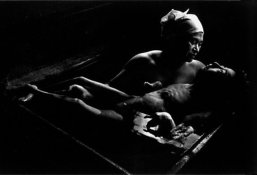
Moreover, I'd say this is his most famous if you could name just one.
 

Attachments

  • williameugenesmith1971minamata.jpg
    williameugenesmith1971minamata.jpg
    111.8 KB · Views: 133

Gerald C Koch

Member
Allowing Ads
Joined
Jul 12, 2010
Messages
8,131
Location
Southern USA
Format
Multi Format
When I attended the University of Florida Jerry Uelsmann was teaching in the arts department. I had the opportunity of seeing several exhibitions of his work. He is a master printer and the original prints are far better than what one sees in books. This has to do with the limited tonal range provided by ink on paper. As far as scanned images on APUG are concerned they are usually so dreadful that I do not even comment on them. Don't know if the problem is with my video display or something more fundamental. ColColt's examples are better than usual.
 
Photrio.com contains affiliate links to products. We may receive a commission for purchases made through these links.
To read our full affiliate disclosure statement please click Here.

PHOTRIO PARTNERS EQUALLY FUNDING OUR COMMUNITY:



Ilford ADOX Freestyle Photographic Stearman Press Weldon Color Lab Blue Moon Camera & Machine
Top Bottom