• Welcome to Photrio!
    Registration is fast and free. Join today to unlock search, see fewer ads, and access all forum features.
    Click here to sign up

Do you use a ring-light?

Tied to the dock

D
Tied to the dock

  • 4
  • 0
  • 72
Running in the Snow

H
Running in the Snow

  • 1
  • 2
  • 87

Recent Classifieds

Forum statistics

Threads
203,085
Messages
2,849,649
Members
101,652
Latest member
Mayorbeez
Recent bookmarks
0

AgX

Member
Allowing Ads
Joined
Apr 5, 2007
Messages
29,968
Location
Germany
Format
Multi Format
And for what purposes?

Aside very close distance photography, where conventional lighting would be blocked by the barrel and the benefits of the ring-light are obvious.
So this is about flat versus oblique lighting.

Strange enough ring-lights were hardly ever discussed here.

We also should be aware that ring-lights may vary in diameter (from about lens-barrel diameter to much wider in diameter).
 
Last edited:
I dislike the ring-reflection in ones eyes. (If the eye-image is large enough to see the catchlight.)
 
I rented one to see how I liked it using my film cameras and decided manual focus and ring lights suck. Kinda like the look, though.

Attached shot on Bronica SQ-A with Alien Bees Ringlight

0041.jpg
 
I've a medical NIKKOR that is excellent in the right situation. For gross specimens though my Metz, disconnected from the camera and held against the barrel and of my Micro-NIKKOR and pointed at the subject, yields results that please the pathologist.

For people I prefer a little modeling.
 
I have a Canon ML2 Microlight that's dedicated to my Canon T90 that gives T..T.L flash I bought it years ago to use for portraiture but I didn't like the way the catchlights in the sitter's eyes made their eyes look a cat's, but the money wasn't wasted because it's a superb setup for close up photography with my macro lens which I think is what it was intended for.
 
Yes, I think they were introduced with small-distance and technical photography in mind.
 
Concerning´the catchlike, one may mask parts of the ring (in case of a true ring-light) to modify the catch-light without losing too much of the evenness of the lighting.
 
Concerning´the catchlike, one may mask parts of the ring (in case of a true ring-light) to modify the catch-light without losing too much of the evenness of the lighting.
I never thought of that, thanks i"ll try it sometime.
 
I used to have an 1100 w/s Elinchrom ring light that hooked up to a Ranger battery pack. It was a great light, but I really never used it. After a few years I ended up selling it on to someone from LaLaLand who probably was going to use it for what it was good for. True ring lights like the Elinchrom really need to be used with a tripod or studio stand. They are hell to handhold after a minute or two. Also, to use them effectively you really need other lights. I was also not fond of putting people through the torture of having it blasting straight into their eyes. I thought it was just plain ol' mean.

I had a friend who had one of those small ring lights and he used it for a catchlight in the eye for available light portraits. I wasn't fond of the look myself.
 
If you're looking to play with a ring-light for 35mm close ups, look for a Yashica Dental-Eye. I picked one up a while back for about $30.00. Originally meant for dentists taking pictures of teeth, you can do some nice macro things with it.
 
Again macro-photography...

But you made a good point!
Even if the ring-flash has an autoexposure feature, then still you have to make a correction (as in the table on your flash) for the extra extention necessary in macro-photography.
The remedy of course would be a ring-flash that allows for TTL-metering. But I wonder when I will come across such as ring flashes seem super rare.


(The only working automation aside TTL would be Canon's old flash-autoexposure system adapted to their macro-lens; but they did not even make a ring-flash back then...)
 
Last edited:
I know that there are TTL-ring-flashes for several SLR systems. But what I meant is that at least here any kind of ring-light is so rare that in many years I only came across one ring-light locally.
 
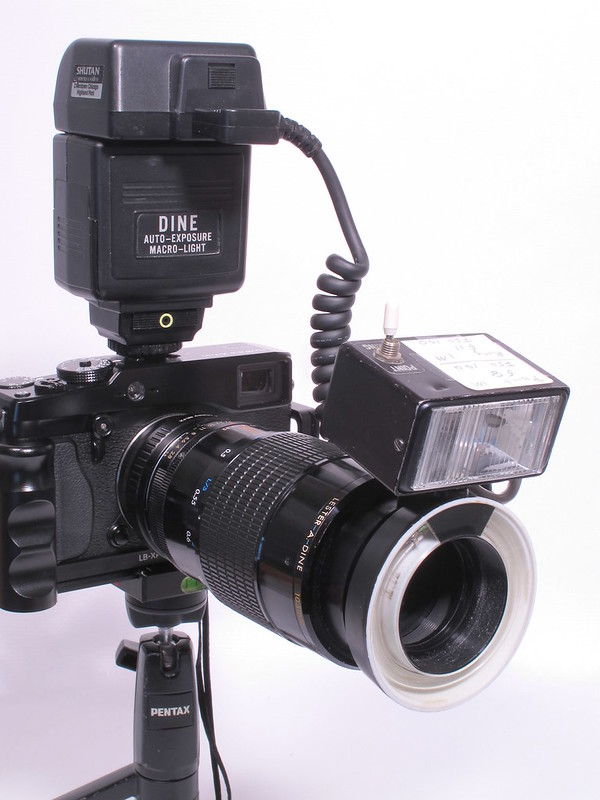
Recently, I was given a ring light and a Lester A. Dine macro lens by a colleague. The last time I used a ring light was decades ago (1970s) when I was working for a medical college. I primarily used the ring light to capture shadow-free photos of surgery and/or pathology in the body cavities (oral, abdominal, and thoracic).


Ring Light by Narsuitus, on Flickr
 
The Orbis ring flash allows you to use a TTL speedlight and turn it into a TTL ringlight. They are not made any more but you can get them used. There are similar light modifiers to the Orbis which are like ring-shaped softboxes which function similarly, but I have not tried those.

The Orbis can also be used off axis to function in a way that is similar to a small beauty dish.

A ring light works well as a fill light, giving you even fill and a catchlight, which can be useful.
 
I did not know that light. It is an optical adapter to a conventional flash head. Thus without electronic flash tube, but yielding the chance to use the flash automation (A/TTL).

Here a DIY-version of such optical head:
http://www.tommyimages.com/Blog/Ringlight/Small_Ringflash.jpg


I got a GNm 60 classic ringflash, that with quite some soldering I could give multi-aperture autexposure, even TTL.
 
Last edited:
Photrio.com contains affiliate links to products. We may receive a commission for purchases made through these links.
To read our full affiliate disclosure statement please click Here.

PHOTRIO PARTNERS EQUALLY FUNDING OUR COMMUNITY:


Ilford ADOX Freestyle Photographic Stearman Press Weldon Color Lab Blue Moon Camera & Machine
Top Bottom