• Welcome to Photrio!
    Registration is fast and free. Join today to unlock search, see fewer ads, and access all forum features.
    Click here to sign up

DIY Ferric Oxalate Synthesis for Kallitype

Melancholy

H
Melancholy

  • 0
  • 0
  • 18
The one that got away

A
The one that got away

  • 1
  • 1
  • 48

Recent Classifieds

Forum statistics

Threads
202,179
Messages
2,836,346
Members
101,152
Latest member
mohmadkhattab
Recent bookmarks
0
OP
OP
Raghu Kuvempunagar

Raghu Kuvempunagar

Member
Allowing Ads
Joined
Jul 28, 2016
Messages
3,142
Location
India
Format
Multi Format
My pleasure. As someone who has not yet had a chance to make Kallitype prints using powdered Ferric Oxalate, I would be interested in knowing, from your experience of working with it, if there are any noticeable differences in the exposure time, contrast, and colour tone.
 

Andrew O'Neill

Moderator
Moderator
Joined
Jan 16, 2004
Messages
13,039
Location
Coquitlam,BC Canada
Format
Multi Format
My pleasure. As someone who has not yet had a chance to make Kallitype prints using powdered Ferric Oxalate, I would be interested in knowing, from your experience of working with it, if there are any noticeable differences in the exposure time, contrast, and colour tone.

I'll be taking a look at that very thing, shortly!
 

fgorga

Member
Joined
Aug 31, 2015
Messages
858
Location
New Hampshire
Format
Multi Format
Nice video. I, too, like the tone of the DIY version best.

Just a note about your comment regarding the respirator... the concentration of CO2 in air is about 0.04%. The breath you exhale has roughly 100x that concentration of CO2.

Thus the amount of CO2 added by this small scale synthesis is completely negligible even in a small enclosed space such as your darkroom.

Furthermore, a typical dust/particulate or even an activated charcoal respirator will not remove CO2 from the air you take in.
 

Andrew O'Neill

Moderator
Moderator
Joined
Jan 16, 2004
Messages
13,039
Location
Coquitlam,BC Canada
Format
Multi Format
Nice video. I, too, like the tone of the DIY version best.

Just a note about your comment regarding the respirator... the concentration of CO2 in air is about 0.04%. The breath you exhale has roughly 100x that concentration of CO2.

Thus the amount of CO2 added by this small scale synthesis is completely negligible even in a small enclosed space such as your darkroom.

Furthermore, a typical dust/particulate or even an activated charcoal respirator will not remove CO2 from the air you take in.

Thanks for the info. All I had on hand was the respirator, so better than nothing...maybe. My fan does a pretty good job sucking air upwards, so I probably would have been fine going without a respirator... But then again, I like sounding like Darth Vader... 😄
 
OP
OP
Raghu Kuvempunagar

Raghu Kuvempunagar

Member
Allowing Ads
Joined
Jul 28, 2016
Messages
3,142
Location
India
Format
Multi Format
Like several of my printmaking friends in India, I was looking for a simple procedure for synthesising Ferric Oxalate for use in the Kallitype process as importing Ferric Oxalate was both complicated and expensive. So I explored several methods to make Ferric Oxalate at home for use in the Kallitype process. Pretty soon I realised that some of the well-known methods for synthesising dry Ferric Oxalate are cumbersome and not well-suited for the low volume users like me. Also, dissolving dry Ferric Oxalate is a pain taking a lot of time and effort.

After some trials, I arrived at the following simple process that allows me to make 20% Ferric Oxalate solution from scratch in about 15 minutes:

Distilled water: 30 ml
Oxalic Acid (Dihydrate): 12 g
Sodium Carbonate: 9.9 g
Ferric Nitrate (Nonahydrate): 25 g
Distilled water to make: 75 ml

Mix Oxalic Acid in distilled water and stir well. Not all of it will go into solution, but that's Ok. Next add Sodium Carbonate in small amounts to the mixture and stir well. Carbon Dioxide will be released with every addition of Carbonate and the solution will fizz. After all Carbonate has been added and the mixture has been stirred well, you get a milky white solution. Now add Ferric Nitrate and stir well. A green coloured solution forms. Top it to 75 ml by adding requisite volume of distilled water. Store the solution in a dark glass bottle tightly stoppered. When kept away from light and in reasonably cool temperature, it stays good for over three months.

The solution thus synthesised is meant be used in the Kallitype process in place of 20% Ferric Oxalate solution. I follow the Kallitype process delineated by Sandy King in his Unblinkingeye article. At 1 ml / A4 sheet, this procedure gives you enough Ferric Oxalate solution to make ~75 A4 sized prints. Of course, one make only as much sensitiser as needed for a working session as it takes not much time to make the desired volume of sensitiser from scratch.

Purists will rightly point out that the solution contains Sodum Nitrate along with Ferric Oxalate. But that doesn't do any harm to the printing. I and my friends have used Kallitype sensitiser made using the above method successfully and are quite happy with it. If you try this method, let me know how it worked for you.

If we don't top up the solution to 75 ml, the volume is about 55 ml after mixing all the ingredients. This is 1.36 times more concentrated solution of Ferric Oxalate than what is generally used in Kallitype. Such a concentrated solution could be of independent interest to some.
 

Debanjan

Member
Allowing Ads
Joined
May 4, 2010
Messages
30
Location
Kolkata, India
Format
35mm
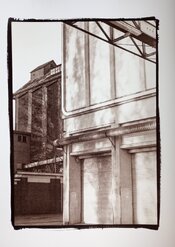
This indeed is super helpful recipe and Raghu has been kind enough to gift me samples to try.. A sample Kallitype [Gold + Selenium toned] is attached with my post so that you all can also assess the range..

1768394677115.png
 
OP
OP
Raghu Kuvempunagar

Raghu Kuvempunagar

Member
Allowing Ads
Joined
Jul 28, 2016
Messages
3,142
Location
India
Format
Multi Format
Thanks @Debanjan for both trying out the sample I shared and posting your beautiful print! Much appreciated. DIY process of making imaking FO solutions is quite simple as you can see from Andrew's lovely end-to-end demonstration. I hope you'll try it yourself in the near future and share your experiences.
 
Photrio.com contains affiliate links to products. We may receive a commission for purchases made through these links.
To read our full affiliate disclosure statement please click Here.

PHOTRIO PARTNERS EQUALLY FUNDING OUR COMMUNITY:


Ilford ADOX Freestyle Photographic Stearman Press Weldon Color Lab Blue Moon Camera & Machine
Top Bottom