


• Welcome to Photrio!
    Registration is fast and free. Join today to unlock search, see fewer ads, and access all forum features.
    Click here to sign up

D23 & Pyrocat-HD Comparison

Grill

H
Grill

  • 4
  • 0
  • 82

Recent Classifieds

Forum statistics

Threads
202,789
Messages
2,845,608
Members
101,533
Latest member
maho
Recent bookmarks
0
I find both very unsatisfactory but that may well be due to the scanning process

I would be very much interested how they actually print on conventional paper.

Bests,

David.
ww.ddsallen.de

I don't print on conventional paper... silver gelatin?. Carbon transfer, mainly and other alt processes.
 
But at 1+3 the sulfite is at 25g/l, which is at least half the optimal concentration of 50-80g/l for solvent action surely?

(I may be misremembering of course, but I'm pretty sure I got that number from a post of Gerald's :smile:)

Yes, the number is about 70 g/l but ever at only 25 g/l the sulfite content is much high than for pyrocat.
 
The thing I have learned about Pyrocat HD is that those who use it as their main developer often explore different dilutions and agitation techniques to work with difficult lighting situations. Normal development is relatively easy with any developer but when you need expansion or contraction of N+or-2, pyrocat begins to shine and is very controllable. Does D23 have similar common use for semi-stand/stand techniques with dilution? What is its shelf life for the infrequent user? Availablility if not mixing own?
 
Divided D-23 is pretty good at handling extreme N- situations. As far as stand/semi-stand development goes, I would think that it wouldn't be a good candidate due to high sodium sulfite content. If you're a Pyrocat-HD user like me, I'd stick with Pyrocat. It's such a versatile developer. Since D-23 is not on the shelves anymore, one has to mix from scratch... which is a piece of cake.
Check out Ken Lee's site: http://www.kennethleegallery.com/html/tech/D-23.php
 
But you still need sharp negatives :D

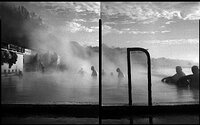
David was asking about the attached images, and the quality in terms of tones, sharpness etc.

Ian

Looks acceptable to my eye. My students just developed all their film at 1+3 for 18 minutes (EI 200) and they look very nice. Not as sharp as Pyrocat, though.
 
They look, if not identical, very similar. It strengthens my belief that the choice of developer has nothing to do with making a good picture.
It does have something to do with safety and comfort to those who develop allergic reactions to metol.
 
It does have something to do with safety and comfort to those who develop allergic reactions to metol.
Yes, for those worried about health and environment, Xtol would be the obvious choice. Pyrocat and Rodinal are downright poisonous. D-76 and HC-110 a little bit less so, but still not good. I would recommend everybody to be careful and treat also Xtol as a chemical, but it is quite harmless.
 
Yes, for those worried about health and environment, Xtol would be the obvious choice. Pyrocat and Rodinal are downright poisonous. D-76 and HC-110 a little bit less so, but still not good. I would recommend everybody to be careful and treat also Xtol as a chemical, but it is quite harmless.

There's far worse household items in everyday use in kitchens, bathrooms, etc, there needs to be more realism.

Ian
 
Uh, Metol might not be the most benign stuff on earth, but Catechol is definitely one of the nastiest developing agents used. It's not that it can't be used safely, but should definitely be treated accordingly.
 
Uh, Metol might not be the most benign stuff on earth, but Catechol is definitely one of the nastiest developing agents used. It's not that it can't be used safely, but should definitely be treated accordingly.

But then stop bath is dangerous when concentrated, so is house-hold Sodium Hypochlorite based bleach, oven cleaners it's a long list.

It's the mixing Pyrocatechin developers from raw chemicals that's potentially the most hazardous, once in use it's not going to hurt you unless you constantly get it on your skin and don't wash it off immediately. I wouldn't use it for a print developer where I do immerse my fingers sometimes (PQ not MQ) but I do use it in IT-8 toner as the paper's redeveloper with tongues,

Ian
 
Ian, isn't Q rather nasty stuff to be putting your fingers in? Isn't Q related (closely?) to pyrogallol and catechol? They're all benzene rings (?) and those are quite nasty. However, I agree that there are many things in our normal life that aren't good and we should be careful of them all.
 
Just because a compound has a benzene ring, it doesn't mean that it is inherently very hazardous; phenidone has a benzene ring too, but is much less toxic. For the record, hydroquinone and Catechol are isomers, the position of a hydroxyl group is the difference between them.
 
Just because a compound has a benzene ring, it doesn't mean that it is inherently very hazardous; phenidone has a benzene ring too, but is much less toxic. For the record, hydroquinone and Catechol are isomers, the position of a hydroxyl group is the difference between them.

Well, you lost me, I am not a chemist. If you say that a benzene ring can be less hazardous that I assume, I will take your word for it.
 
Well, you lost me, I am not a chemist. If you say that a benzene ring can be less hazardous that I assume, I will take your word for it.
Take sodium benzoate for example. It's a very common food preservative, your soft drink might have a small amount of it.

PS I'm not a chemist either.
 
Ian, isn't Q rather nasty stuff to be putting your fingers in? Isn't Q related (closely?) to pyrogallol and catechol? They're all benzene rings (?) and those are quite nasty. However, I agree that there are many things in our normal life that aren't good and we should be careful of them all.

Lots of things are nasty, Coke will dissolve your teeth, it's about realism. I use tongs in the darkroom when printing but at times particularly with large prints prefer to use fingers which get rinsed well immediately after.

I ran a lab, I had to do the COSSH assessments, that's risk analysis and putting correct safety procedures in place and we dealt with chemicals far more hazardous than the average photographer will use, so I have confidence in my comments. Everything we use has an MSDS (data-sheet) which should be read. I have grave concerns that many household products don't carry sufficient warnings and they are being used by people with in general no chemical knowledge, particularly in relation to their own safety.

Ian
 
Photrio.com contains affiliate links to products. We may receive a commission for purchases made through these links.
To read our full affiliate disclosure statement please click Here.

PHOTRIO PARTNERS EQUALLY FUNDING OUR COMMUNITY:


Ilford ADOX Freestyle Photographic Stearman Press Weldon Color Lab Blue Moon Camera & Machine
Top Bottom
