• Welcome to Photrio!
    Registration is fast and free. Join today to unlock search, see fewer ads, and access all forum features.
    Click here to sign up
Resource icon

Converting C-41/E-6 BLIX into Separate Bleach and Fixer

Cool as Ice

A
Cool as Ice

  • 0
  • 0
  • 22
Pond

H
Pond

  • 2
  • 0
  • 47

Recent Classifieds

Forum statistics

Threads
202,701
Messages
2,844,450
Members
101,478
Latest member
The Count
Recent bookmarks
0
Rudi, if you look at the left column of chemistry in the reference you give it is for C41, but the right column is for RA4 or what is often called Ektacolor.

PE
 
Separate bleach and fix need only one concentrate per bath, whereas BLIX usually needs two concentrates. The image on that Unique Photo site looks very much like the set of concentrates to make BLIX (one bottle containing a deep red liquid, the other bottle looks mostly colorless), whereas the same page states "bleach" all over the place.

It has been a while since I mixed any Bleach III but am fairly certain it consisted of a Part A and Part B, so two parts on the Unique site for the bleach they show may be correct.
 
My Bleach III came as a one parter that is used as is with no dilution. So, there is no real "normal" for any of these kits.

PE
 
Actually mine was Bleach III Replenisher, in a 12.5 gallon size so that may have had something to do with it. It was given to me by a lab when they stopped processing film.
 
If you look at the MSDS for Kodak's bleach III concentrates for higher volume, you will quickly see that they separated oxidizer (Ammonium Ferric PDTA) and counter anion (Ammonium Bromide) into two separate concentrates. The same thing seems to be the case with their bleach iii replenisher, which again comes as part A and part B.
 
Hi, diggin this up again to find out if Acetic acid based KOdak indicator stop batch can be used as the acid in getting the PH level correct. Or can I ise sulfiric since I have gallons of it.


From a different thread:
Acids lower pH of any solution. They're acids... :wink:

Sulphuric acid is mentioned on page 31 of the document at http://motion.kodak.com/motion/uploa...h247_h2407.pdf. It's the main ingredient of the stop bath, yes.

EDIT: Sulphuric acid is also mentioned as the recommended substance to adjust the pH of almost all other bathes.
 
Yes, both Acetic Acid and Sulphuric Acid will both work for lowering pH, and Kodak Indicator Stop Bath consists mostly of Acetic Acid and some (photographically irrelevant) pH indicator dye. Watch out, though, both can be quite concentrated, so be careful when adjusting pH with them, maybe work with diluted versions.
 
Thanks as always, PE. You're incredibly generous to share your knowledge and experience for all of us here.

A few more questions, if I may impose: apart from using the correct CD agent and using a formalin based stabilizer, is the pH of the bleach and fix baths the most important consideration for "archival" E6 processing? How well buffered is TF-5, if I use it to its stated capacity of 20 rolls per gallon working solution, will its pH stay in the acceptable range for E6? Am I making significant compromises in archival qualities of a film by converting a 3-bath kit to separate bleach and fix instead of sending the film to a lab?
 
Am I making significant compromises in archival qualities of a film by converting a 3-bath kit to separate bleach and fix instead of sending the film to a lab?

You basically shift risk from external sources to yourself. I have read stories about labs messing up whole batches of film, while other people report nothing but praise for excellent lab work. Likewise we have all messed some batches of film at home, while delivering great work on other occasions.

If you do the BLIX--->bleach&fix conversion correctly, and properly use FD, CD and STAB, there is absolutely no reason why your slides/negs shouldn't come out archivally stable.
 
Iandvaag, the pH is critical, all else being correct (CD, bleach, fix, wash etc...). That is why TF-4 is not suitable. It is alkaline. It would probably do something bad to the dyes. As long as the pH is between 5 and 6.5, as a good working range, things should be OK. Below or above that and you have problems.

PE
 
Iandvaag, the pH is critical, all else being correct (CD, bleach, fix, wash etc...). That is why TF-4 is not suitable. It is alkaline. It would probably do something bad to the dyes. As long as the pH is between 5 and 6.5, as a good working range, things should be OK. Below or above that and you have problems.

PE
The C41RA fixer with thiocyanate seems to be around ph=7.1. I wonder if it is designed to depend on retained bleach along with the short fixing time, if that is too high a pH normally? Now I wonder if it would be bad to add a wash step after the bleach
 
My instructions do have a wash after the bleach, but the bleach and fix have changed. See the Kodak web site for up to date info.

PE
 
I was originally asking about E6, so I assume that a neutral fix maintained in the range of pH 5 - 6.5 such as TF-5 would be suitable for E6. However I do process my own C-41 and would be interested to understand this a bit better.

I must admit, I find the Kodak website rather confusing. There are several different C-41 process for a variety of processing styles. I'm pretty sure that my method of processing in a small tank in a tempered water bath is an "off-label" use. Some methods have a wash between bleach and fix, others do not. What method listed by Kodak is closest to processing in a small developing tank in tempered water bath: sink-line processing or rotary tube processing?
 
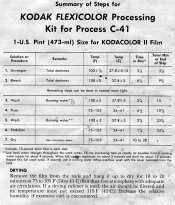
Here is the C41 process I use. I sometimes use a 2% stop after the CD and before the bleach. It depends on film/solution volume and thus pour time.

E6 requirements for pH range are the same as for C41, as the dyes formed are of the same classes of chemicals.

I run the final wash until the water runs clear and leaves no stain in the final rinse.

PE
 

Attachments

  • C41 process.jpg
    C41 process.jpg
    286.3 KB · Views: 271
This has been a great thread! Thanks everyone who has contributed. I kind of got lost though and have chemicals coming so I wanted a little clarification.
I have the Tetenal Colortec C-41, potassium bromide, indicator stop bath (with acetic acid), sodium sulfate, and TF-5 fixer on the way. These are the correct ingredients right?

I am mixing the BX part one with potassium bromide to get a pH of 5.5 for the bleach. If I need to adjust can I use the stop bath with the acetic acid to bring it down?
I can use the stop bath and sodium sulfate to make a clearing bath correct? What pH am I looking for?

I just saw the chart with C41 times. Thank you PE! That is really helpful.
I have been doing C41 for a while and I noticed that every kit gives you adjusted times for the more rolls that are processed with the chemicals. Since the bleach and fix are separate in this process do they exhaust as quickly? Do I need to adjust bleaching times as often? Are there hints I can be keying on in development to see bleach exhaustion?
 
There is a complete chart on times vs usage on the EK web site under C41 processing.

I don't have the reference though.

Bleach can be regenerated using methods posted here on APUG.

PE
 
I have the Tetenal Colortec C-41, potassium bromide, indicator stop bath (with acetic acid), sodium sulfate, and TF-5 fixer on the way. These are the correct ingredients right?
You should use Sodium Sulfite (=Na2SO3), not Sodium Sulfate (=Na2SO4).
I am mixing the BX part one with potassium bromide to get a pH of 5.5 for the bleach. If I need to adjust can I use the stop bath with the acetic acid to bring it down?
Yes, that should work.

I can use the stop bath and sodium sulfate to make a clearing bath correct? What pH am I looking for?
Again, you want Sodium Sulfite (=Na2SO3), not Sodium Sulfate (=Na2SO4). pH should be low for proper stopping action, but not too low, since too low pH will liberate nasty Sulfur Dioxide from Sodium Sulfite. Ideally you'd start with a solution of about 10 g/l Sodium Sulfite, to which you slowly, and with good stirring add indicator stop bath. The resulting mixture should be purple at first, and you should stop adding stop bath just when it turns yellow. If you are unsure, test this with a few very small batches first, then upscale your final procedure.

I have been doing C41 for a while and I noticed that every kit gives you adjusted times for the more rolls that are processed with the chemicals. Since the bleach and fix are separate in this process do they exhaust as quickly? Do I need to adjust bleaching times as often? Are there hints I can be keying on in development to see bleach exhaustion?
Bleach and fixer times should be extended as you reuse your bleach and fixer, but not nearly by as much as you have to with Tetenal's BLIX. Here are bleach and fixer times I would recommend, assuming you start with 500ml for each liquid and process rolls of 135 or 120 film:

films 1-2: bleach 6 minutes, fix 4 minutes
films 3-5: bleach 7 minutes, fix 5 minutes
films 6-8: bleach 8 minutes, fix 5 minutes
These times should be on the safe side. As mentioned before, longer times won't hurt, but too short times will give you incomplete silver removal and a lack of archival stability.
 
Rudeofus thank you! sulfIte not sulfAte. I would have definitely used the wrong stuff.
Great information I really appreciate it. This has been extremely helpful.
 
There is a complete chart on times vs usage on the EK web site under C41 processing
PE:
All of those reference materials on the Eastman Kodak website have been removed, save for some that are in reference to cine materials. There are still links, but they go nowhere.
Kodak Alaris has a number of those previously Eastman Kodak materials now listed on their site. Others (eg the Z manuals) are in the process of being added. But many, many of the reference materials (such as for discontinued films and papers) appear to be gone.
Here is the link for those reference materials that are available from Kodak Alaris: http://imaging.kodakalaris.com/professional-photographers/techenvironment
 
Photrio.com contains affiliate links to products. We may receive a commission for purchases made through these links.
To read our full affiliate disclosure statement please click Here.

PHOTRIO PARTNERS EQUALLY FUNDING OUR COMMUNITY:



Ilford ADOX Freestyle Photographic Stearman Press Weldon Color Lab Blue Moon Camera & Machine
Top Bottom