• Welcome to Photrio!
    Registration is fast and free. Join today to unlock search, see fewer ads, and access all forum features.
    Click here to sign up

Circle of confusion

.

A
.

  • 2
  • 1
  • 17

Recent Classifieds

Forum statistics

Threads
203,557
Messages
2,856,512
Members
101,904
Latest member
Melissa.cat.smith
Recent bookmarks
0

Photoemulator

Member
Allowing Ads
Joined
Aug 13, 2025
Messages
19
Location
Washington DC
Format
4x5 Format
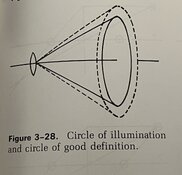
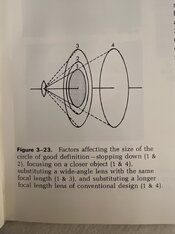
I was aware of the idea of an image circle of lens and how they cover the format of desire. But the Stroebel book “View Camera Technique” 5th edition, has this (new to me) idea of “circle of good definition” which is not the same circle of coverage because it is likely smaller than coverage. Now, that makes sense. But I never considered it before it was mentioned. But what is meant by the second image, “substituting a longer focal length of conventional design”?
 

Attachments

  • IMG_8813.jpeg
    IMG_8813.jpeg
    304.8 KB · Views: 39
  • image.jpg
    image.jpg
    344.7 KB · Views: 36
I was aware of the idea of an image circle of lens and how they cover the format of desire. But the Stroebel book “View Camera Technique” 5th edition, has this (new to me) idea of “circle of good definition” which is not the same circle of coverage because it is likely smaller than coverage. Now, that makes sense. But I never considered it before it was mentioned. But what is meant by the second image, “substituting a longer focal length of conventional design”?

He means substituting a longer focal length lens that is not a telephoto design.
 
Generally speaking, the longer the FL of the lens, the larger both the Circle of Good Definition, and the 'Circle of Illumination' both get.

What is not apparent is what is a lens of 'conventional design' vs. a lens of 'unconventional' design! I have Stroebel's book, and the 'unconventional' does not seem to be given a definition.

What is also not apparent is if the 'Image Circle' commonly defined in lens specs is what Stroebel calls the 'Circle of Good Definition' or the 'Circle of Illumination'.

...a bit of 'literary license'?!

I found this definition for 'Image Circle': "An image circle is the circular, light-projected area a lens creates on an image plane (sensor or film). It defines the maximum area of acceptable image quality, usually covering the diagonal of the sensor to prevent dark, vignetted corners. And so it seems that the common 'Image Circle' is Stroebel's 'Circle of Good Definition'
 
Last edited:
I think it refers to a "standard" lens design, not retro focus or telephoto, etc.

In other words, the focal length is indeed the distance from the lens to the film plane when focused, not closer or farther.
 
Generally speaking, the longer the FL of the lens, the larger both the Circle of Good Definition, and the 'Circle of Illumination' both get.

What is not apparent is what is a lens of 'conventional design' vs. a lens of 'unconventional' design! I have Stroebel's book, and the 'unconventional' does not seem to be given a definition.

What is also not apparent is if the 'Image Circle' commonly defined in lens specs is what Stroebel calls the 'Circle of Good Definition' or the 'Circle of Illumination'.

...a bit of 'literary license'?!

I found this definition for 'Image Circle': "An image circle is the circular, light-projected area a lens creates on an image plane (sensor or film). It defines the maximum area of acceptable image quality, usually covering the diagonal of the sensor to prevent dark, vignetted corners. And so it seems that the common 'Image Circle' is Stroebel's 'Circle of Good Definition'

The text for the illustration does give an explanation that by inference you can determine that a conventional lens is neither a wide angle nor a telephoto design. This is from the 3rd edition, so when it says Figure 99 it is the same figure as 3-23 above).

Scan_20260424.jpg
 
Stroebel seems to be referring to non-wide angle or telephoto lens designs when he uses the term "conventional." That would include things like Plasmats and Tessars, et al.

But, let's clear up the confusion about "circles of this and that." The "circle of good definition" is the part of the image circle that is free of optical aberrations and distortions from the lens design. The entire image circle being the "circle of illumination". For many lenses, the extreme outer parts of the projected image circle are not sharp. Older Tessars nave this characteristic. Many more modern lenses, like newer Plasmats, have mechanical vignetting built in to eliminate the outer edge of the possible image circle and restrict it to just the "good definition" part. FWIW, I have to be careful with my older Tessars and Ektars to make sure I don't place objects that need good definition at the edge of the circle of illumination. Open sky is fine though.

The "circle of confusion" is something else entirely. When a point is focused on the film, it is rendered close enough to a point that we see it as sharp. When that point is gradually moved out of sharp focus, that point becomes larger. It moves one way or other along the projected cone of light coming from the lens, so it is really a perpendicular conical section, i.e., a circle (barring aberrations from the lens). If that circle stays small enough that we can't distinguish it from the perfectly focused point, then we still see it as sharp. But, when it gets large enough, we begin to see softness, or perceive it as out of focus. It is this growing circle that is the "circle of confusion" and it's size on the film and in the final print determine what is perceived as sharp or unsharp.

Best,

Doremus
 
"Circle of confusion" is a confusing concept based upon presumptions about image magnification and viewing distance. It might make sense in pictures reproduced in books or magazines meant for typical reading distance. Otherwise, it's just another Alice in Wonderland rabbit hole leading to endless nitpicky controversy.

With old time lenses, which were not yet fully corrected for different wavelengths, you might get a peripheral ghost image fringing over a sharper wavelength impression for which the lens is better corrected. Or that might be due to spherical aberration. Some images might benefit from that kind of old-timey look, but not others. Sometimes portrait pros want a less harsh look with more "rounded edges" - hence certain modern lenses factor that into their design. But that should not be confused with "soft focus" lenses or filters.
 
The "circle of confusion" is a personal choice because it depends on different factors, as Drew mentioned. Likewise, "image circle", "circle of illumination" and "circle of good definition" are too. The manufacturers list them according to their preferences. Light fall-off starts at one degree away from the axis. At what point does it make a difference? You decide. I bet it's not the same as the lens maker.
 
Graphics reproduction standards for lenses are much stricter. In those cases, the rated area of coverage for a lens is apt to be rated much more conservatively than for a general photography. Same with the definition of "apo", which was much stricter for the color printing trade (pre-scanning days) than for general camera lens marketing purposes.
 
When does a lens become an achromat becomes a apochromat.

When does a lens become a close-up becomes a macro becomes a micro.

When does a lens become a coated lens becomes a multi-coated lens.

There are no legal definitions.
 
Oh, there were once patent distinctions behind the terminology. But over time some of that morphed into marketing jargon.
 
By the way, what CoC size "should" be used?

That's the million dollar question, and why it's up to you. The smaller you make it, the less DOF you have, and the larger you make it, the more DOF you have. But not really. The DOF is always the same. It's merely what you consider IN focus or OUT of focus. And that depends on a lot of things. The farther away you are from a print, the more in focus it looks. It also depends on how much you enlarge the image. The bigger the print, the more out of focus it will appear -- if you stand at the same distance. And since a 35mm negative is enlarged much more than a 4x5" negative to make the same sized print, the CoC needs to be smaller for the smaller negative to compensate.
 
This DOF app allows you to set the Circle of Confusion size to determine DOF if you don;t like the lens manufacturer's CoC size selection. Click on Advanced Options.

By the way, what CoC size "should" be used?

https://www.pointsinfocus.com/tools/depth-of-field-and-equivalent-lens-calculator/#{%22c%22:[{%22f%22:13,%22av%22:%2216%22,%22fl%22:150,%22d%22:7498,%22cm%22:%220%22,%22sf%22:%221%22}],%22m%22:0}
xkaes summarized the nature of the issue. For the solution...

The CofC calculator available by Cambridge Color permits you to choose 'standard manufacturer' value (which is not as good as what an optometrist aims to accomplish in correcting vision) vs choosing 20/20 vision standard, and permits you to specify both the print size and the print viewing distant, to meet your expectations, as well as specifying shooting format.

 
By the way, what CoC size "should" be used?
The calculations for CoC in a print are based on average resolution of the human eye (i.e., at what point does a CoC in a print begin to look blurred instead of like a point) and an assumed average viewing distance from the print. Both of these are somewhat arbitrary, but not completely, and can be adjusted if you don't agree with the set parameters e.g., if you want to set the CoC for a closer viewing distance, etc.

Then, you simply calculate back using enlargement ratio to find the necessary size of the CoC on the film to deliver a CoC on the print that is at, or smaller than, the desired limit. This value would then be used to determine DoF. Lots of math, but not rocket science - quite.

Best,

Doremus
 
One won't get many shots to begin with if they're always futzing around trying to figure out the math involved. That's more like standing in the middle of a "circle of confusion".

But it's all married to that matching "normal viewing distance" nonsense. Unless you're a book publisher or an outdoor ad/billboard marketeer, those are the kind of stretchy "rules" best ignored.
 
The COGD (circle of good definition) is smaller than the COI (circle of illumination). The COI doesn’t get larger by stopping down. But doing so increases the good definition radially outward as defined by the lens maker through testing. It also results in more even illumination out to the periphery of the COGD.

Nikon and other lens large format lens makers generally give two image circle sizes:

1. Aperture wide open.

2. Aperture closed to a practical limit, often f/22, but sometimes f/16 for certain 4” x 5” format lenses.

For example, consider the Nikkor-W 300 mm f/5.6 lens.

It states a wide-open image circle (infinity focus) of 346 mm diameter (60º coverage angle).

At f/22, this becomes 420 mm and the coverage angle expands to 70º.

https://www.mr-alvandi.com/downloads/large-format/nikon-large-format-lenses.pdf

An example of “substituting a longer focal length of conventional design” is the following:

Instead use a Nikkor-W 360 mm f/6.5 lens. This lens is essentially identical, except tfor the longer focal length.

The wide-open f/6.5 coverage is 415 mm diameter, 60º coverage angle.

The f/22 coverage is 494 mm, and the coverage is only marginally less at 69º.

Assuming the same format in both cases, the longer lens (now farther from the film) has greater coverage of the film. This gives a larger projected circle—including the circle of good definition.

 
Last edited:
As if we always know what size print(s) we will make when we take the shot.
I certainly know the largest size print I can practically make without degradation from diffraction or out-of-focus points. I'll note in my exposure log "no larger than 11x14" for example. I don't make larger than 20x24 though.

And, of course, one can always enlarge more for certain applications, like mural prints or billboards or whatever, for which the viewing distance will usually be greater than in a gallery or home display setting. Or, one can compromise and accept some degree of softness in a trade-off for size if that seems a good expressive choice. For gallery prints, I like viewers to get right up close, so I strive for sharpness in the print at 10-12 inches viewing distance. In order to do that, I'm using a pretty small CoC on 4x5 film to use in my calculations of DoF/diffraction. I use the method described on the LF home page (which is still up despite the forum being compromised lately) in the article on how to choose the f-stop.

And, one further thought about how large to make a print. Even if you don't know how large you want to print an image when you make the negative, if you make a large print, and it's too soft, for whatever reason, and you don't like that, then you discard it and print smaller or not at all.

Best,

Doremus
 
...

An example of “substituting a longer focal length of conventional design” is the following:

Instead use a Nikkor-W 360 mm f/6.5 lens. This lens is essentially identical, except tfor the longer focal length.

The wide-open f/6.5 coverage is 415 mm diameter, 60º coverage angle.

The f/22 coverage is 494 mm, and the coverage is only marginally less at 69º.

Assuming the same format in both cases, the longer lens (now farther from the film) has greater coverage of the film. This gives a larger projected circle—including the circle of good definition.
The inherent issues with using a longer lens for a particular shot than the one you've composed with and chosen a camera position for are that you either end up not moving the camera and cropping the original image, or moving the camera to a different location to approximate the extent of the original image and altering the perspective and the near-far relationships in the original view. This simply results in a different image. The compromise might be worth it, heck, the new image might even be better, but it's not going to be the same as if you had made the original image and substituted a lens of the same focal length with a larger circle of good definition.

We have to make these kind of compromises often in the field. I seem to always end up imagining an image that ends up being impossible to make and keep everything in my desired DoF. So I'll re-imagine and maybe find a good image that's more practical. Still, it's not the same...

Best,

Doremus
 
For those of us with a background in more perilous kinds of "landscape" photography, just moving in closer with a shorter lens might mean walking off a cliff, or trying to levitate in the middle of a profoundly deep chasm. Now, when people do that kind of thing, they simply walk off the cliff backwards, taking a suicidal "selfie" with their phone. Happens rather frequently at the Grand Canyon and Yosemite : the annual Darwin's Awards.

But in more common situations, detecting a lovely perspective from a distance rarely pans out in the same manner if you change your position. With large format photography in particular, especially 8x10, learning plane of focus management with respect to effective composition is the name of the game. I won't elaborate on that at the moment ... gotta print one such image this afternoon, which did involve a precarious 8X10 setup on the side of a cliff. It was the exact spot, or nothing.
 
I certainly know the largest size print I can practically make without degradation from diffraction or out-of-focus points. I'll note in my exposure log "no larger than 11x14" for example. I don't make larger than 20x24 though.

And there's one more confounder in this formula -- for me anyway. I've never met a negative I didn't want to crop. For me, taking the picture is just the start.
 
Photrio.com contains affiliate links to products. We may receive a commission for purchases made through these links.
To read our full affiliate disclosure statement please click Here.

PHOTRIO PARTNERS EQUALLY FUNDING OUR COMMUNITY:


Ilford ADOX Freestyle Photographic Stearman Press Weldon Color Lab Blue Moon Camera & Machine
Top Bottom