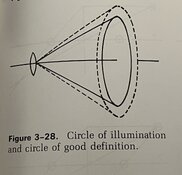
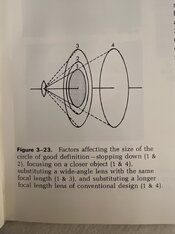
The COGD (circle of good definition) is smaller than the COI (circle of illumination). The COI doesn’t get larger by stopping down. But doing so increases the good definition radially outward as defined by the lens maker through testing. It also results in more even illumination out to the periphery of the COGD.
Nikon and other lens large format lens makers generally give two image circle sizes:
1. Aperture wide open.
2. Aperture closed to a practical limit, often f/22, but sometimes f/16 for certain 4” x 5” format lenses.
For example, consider the Nikkor-W 300 mm f/5.6 lens.
It states a wide-open image circle (infinity focus) of 346 mm diameter (60º coverage angle).
At f/22, this becomes 420 mm and the coverage angle expands to 70º.
https://www.mr-alvandi.com/downloads/large-format/nikon-large-format-lenses.pdf
An example of “substituting a longer focal length of conventional design” is the following:
Instead use a Nikkor-W 360 mm f/6.5 lens. This lens is essentially identical, except tfor the longer focal length.
The wide-open f/6.5 coverage is 415 mm diameter, 60º coverage angle.
The f/22 coverage is 494 mm, and the coverage is only marginally less at 69º.
Assuming the same format in both cases, the longer lens (now farther from the film) has greater coverage of the film. This gives a larger projected circle—including the circle of good definition.