• Welcome to Photrio!
    Registration is fast and free. Join today to unlock search, see fewer ads, and access all forum features.
    Click here to sign up

Calibrating Zone System to Grade 3?

Do Not Come Here

A
Do Not Come Here

  • 2
  • 1
  • 23
Heavy

H
Heavy

  • 9
  • 5
  • 94

Recent Classifieds

Forum statistics

Threads
201,921
Messages
2,832,056
Members
101,018
Latest member
andycapp
Recent bookmarks
1

Jarin Blaschke

Member
Allowing Ads
Joined
May 30, 2013
Messages
378
Location
London and wherever
Format
Multi Format
Hi all:

I have acquired a new camera (RZ67) and am beginning the process of getting used to the camera, calibrating and finding my new 'system' of working. Before, I used a pretty loose system, as my shooting was often roving portraiture, spontaneous, and I was using roll film where not every exposure was finely controlled: I shot my black and white film about 2/3 stop "slower" than the manufacturer's rating, and came to find a developing time that gave a negative that preserved all the values, especially the highlights, and I used dilute developers with "semi-stand" development. Anyway, it was a fail proof method to wander the city at night, or day, or go to Madagascar or Uganda or wherever and always have a negative that I could print well.

I'm looking for a bit more control now, for most of my work anyway, and my image priorities have changed. 20 years ago when I was starting, I was obsessed with grain. Then for a long time, I was after the sharpest images I could, using Rodinal and then Dixactol with Ilford Delta films. My Semi-stand development then would give edge effects furthering this end. I still want a very sharp image, but my priority now is tonality, then sharpness, with grain at 3rd place and really only objectionable if it's quite large. I'm now after the more subjective, nuanced aspects of the image. For more control and image "dimentionality" I've decided to switch to FP4 and HP5 and have been experimenting with WD2D+. I've very much liked what I've seen with FP4 especially. A very 'liquid' look that I love.

Part of my current intention is to really know my materials much more and exercise tighter control, as I now make plenty of work that isn't found portraiture. I've taken up use of a spot meter and have started identifying and placing zones when I shoot. For the first time I intend to go through and calibrate my methods to the zone system. For the first time, I'll know the real working speed of my film as I use it! I'm testing the workflow with my previously informally-used Rodinal, Dixactol and WD2D+, but will likely settle on one of the staining developers. Anyway, to finally get to my question, is there a difference in final tonality or otherwise if I calibrate my workflow to a paper grade of 3 instead of 2? Would I somehow miss out on what the film can offer, as I'm thus using less of the full scale that it can deliver? Any other drawbacks?

The reason I am pursuing a grade 3 pipeline is that there will still be times when I will go away on a 3rd world adventure and cannot control every exposure as well as I normally could, and want to have some safety built into the softer negative. However, with the same system I would like continuity with what I otherwise produce. I print with Ansco 130 and so one thought is to split some of the difference with tweaking the formula: less hydroquinone and perhaps more metal and glycin, effectively calibrating to a grade 2.5 or 2.75.

Thanks!

Jarin
 

David A. Goldfarb

Moderator
Moderator
Allowing Ads
Joined
Sep 7, 2002
Messages
20,021
Location
Honolulu, HI
Format
Large Format
In general, a thinner negative will give you a little finer grain and better acutance, so that's an advantage to targeting to grade 3, and some 35mm photographers do this as a matter of course.

The question might be, given your process, is it easier for you to get more contrast or less contrast from a neg that doesn't quite hit the target. If it's easier to get more contrast, then it would be better to target to grade 2.

With modern VC paper, it probably doesn't matter. If you prefer graded paper, it may depend on the paper grades available to you.

Also, bear in mind that more modern papers are designed to give very consistent results in a variety of developers, which means that developer controls are less effective, and if you want to use those methods, you might try experimenting with more old tech papers like Slavich.
 

ic-racer

Member
Joined
Feb 25, 2007
Messages
16,735
Location
USA
Format
Multi Format
In terms of control, I favor multigrade paper and a variable color head.
In terms of calibrating to Grade 3. This is achieved when using Grade 3 paper for your Zone 8 development time test. That is, use Grade 3 paper when you are making your test print to see which of your Zone 8 negatives (processed to different development times) gives you a print where Zone 8 is "just off white".
 

markbarendt

Member
Allowing Ads
Joined
May 18, 2008
Messages
9,422
Location
Beaverton, OR
Format
Multi Format
I'm now after the more subjective, nuanced aspects of the image. For more control and image "dimentionality" I've decided to switch to FP4 and HP5 and have been experimenting with WD2D+.

I enjoy these films.

is there a difference in final tonality or otherwise if I calibrate my workflow to a paper grade of 3 instead of 2?

Probably little if any.

Would I somehow miss out on what the film can offer,

Probably not, nor should there be a big gain.

as I'm thus using less of the full scale that it can deliver?

The final photo is a dance between the film and paper curves. Make one steeper the other needs to be flatter. The same amount is printed either way.
 

Mainecoonmaniac

Member
Allowing Ads
Joined
Dec 10, 2009
Messages
6,297
Format
Multi Format
Grade 2 goal

If it's easier to get more contrast, then it would be better to target to grade 2.

With modern VC paper, it probably doesn't matter. If you prefer graded paper, it may depend on the paper grades available to you.

I use VC paper and I admire old timers that soup their film for grade2 paper. I'm not a slave to the zone system and my negs are sometimes are printed on grade 3. I do strive to process film for grade 2. I'm wondering if doing N+ and N- film processing is to match contrast range is necessary with VC paper?
 

David A. Goldfarb

Moderator
Moderator
Allowing Ads
Joined
Sep 7, 2002
Messages
20,021
Location
Honolulu, HI
Format
Large Format
I like graded papers, but even with VC papers, I think you can do more with a neg that's adequately exposed and developed to print at a middle grade.
 
OP
OP
Jarin Blaschke

Jarin Blaschke

Member
Allowing Ads
Joined
May 30, 2013
Messages
378
Location
London and wherever
Format
Multi Format
So no disadvantage to calibrate to grade 3 then? David - What graded papers are left at this point, save Galerie and maybe Fotokemika or some other dubious eastern European brand? Unless you contact print big negs on Lodima? Seagull graded is gone, so is Kentmere Bromide, Forte, Bergger...

I really tried graded paper at several points, but I liked the ability to tweak a quarter grade here or there with a color head. I gave Gallerie (seemingly the only real graded option now) another shot some months ago, finding that it unattractively split toned in Selenium, unless I toned to completion, which was much too brown to my taste. Also, My attempts to tweak contrast in the chemistry (Ansco 130) was also largely unsuccessful - adding contrast with hydroquinone actually slowed down development significantly. Weird.

Jarin
 

David A. Goldfarb

Moderator
Moderator
Allowing Ads
Joined
Sep 7, 2002
Messages
20,021
Location
Honolulu, HI
Format
Large Format
I think we've got Galerie, Slavich, and Lodima left among graded papers, and I do contact print big negs. I've got a stash of Efke and Azo still as well as some very old Haloid paper and a few sheets of Structura Classic. Efke Emaks is beautiful paper, which was sold in the US as Cachet Expo at one time. I've seen great prints on Slavich paper, but haven't tried it myself yet.

Those "dubious" East European papers are your best bet for toning and developer effects. Ilford is impervious, which has its pluses (rock solid consistency) and minuses (fewer creative options).
 

David A. Goldfarb

Moderator
Moderator
Allowing Ads
Joined
Sep 7, 2002
Messages
20,021
Location
Honolulu, HI
Format
Large Format
Freestyle was importing Slavich.

I'm getting used to 80F film processing here in Honolulu.
 

ic-racer

Member
Joined
Feb 25, 2007
Messages
16,735
Location
USA
Format
Multi Format
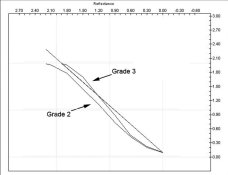
Not much to gain or lose by favoring Grade 3. Here are Grade 2 and Grade 3 tone reproduction curves posted by Stephen Benskin a while back.

tonereproduction.jpg
 

Old-N-Feeble

Member
Allowing Ads
Joined
Feb 22, 2012
Messages
6,805
Location
South Texas
Format
Multi Format
My experience with printing on grade 3 Ilford Gallery DW fiber is I preferred the local contrast vs. grade 2.
 

Jim Noel

Member
Allowing Ads
Joined
Mar 6, 2005
Messages
2,261
Format
Large Format
It makes sense to calibrate for Zone 3. If you want to see the works of an excellent photographer who does so, look at the work of Huntington Witherill.
 

Mainecoonmaniac

Member
Allowing Ads
Joined
Dec 10, 2009
Messages
6,297
Format
Multi Format
So for folks that calibrate for zone III and use VC paper, I would think you would have more wiggle room for split grade printing at the low contrast part of the paper.
 

markbarendt

Member
Allowing Ads
Joined
May 18, 2008
Messages
9,422
Location
Beaverton, OR
Format
Multi Format
Not much to gain or lose by favoring Grade 3. Here are Grade 2 and Grade 3 tone reproduction curves posted by Stephen Benskin a while back.

View attachment 94194

I assume the curve represents the results from a single (common) negative calibrated to grade 2, rather than two negatives with one calibrated to each paper grade. If it were the latter case then the illustrated curves should (nearly) match.

My experience with printing on grade 3 Ilford Gallery DW fiber is I preferred the local contrast vs. grade 2.

Sounds like you are calibrated to grade 3 Ilford Gallery DW fiber already. :wink:
 

ic-racer

Member
Joined
Feb 25, 2007
Messages
16,735
Location
USA
Format
Multi Format
I assume the curve represents the results from a single (common) negative calibrated to grade 2, rather than two negatives with one calibrated to each paper grade. If it were the latter case then the illustrated curves should (nearly) match.


Sounds like you are calibrated to grade 3 Ilford Gallery DW fiber already. :wink:

Sorry, I posted the wrong curve.
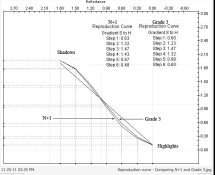
Correct curve from Stephen Benskin for my post above. Shows tone reproduction curve for same scene and two different negative developments (N and N+1) and two different grade paper (2 and 3) (Image Reference: (there was a url link here which no longer exists))

Gr3.jpg
 

markbarendt

Member
Allowing Ads
Joined
May 18, 2008
Messages
9,422
Location
Beaverton, OR
Format
Multi Format
Sorry, I posted the wrong curve.
Correct curve from Stephen Benskin for my post above. Shows tone reproduction curve for same scene and two different negative developments (N and N+1) and two different grade paper (2 and 3) (Image Reference: (there was a url link here which no longer exists))

View attachment 94259

That makes more sense.
 

Bill Burk

Subscriber
Allowing Ads
Joined
Feb 9, 2010
Messages
9,476
Format
4x5 Format
Jarin Blaschke,

I aim for between Grade 2 and Grade 3 Galerie, so that if I hit the target, it should print equally well on either grade. If I miss the exposure or development target, the negative will obviously need one over the other. I prefer the decisiveness this gives me.

I think the decision to aim for Grade 2, in-between or aiming for Grade 3 is a nuance. You're making a benchmark decision. It's as good as any.
 

David A. Goldfarb

Moderator
Moderator
Allowing Ads
Joined
Sep 7, 2002
Messages
20,021
Location
Honolulu, HI
Format
Large Format
The argument among the acutance geeks for targeting to G3 rather than G2 is that the thinner negative (say "N-1") that prints normally on G3 is inherently sharper and finer grained than the "N" neg that prints normally on G2. I haven't tested this myself, because I'm not too worried about maximizing sharpness with small formats (I'd rather just shoot a larger format), but Adams seems to adhere to this principle in The Negative by keeping the density for Zone I to a minimum over base+fog (0.1). This parsimonious approach leaves more room at the other end of the scale for expansion development as well, but I think Adams is also trying to produce the thinnest negative possible to achieve a range of tones that print well, in his case, at G2, because a thinner neg is sharper. If I were shooting Minox or more 35mm than I currently do, I'd worry about this more.
 

Bill Burk

Subscriber
Allowing Ads
Joined
Feb 9, 2010
Messages
9,476
Format
4x5 Format
You've heard lots of confirming advice (that there is no downside to aim for Grade 3).

Somebody needs to present the contrary position.

Allow me to play devil's advocate for William Mortensen. I still don't approve of his overall position. He claims that it is harmful to follow the traditional advice to "expose for the shadows and develop for the highlights." But reading his books recently has exposed me to his contrary position, and I can see a bit of value to what he is saying.

In light of what William Mortensen would say, you are going the wrong way when you make flatter negatives. You are reducing the tonal separation in the highlights. To his credit, I believe him when he says 99.9% of the interesting tones in a photograph, and where the eye is drawn, is in the light areas.

So when you make a flatter negative you are reducing the tonal separation.

I translate Zone System meter readings and development plans from the field, into Contrast Index terms for the darkroom. This gives me an easy way to compare the idea of aiming for Grade 2 and 3. You are talking about a relatively small difference between 0.62 Contrast Index (for N development plan, Grade 2 aim on a Diffusion Enlarger) and 0.52 Contrast Index (N aimed for Grade 3).

You're basically making a flatter negative than traditional Zone System aims. By my rough calculation it's about the same as calling for N-1 development time in an N metered situation. You are practically calling N-2 where others call N-1, etc. I don't personally like developing negatives as flat as 0.40 Contrast Index (But that is what you will do the day you shoot N-2). So when you get down into the long-scale subjects, you start to specify negatives which will have very little tonal separation.

To conclude my thought, in light of the possibility you might be making negatives that are too flat in some cases...

I think you will be fine to aim for Grade 3 at the upper end of the scale (Normal and expansion development N+1, N+2, etc.). I think the difference will be minor and will lead to improved sharpness and definition compared to traditional Grade 2 aim. Like David A. Goldfarb, I haven't tested the sharpness and definition claims of thinner negatives, but believe the writing.

But for N-1 and N-2 you might be better served to make higher contrast negatives. Plan for traditional Grade 2 aim when you are talking about contractions, to avoid losing too much tonal separation.
 

Old-N-Feeble

Member
Allowing Ads
Joined
Feb 22, 2012
Messages
6,805
Location
South Texas
Format
Multi Format
Apparently, Mr. Mortensen is/was unaware of the virtues of selenium toning negatives.:smile:
 

MartinP

Member
Allowing Ads
Joined
Jun 23, 2007
Messages
1,569
Location
Netherlands
Format
Medium Format
What graded papers are left at this point, save Galerie and maybe Fotokemika or some other dubious eastern European brand?

Fotokemika (aka. Efke) no longer exist as a photo-materials manufacturing concern. There may be a few old stocks here and there however.

Ilford Galerie is easily available in grades 2 and 3. Kentmere Bromide is easily available in grade 2. Foma Fomabrom is available in grades 1,2 and 3. Foma Fomalux (a silver-chloride paper) is easily available in one grade. Slavich seems to have availability problems in Europe (especially with the recent political problems) but is apparently still made.

There are also perhaps occasional special orders made by Harman with different characteristics for different resellers.
 
Photrio.com contains affiliate links to products. We may receive a commission for purchases made through these links.
To read our full affiliate disclosure statement please click Here.

PHOTRIO PARTNERS EQUALLY FUNDING OUR COMMUNITY:


Ilford ADOX Freestyle Photographic Stearman Press Weldon Color Lab Blue Moon Camera & Machine
Top Bottom