• Welcome to Photrio!
    Registration is fast and free. Join today to unlock search, see fewer ads, and access all forum features.
    Click here to sign up

Build: A calibrated white light sensitometer

Recent Classifieds

Forum statistics

Threads
202,907
Messages
2,847,375
Members
101,534
Latest member
michaelhfreeman
Recent bookmarks
0
I think the LCD would be great for it. Having seen ic-racer’s sensitometer shootout and seeing significant latent image degradation effects, I think marking timestamp is more critical than light source falling short of ideal.

A standalone edge stamper would be good too

Yes we thought about a 0.9 inch oled display board from aliexpress. It could show custom information.

1774025142002.png
 
You might remedy this by making the left and right walls out of mirrors, creating virtual LEDs to the left and right, without increasing the physical width of your box.

Thats a good idea and easy to try, ill order some small mirrors and try.
 
FYI, if you had not seen it, the ESECO uses a system like this. Multiple downward pointing LED and some diffusion sheet over the lightbox. Also note the light sensors for ensuring repeatable illumination.

Also, perhaps the 41 step wedge might not be worth the extra effort for such a large illumination stage?


Sensitometer Insides.JPG
 
Another sensitometer I haven't seen mentioned was the Photex 2B by Condit Manuf. About the same size as the Speedmaster ones. Was incredibly repeatable. Sold for $ 250 40 years ago. Haven't seen any on the used market. Worth keeping an eye out for one. When I was working with a $ 250K MTL Star sensitometer I did a crossover with the Photex so I essentially had a super calibrated $ 250 unit.
 
41 steps could be easily done by two different exposures through one 21 step scale (allow one overlapping step). Could even do shoulder, reversal and re-reversal studies by making several increasing exposures.
 
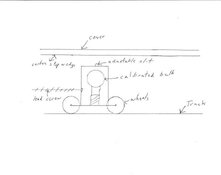
I also used a really cool table top model ( I don't remember the manufacturer) that looked like my crude drawing below. It was essentially a calibrated light bulb mounted to a chassis that was on wheels that rode back and forth on a track. The chassis was driven back and forth by a lead screw. An adjustable slit was mounted above the light source and traveled with the bulb chassis. A carbon step wedge was mounted above and a cover was above that. When actuated the bulb chassis would travel the length of the step wedge. Exposure time was adjuster by changing the slit width or speed of the lead screw.
 

Attachments

  • Scan 3 copy 2.jpeg
    Scan 3 copy 2.jpeg
    37.8 KB · Views: 6
Another sensitometer I haven't seen mentioned was the Photex 2B by Condit Manuf. About the same size as the Speedmaster ones. Was incredibly repeatable. Sold for $ 250 40 years ago. Haven't seen any on the used market. Worth keeping an eye out for one. When I was working with a $ 250K MTL Star sensitometer I did a crossover with the Photex so I essentially had a super calibrated $ 250 unit.

1774301981760.png
 
FYI, if you had not seen it, the ESECO uses a system like this. Multiple downward pointing LED and some diffusion sheet over the lightbox. Also note the light sensors for ensuring repeatable illumination.

Also, perhaps the 41 step wedge might not be worth the extra effort for such a large illumination stage?


View attachment 420812
Thanks for this image. Nice to see such things.

Well maybe, its just a personal preference of mine.
 
41 steps could be easily done by two different exposures through one 21 step scale (allow one overlapping step). Could even do shoulder, reversal and re-reversal studies by making several increasing exposures.

Maybe yes. I just build what I had in mind for some time, and it seems to work rather well. Its easy to work with and does what I want it to do :D
 
I also used a really cool table top model ( I don't remember the manufacturer) that looked like my crude drawing below. It was essentially a calibrated light bulb mounted to a chassis that was on wheels that rode back and forth on a track. The chassis was driven back and forth by a lead screw. An adjustable slit was mounted above the light source and traveled with the bulb chassis. A carbon step wedge was mounted above and a cover was above that. When actuated the bulb chassis would travel the length of the step wedge. Exposure time was adjuster by changing the slit width or speed of the lead screw.

That's great, I was thinking about such solutions too.
 
Yes. That's it.
I have seen this unit somewhere but couldn't remember the name. Thanks for the reminder. How did you guys perform calibration on your devices? I have ordered a Gossen Mavolux 5032B to measure surface illuminance of the glass.

1774302995617.png
 
Last edited:
I have seen this unit somewhere but couldn't remember the name. Thanks for the reminder. How did you guys perform calibration on your devices?

Sensitometers that I worked with that used a light bulb as the light source (MTL star, Kodak 1B Model 5, Kodak 101) all used calibrated bulbs where the spectral output was supplied by the manufacturer. Path length from the filliment to the step wedge was easily measured. Voltage was highly regulated and total operating time was logged by the machine . Exposure time (MTL and 1B model 5) was measured with a device that was a cylinder that had a photosensor on one ends and an optic on the other end that produced a one micron sampling size. This was attached to an oscilloscope. One of the mTLs also had a radiometer where each exposure could be compared to the calibration. As for flash tube models like the EG&G calibration was supplied by them and we also had an integrating radiometer to check multiple units at different facilities. Sensitometer crossovers were done between different facilities and agencies routinely. We did most of the calibration work for the Air Force and other govt. agencies. We also wrote their film analysis software.
 
Photrio.com contains affiliate links to products. We may receive a commission for purchases made through these links.
To read our full affiliate disclosure statement please click Here.

PHOTRIO PARTNERS EQUALLY FUNDING OUR COMMUNITY:



Ilford ADOX Freestyle Photographic Stearman Press Weldon Color Lab Blue Moon Camera & Machine
Top Bottom