• Welcome to Photrio!
    Registration is fast and free. Join today to unlock search, see fewer ads, and access all forum features.
    Click here to sign up

Bergger Pancro 400 - 120 roll

Recent Classifieds

Forum statistics

Threads
202,798
Messages
2,845,676
Members
101,539
Latest member
UwBouwMeester
Recent bookmarks
0
My first essays... The film has a 'blanco' of 0,20 density versus FP4+. What is the reason? X-tol works well with T-max 400, so no no problem of the developer.

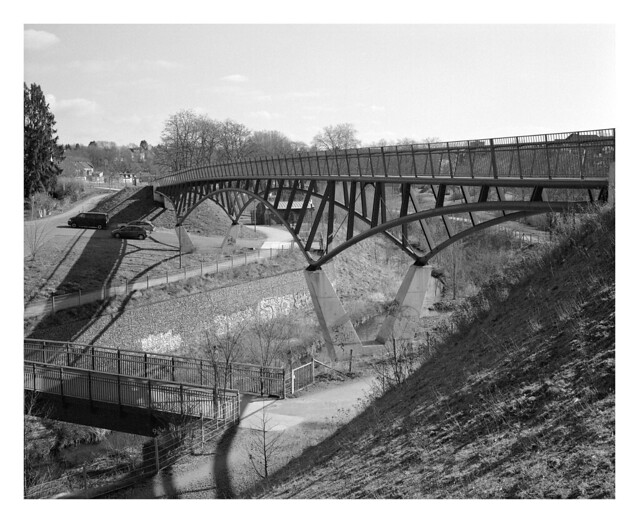
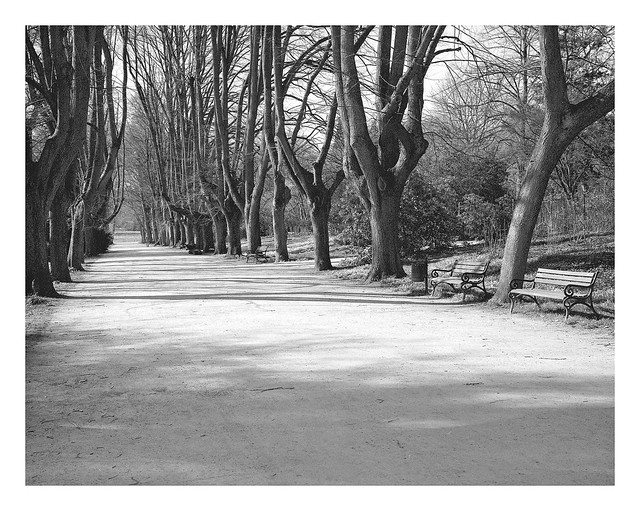
Some images: https://efbeo.blog/2017/06/13/2452/ Pancro 120 @250 iso, x-tol 1+1, 20°C, 20'. Epson V700. Today, I printed a scene with a contrast of 8 stops with the Durst 805 splitgrade. Workable...
 
Mindless and provoking question (imo) - maybe he likes to share his results ... ? :errm:


I cannot believe how many people are scanning conventional B&W negatives, oblivious to the fact that the results look like crap. I do not understand this, at all.
 
I will always prefer an (self -) enlarged / printed negative ...
But this is not what I'm talking about. What about those photographs in our galleries - what about those in various threads ? All crap ??
 
I will always prefer an (self -) enlarged / printed negative ...
But this is not what I'm talking about. What about those photographs in our galleries - what about those in various threads ? All crap ??
Indeed, I prefer also printing in the darkroom. For what it's worth: some thoughts and images about the combination: https://efbeo.blog/2017/06/16/first-impression-pancro-x-tol/ This w-e I wil give it a try with ID-11. Kind regards Fred
 
In-depth review for the ones interested in this film
 
In the mean time I did 2 test. 1) Pancro @ 400 iso and x-tol. 'For me': this combo doesn't work at all. The grain is terrifying. So, I don't show the results of the testfilm. 2) The second testfilm: Pancro @ 400 iso in ID-11 1+1 17' at 20°C: one 120 film, 10 images. The results you can find on my blog. There was no post-processing. I'm disapointed about the grain and the sharpness. 'For me' there are much better films on the market (like FP4+, Acros, Tmax100 and Tmax 400, Tri-x. Pancro is too much marketing. It's a pity that I must say it.
Just for what it's worth. Kind regards fred
https://efbeo.blog/2017/06/16/pancro-and-id-11/
 
In the mean time I did 2 test. 1) Pancro @ 400 iso and x-tol. 'For me': this combo doesn't work at all. The grain is terrifying. So, I don't show the results of the testfilm. 2) The second testfilm: Pancro @ 400 iso in ID-11 1+1 17' at 20°C: one 120 film, 10 images. The results you can find on my blog. There was no post-processing. I'm disapointed about the grain and the sharpness. 'For me' there are much better films on the market (like FP4+, Acros, Tmax100 and Tmax 400, Tri-x. Pancro is too much marketing. It's a pity that I must say it.
Just for what it's worth. Kind regards fred
https://efbeo.blog/2017/06/16/pancro-and-id-11/

In addition: with ID-11 the blanco reading of the film stays at 0,20 densitity. And in the highlights the density was not above 1,30 what AA gives for zone VIII highlights.
 
I cannot believe how many people are scanning conventional B&W negatives, oblivious to the fact that the results look like crap. I do not understand this, at all.

How else can we show our results here? I don't understand your comment, at all.
 
Print the negatives on paper, then scan the print.
Andrew doesn't do standard prints - all his final prints are in various Alternative processes, like Carbon prints, which often don't scan well.
While encouraging darkroom printing, APUG happily accepts un-manipulated scans of negatives and transparencies.
You are free to make your own choices, but so are we. I am the first to advocate darkroom printing, but I would never criticize someone for making the considered choice to scan rather than print - people's circumstances differ widely.
It is always appropriate of course to make reference to the often unwanted effects that are added when one introduces a scanning stage to a process .
In my case, for APUG sharing, some scans are of prints, some scans are of transparencies and some scans are of negatives. At least in some cases, I have elected to use a negative scan because it is a much more faithful reproduction of my prints than I have been able to achieve with a scan of a print made with that negative.
In my opinion, scanning is as much a difficult craft as printing in the darkroom (and way less fun).
 
Thanks, Matt. It's pointless scanning in a carbon transfer print (but I have done so) as you cannot appreciate the relief. Then there is the colour...and I certainly don't want to start playing around with the colour in PS as I'm useless at that. Even scanning in Kallitypes are tricky due to colour variations. I haven't made a silver gelatin print for a few years now. It's not that I don't want to ( I love making them!) it's just that these alt processes take up so much of my free time!

Andy
 
Why are you scanning? The grain is horrible!

"Grain"? No

I cannot believe how many people are scanning conventional B&W negatives, oblivious to the fact that the results look like crap. I do not understand this, at all.

Print the negatives on paper, then scan the print.

The quality of a "scanned" print is clearly worse than the quality of a "scanned" negative (good news with the first method is that at least you have the print) but in either case, nothing looks like ... (like you look).
 
In my opinion, scanning is as much a difficult craft as printing in the darkroom (and way less fun).

Indeed, it is. And there is more: even if you make a good scan, you are not sure how the beholder would see it on another device (mostly no device is calibrated). So an image is only an image when it is printed (and shown under good light conditions).
 
Indeed, it is. And there is more: even if you make a good scan, you are not sure how the beholder would see it on another device (mostly no device is calibrated) ...

The relative importance of calibration with B&W is not as strict as it is with colour which also needs other previous considerations (which is not the point in this thread with Bergger Pancro 400 I believe).

... So an image is only an image when it is printed (and shown under good light conditions).

OMG! ... and what about slides?
 
[QUOTE="LAG, post: 1933770,


OMG! ... and what about slides?[/QUOTE]
They don't count because they are not pictures! They are just impersonations of real subjects in 2D. Or 3D if you use Leica or Zeiss glass.
 
I cannot believe how many people are scanning conventional B&W negatives, oblivious to the fact that the results look like crap. I do not understand this, at all.

The fact that YOU don't know how to get good results does not mean that all scans look like crap.
 
Photrio.com contains affiliate links to products. We may receive a commission for purchases made through these links.
To read our full affiliate disclosure statement please click Here.

PHOTRIO PARTNERS EQUALLY FUNDING OUR COMMUNITY:


Ilford ADOX Freestyle Photographic Stearman Press Weldon Color Lab Blue Moon Camera & Machine
Top Bottom