• Welcome to Photrio!
    Registration is fast and free. Join today to unlock search, see fewer ads, and access all forum features.
    Click here to sign up

Barnbaum - Zone IV Shadows

Recent Classifieds

Forum statistics

Threads
202,087
Messages
2,834,886
Members
101,106
Latest member
ludwigkirch
Recent bookmarks
0

pentaxuser

Member
Joined
May 9, 2005
Messages
20,381
Location
Daventry, No
Format
35mm
. Among other things, he shows you an illustrative H&D curve that has a straight line up to something like zone 15 or 17. This is very misleading. With most films the straight line begins to shoulder around zone 12.

I had alway thought that the zone system as described by A.A. only had 10 zones(0-9). Once you had reached textureless white it wasn't possible to get "whiter". It only left you with specular highlights such as shiny metal like that created by sunshine on a chrome car bumper which doesn't have a zone.

Is a system with 17 zones a kind of sub system of the 10 zone system in which each zone covers a smaller range of the particular zone covered in the 0-9 system?

Thanks

pentaxuser
 

Bill Burk

Subscriber
Allowing Ads
Joined
Feb 9, 2010
Messages
9,479
Format
4x5 Format
"...Bruce Barnbaum's idea that shadows should be placed well onto the straight-line section. This will make photographs worse, they will be grainier...."

Grain is an inherent film property and is not determined by shadow placement. The appearance of grain in the final print depends, in part on the degree of enlargement, film developer, development techniques (temperature, time, agitation, extended) and of course the selected film.

Hi Harrison,

Appreciate your perspective. Since this was my quote, I should clarify. The grain won't change character. There will simply be more of it. By sensitometry that's worse. Pictorially it is up to the individual to decide.
 

Bill Burk

Subscriber
Allowing Ads
Joined
Feb 9, 2010
Messages
9,479
Format
4x5 Format
I had alway thought that the zone system as described by A.A. only had 10 zones(0-9). Once you had reached textureless white it wasn't possible to get "whiter".

You can have as many Zones as there are stops of light difference from darkest to lightest. It's true you exclude specular highlights when choosing what you want in the picture.

But if you feel you need to hold XII in the picture, you would develop to N-3, which compresses the scale and fits three more zones, so you can print highlights up to XII in the subject (because you developed them to IX)
 

pentaxuser

Member
Joined
May 9, 2005
Messages
20,381
Location
Daventry, No
Format
35mm
Thanks both. So if in a scene you can get to zone XVII as was quoted and want to hold this in a print you'd develop to N-6. At what point does such a dev regime become theoretically correct but in reality absurd or in practical terms impossible?

What might be recorded at zone XVII? Where on earth is there likely to be a 17 zone light difference from darkest to lightest?

I have read several books on photography and do recall seeing mention of N-3 dev but as a kind of extreme theoretical limit accompanied with practical difficulties but had never seen any mention zones XV to XVII.

Thanks

pentaxuser
 

Bill Burk

Subscriber
Allowing Ads
Joined
Feb 9, 2010
Messages
9,479
Format
4x5 Format
In your example, when you moved your shadow from Zone III to Zone IV did you cause your Zone XVI highlight to fall higher on Zone XVII? If so, I think you can knock one N-number off since you shifted everything.

My favorite illustration is a cave near a beach.

I don't find this kind of lighting very often. But I'd go N-3 at the most and find some other way to solve the rest of the puzzle. (Add light/Softer paper/Change developer)
 
Joined
Jan 7, 2005
Messages
2,743
Location
Los Angeles
Format
4x5 Format
Grain is an inherent film property and is not determined by shadow placement. The appearance of grain in the final print depends, in part on the degree of enlargement, film developer, development techniques (temperature, time, agitation, extended) and of course the selected film.

Exposure is a factor in appearance of grain. One of the reasons why the safety factor was reduced in the 1960 ASA film speed standard was to minimize grain. From Safety Factors in Camera Exposure by C.N Nelson,

"If a large safety factor is undesirable at the present time, why was it thought to be necessary when the American Standards for film ratings and exposure meters were first adopted in the 1940's? The first reason is that exposure meters, camera shutters, and lens apertures were not as accurate in the 1940's as they are in 1959. The second reason is that the camera-exposure latitude of black-and-white films was effectively greater in those earlier years, largely because the increase in print graininess with increase, in camera exposure was not as evident with the large cameras, large negatives, and small degree of enlargement or contact printing then commonly used. The great increase in the number of small cameras in recent years and the increase in the degree of enlargement has made the graininess problem more acute.

Many photographers have adopted the practice of giving less exposure than is indicated by the use of ASA exposure indexes with exposure meters. The American Standard indexes for black-and-white films are used by them only as a starting point for deriving a new kind of exposure index which is obtained by the simple procedure of doubling the Standard exposure index. This practice, of course, has the effect of cutting the safety factor in half, giving the preferred thinner negatives."


I left that second paragraph in because I find it amusing that after the film speed was increased by one stop with the adoption of the 1960 standard, people started cutting their EIs in half.

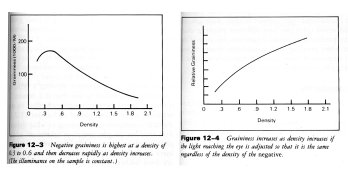
Here are a couple of graphs from Photographic Materials and Processes by Strobel et al.

Grain and Exposure.jpg

"...Loyd Jones, for instance, wasn’t known for his image making, but he is one of the most influential figures in the history of photography...."

For those who enjoy sensitometry, Jones, Rockwell, Davenport, Neblette, Clerc or Pitman may very well be the most influential figures in the history of photography. However, for those who believe making beautiful images is the goal, Adams, Weston, Sommer, O'Sullivan, Bravo, Brandt, Steichen, Stieglitz, Strand, Lange, Karsh, Hurrell, or Cunningham (to name a few) may represent the most influential figures in photographic history.

When we trot out our favorite "gods", we should first check to see which side of the burn you are standing.

I was in responding to a poster. I was trying to make the point that you don't have to be a great photographer to be correct with a technical photographic fact for which the poster implied the opposite.

BTW, you should include the name of the poster to whom you are commenting on. It will help people find the original post with the full comment.

"...Looking at an image doesn't prove anything. It is commonly known that Ansel Adam's Moonrise over Hernandez was underexposed. And while it is widely regarded as one of his best images, it's more an example of printing prowess than a proof of any exposure concept....

For those who are dependent on the sell of images to the paying public, the final image proves everything. In the real world, we do not always place the shadow and highlights on the proper portion of the curve, expose the film properly or develop the film according to standard. Yet we have to make beautiful images from those under/over exposed/developed negatives. Printing prowess is often the firewall which prevents us from becoming a corpse on the gelatin silver highway.

Again, making the point that it's hard to evaluate the individual factors, such as camera exposure and film processing, looking at the finished print in response to a poster's comment.
 

PeterB

Member
Allowing Ads
Joined
Apr 3, 2005
Messages
644
Location
Sydney, Aust
Format
Medium Format
changed 2nd last paragraph re importance of 2nd graph

Exposure is a factor in appearance of grain. ....... Here are a couple of graphs from Photographic Materials and Processes by Strobel et al.

Appearance is the key word here because the actual grain does not decrease with increasing density.

Quoting from the text referring to those two figures:

"A density of 0.3 corresponds to a transmittance of one half, which represents equal clear and opaque areas. One would expect little graininess at very low and very high density levels, but for different reasons. At very low densities there is little grain structure. As the density of the negative increases, the amount of light transmitted decreases. The perception of graininess decreases rapidly as the density increases because our ability to see detail and tonal differences decreases at low light levels. At a very high density, graininess is not perceptible even though the silver in the negative has a very grainy structure."


Those two graphs Stephen posted from Strobel et al. are a result of subjective measurements. I initially though that the first graph has more practical value since for the second graph, the light level has been adjusted so that the transmitted light remains constant regardless of the density level. But perhaps the 2nd graph is equally important in this thread because if one is placing the shadow detail on Zone IV (higher neg density) and printing those shadows to an equal or higher gray value on the final print, then that graph says those shadows will be more grainy than if you gave them less initial exposure on the negative.

Objective measurements of film grain using a microdensitometer reveal that higher negative densities exhibit a higher mean granularity.
 
Last edited by a moderator:
Joined
Jan 7, 2005
Messages
2,743
Location
Los Angeles
Format
4x5 Format
According to W.F. Berg in Exposure: Theory and Practice:

" The grainy appearance of the negative itself shows a very similar behavior when inspected over a source of constant illumination. It is possible, however, to alter the illumination of the negative under examination in such a way as to keep the amount of light reaching the eye constant and independent of the density of the negative. This means, in effect, using an apparatus which allows the illumination to be increased at will in order to compensate for the higher negative densities. When the graininess of the negative is investigated in this fashion, it is found to increase continuously with increasing density range. This is a most important result, for on it are based recommendations for the ideal photographic exposure to be aimed at in practical photography."
 

Chuck_P

Member
Allowing Ads
Joined
Feb 2, 2004
Messages
2,369
Location
Kentucky
Format
4x5 Format
I had alway thought that the zone system as described by A.A. only had 10 zones(0-9). Once you had reached textureless white it wasn't possible to get "whiter". ...............Is a system with 17 zones a kind of sub system of the 10 zone system in which each zone covers a smaller range of the particular zone covered in the 0-9 system?

A 0-9 system can be a system, but it is not the ZS.

The ZS, and I'll use the word "proper", as described by AA with the release of The Negative in the early 80's introduced a new scale of Zones-----11 values from Zone 0 to Zone X.

Early Kodak gray scales, I believe, were comprised of only 10 steps---a black, a white, and 8 steps in between. Early ZS descriptions from his original writings described 10 steps of value. Obviously, Zone V, touted to be middle gray, could not be reconciled with a 10 step scale. By counting up that scale to where Zone V would land, the tone of that scale clearly did not match the the tone of the gray card, I suppose this would have been quite confusing.

With the introduction of The Negative, that changed, the scale of zones was increased to 11 distinct steps from 0 to X, four steps above and below Zone V. The Negative often refers to the 18% gray card (wether it is truly 18% is immaterial IMO). To produce a scale of zones as described on a textured target (post testing that is), the Zone V negative is printed to match the tone of the gray card, then all other negatives are printed at the same enlarging exposure time to produce the gray scale. I've done it, it works beautifully.

Most people it seems today don't even consider Zone 0 or even Zone I, but it is a distinct zone on the scale of zones that describes the ZS as it is (and should be) thought of today-----it is full black, and as density increases to the threshhold level of exposure i.e., Zone I, there, then, is the first "useful" density on the negative that can be put to use on the paper-----described as the: "Effective threshhold. First step above complete black in print, with slight tonality but no texture."
 

Vaughn

Subscriber
Allowing Ads
Joined
Dec 13, 2006
Messages
10,289
Location
Humboldt Co.
Format
Large Format
...Most people it seems today don't even consider Zone 0 or even Zone I...

I love Zones 0 and I! If I could easily cut out parts of the negative to get a Zone -I, I would! :wink: (I suppose the Romans did not have negative numbers...I guess it would hard to have something on the other side of zero if you had not invented the zero yet.) But that is why I don't mind some reciprocity failure in a film -- those small deep shadows just about stay right there at the base+fog level, while the highlights gallop away...just what I need for carbon printing!

But the difference between Zone 0 and Zone I shows up as a change in the relief on a carbon print. Even if it is difficult for one's eye to see a difference in the tone between them, there can be a noticable difference in relief...sort of takes the phrase "A black with texture" to a new level!

A question on terminology...

If I use my Pentax Digital Spot meter and read the darkest shadow and brightest highlight and get, for example, 4 and 9 respectively. Is this a 5 stop range? Is it also a scene that contains 6 "zones"? If I expose at 6, then Zones III, IV, V, VI, VII and VIII are represented in the scene. (where they actually end up will depend on the development).

So, in the example of readings from 4 to 9, the range is 5 stops but I have 6 stops of light in the scene?

Vaughn
 

Hexavalent

Member
Allowing Ads
Joined
Nov 19, 2009
Messages
592
Location
Ottawa, Onta
Format
Multi Format
....

But the difference between Zone 0 and Zone I shows up as a change in the relief on a carbon print. Even if it is difficult for one's eye to see a difference in the tone between them, there can be a noticable difference in relief...sort of takes the phrase "A black with texture" to a new level!

...

Absolutely! One of things I love about carbon prints.. "shadows you can swim in" :smile:
 

Vaughn

Subscriber
Allowing Ads
Joined
Dec 13, 2006
Messages
10,289
Location
Humboldt Co.
Format
Large Format
I just got done watching some Monty Python TV shows on DVD and somehow your explanation now makes sense -- which is a bit worrisome...
 

RalphLambrecht

Subscriber
Allowing Ads
Joined
Sep 19, 2003
Messages
14,959
Location
K,Germany
Format
Medium Format
I know Barnbaum advocates placing shadows on Zone IV, and also cutting the ASA in half for standard developers. So, he is essentially saying, "for an ASA 400 film, set your meter on ASA 100, and place the shadows on Zone III."

From there, you would want to develop a Normal neg so that you maintain the same optical density spread between Zones III and VIII, which is 0.91, only now your Zone III is around .54, Zone VIII is around 1.45, giving you tons of shadow detail.

I am testing several films (TX400, HP5, and TMY, FP4) with XTOL, and I was wondering if this technique would lead to blocked highlights. Barnbaum says most modern films don't shoulder off, but I figured I'd ask the experts.

he is a smart man!!!
 

markbarendt

Member
Allowing Ads
Joined
May 18, 2008
Messages
9,422
Location
Beaverton, OR
Format
Multi Format
I just got done watching some Monty Python TV shows on DVD and somehow your explanation now makes sense -- which is a bit worrisome...

+1
 

Chuck_P

Member
Allowing Ads
Joined
Feb 2, 2004
Messages
2,369
Location
Kentucky
Format
4x5 Format
that's a pretty sure way tocreatea flat and boring print

What you must have typed:

"Yes------underrating a you still have to develop the density range of the negative to fit within the the exposure scale of the pape." I can take a disagreement from such a well known source such as you Ralph, that's fine, but, with due respect, let's not tinker with the words in someone else's quote, it's an unfair way to make a point, IMO.

The actual quote:

"Yes------underrating a film without taking provisions for controlling the highlight density on the negative with development can definitely lead to blocked highlights. The fact remains, regardless of a pronounced shoulder or not, you still have to develop the density range of the negative to fit within the the exposure scale of the paper." --- Me

So, underrating a film (which is what I was responding to) is an act of trying to ensure proper shadow density, are not the potential consequences of that act the development of blocked highlights, and isn't it true that one "provision" against blocked highlights is to reduce the development of the negative? Isn't it true, also, that when reducing development, what is actually being attempted, is to keep the negative's density range within a range of printable paper densities? Do you disagree with this?
______________

On page 4 Dead Link Removed you suggest using a standard negative density range of 1.2, as established with your own parameters for the desired "minimum shadow and speed point density" i.e., 0.17 at Zone II and a Zone VIII density of 1.37----this is your neg density range of 1.37-0.17 = 1.2. According to you, "this covers the entire paper exposure range, from the beginning of Zone II to the end of Zone VIII,....." . It has to be assumed, wouldn't you agree, that you intend to teach others that whatever the luminance range of the subject, developing those luminances to stay within the printable range of II to VIII, the pictoral range as you call it, is the goal-------as you say, a standard neg density range of 1.2.

This is the same negative density range that I develop to under the ZS testing method that I use. Except the difference is, and I make no claim of it being better, a Zone I neg density of 0.1 and a Zone VIII neg density of 1.3----this is my neg density range of 1.3-.1= 1.2. I have proven to myself, that this also covers the paper exposure range from .......I to VIII quite well.

The same negative denisty range, but over a different log exposure range, yours 2.1 as is seen in your graph, mine 2.4.
______________

Just as I can accept being disagreed with, I can equally accept an opposing opinion, if it makes sense to me first. The relevant question to your comment on my post is this: If keeping the negative density range within the exposure scale of the paper will create "flat" and "boring" prints, then why are you doing it?

 
Last edited by a moderator:

markbarendt

Member
Allowing Ads
Joined
May 18, 2008
Messages
9,422
Location
Beaverton, OR
Format
Multi Format
Sorry. I thought it was pretty clear.

No big deal I regularly say more confusing things.

Getting the idea across that: the 10-zones in the ZS and the actual number f-stops measured in a SBR are not always, or even regularly, equal; is tough. People want 1-10 to equal I-X, they don't want to do base 9.3 or base 11.6 math and translate.

Part of the problem is that when we are taught how to "find" zone VIII (or II) in a scene it is often phased as "meter reading plus 3-stops (or minus 3-stops). If a long scale scene is measured at a total SBR of say 13.5 saying "+3-stops" may actually define a point in zone VII not VIII (minus 3 might define a point in zone III instead of II).

This is not easy to understand.
 

Vaughn

Subscriber
Allowing Ads
Joined
Dec 13, 2006
Messages
10,289
Location
Humboldt Co.
Format
Large Format
Sorry. I thought it was pretty clear.

A bit clearer than my original question, anyway! LOL!

I will re-ask it.

I meter a scene with my spot meter and it reads 6 in the darkest area and 9 in the brightest area. I would say the scene has four stops (or zones) of light. I have had others insist that, no, it only has a range of 3 stops. I just have a feeling that we both would be correct.
 
Joined
Jan 7, 2005
Messages
2,743
Location
Los Angeles
Format
4x5 Format
I meter a scene with my spot meter and it reads 6 in the darkest area and 9 in the brightest area. I would say the scene has four stops (or zones) of light. I have had others insist that, no, it only has a range of 3 stops. I just have a feeling that we both would be correct.

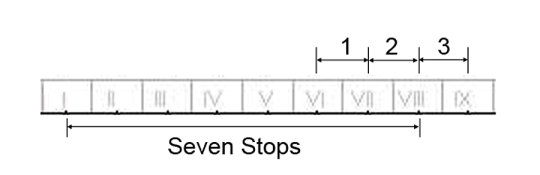
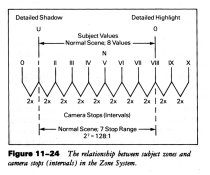
That's a three stop range: 6 to 7 = stop 1, 7 to 8 = stop 2, 8 to 9 = stop 3. Same as Zone I to Zone VIII is 7 stops and not 8.
 

markbarendt

Member
Allowing Ads
Joined
May 18, 2008
Messages
9,422
Location
Beaverton, OR
Format
Multi Format
That's a three stop range: 6 to 7 = stop 1, 7 to 8 = stop 2, 8 to 9 = stop 3. Same as Zone I to Zone VIII is 7 stops and not 8.

Or

Measured point middle of 6 then

7 & 8 then

Measured point middle of 9

= 4
 

Bill Burk

Subscriber
Allowing Ads
Joined
Feb 9, 2010
Messages
9,479
Format
4x5 Format
It's the old towel-and-clothespin question: How many clothespins it takes to hold a number of towels on a clothesline?

Or another way. Say you start with 60 dollars and I give you some money. Now you have 90 dollars.

How much money did I give you?
 

Kirk Keyes

Member
Allowing Ads
Joined
Jun 17, 2004
Messages
3,234
Location
Portland, OR
Format
4x5 Format
A bit clearer than my original question, anyway! LOL!

I will re-ask it.

I meter a scene with my spot meter and it reads 6 in the darkest area and 9 in the brightest area. I would say the scene has four stops (or zones) of light. I have had others insist that, no, it only has a range of 3 stops. I just have a feeling that we both would be correct.

I would say the range is 3 as 9-6=3.

But the scene contains 4 zones of information, Zone 6, 7, 8, and 9.
 
Joined
Jan 7, 2005
Messages
2,743
Location
Los Angeles
Format
4x5 Format
But the scene contains 4 zones of information, Zone 6, 7, 8, and 9.

I don't want to get into a fight here, but this is where I believe the arbitrary nature of Zone labels begins to get in they way. Take it out of Zones and place it within a strictly tone reproduction framework. Here is the same information using reflection densities - RD 0.62 to RD -0.28 for a range of 0.90 logs. Three stops can only contain three stops of information.
 
Photrio.com contains affiliate links to products. We may receive a commission for purchases made through these links.
To read our full affiliate disclosure statement please click Here.

PHOTRIO PARTNERS EQUALLY FUNDING OUR COMMUNITY:


Ilford ADOX Freestyle Photographic Stearman Press Weldon Color Lab Blue Moon Camera & Machine
Top Bottom