• Welcome to Photrio!
    Registration is fast and free. Join today to unlock search, see fewer ads, and access all forum features.
    Click here to sign up

Barnbaum - Zone IV Shadows

Recent Classifieds

Forum statistics

Threads
202,087
Messages
2,834,888
Members
101,106
Latest member
ludwigkirch
Recent bookmarks
0
Joined
Jan 7, 2005
Messages
2,743
Location
Los Angeles
Format
4x5 Format
I thought your post was clear, I just provided comment on a point that I disagreed with

Being that it wasn't about density range, then you must have disagreed with an imaginary post. I've written rather extensively about the negative density range and the importance of determining how to measure it. Here I was discussing how once the density range is determined (development), the entire range can be moved up and down the film curve through exposure. As long as the placement doesn't negatively affect a portion of the curve, the prints will be similar.

My problem with Barnbaum is the way he describes it. If the intention is to print a Zone III shadow value on Zone III, then you're not placing a Zone III shadow value on Zone IV. You are simply giving the entire range an additional stop of exposure. There is no difference than simply changing the film's EI. In fact, Barnbaum could simply state that he opens up two stops from the ISO speed. Ever heard of the photographer who sets his EI at 1/2 the ISO speed then stops down one stop when shooting? There is a distinction between shifting the Zone III shadow to print on Zone IV and just giving everything an extra stop of exposure.

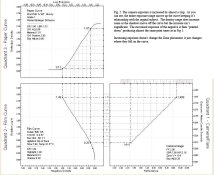
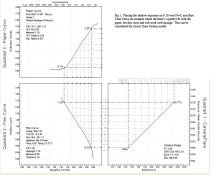
This is part of why I said, "I keep trying to make is there isn't a fixed correlation between Zones and negative densities. Over-exposing the film simply moves everything toward the right on the film curve." Exposure, curve shape, and flare combine to make it impossible to have exact negative density aims for the various Zones (outside of testing). I've uploaded some examples to help illustrate this.

Figures 1 and 2 show how additional exposure shift the entire exposure up the curve and that it is then "printed down" producing almost identical prints. The negative density changes only slightly with the increase curve gradient as the shadows move off the toe.

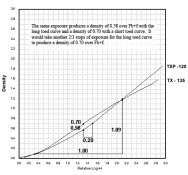
The long and short toed film comparison shows how an identical exposure will produce different density values depending on the curve shape. In this example, point of exposure can be considered Zone V. For the long curve to produce the same 0.70 density value, it would require an additional 2/3 of a stop exposure. How would that work if Zones had a specific correlating density?

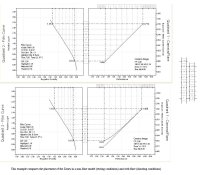
The final example shows the difference in Zone placement between a non-flare example and a flare example. The flare example can vary depending on the degree of camera flare, but the non-flare conditions only exist under testing conditions. In this example, which has the exposure keyed to 0.10 density, has the Zone V shooting exposure falling at the point of the Zone IV testing exposure.

One other thought. Barnbaum's tends to be a flame thrower. He wants to be an iconoclast. And while I've found the explanations in his book to be from another planet, I believe he's just trying to be provocative with his statement about exposure. What's actually going on is no big deal.

If Barnbaum's approach is so outlandish, then so should Ralph's. His 0.17 speed point can easily be within 1/2 stop of Barnbaum's approach. Ralph's 0.17 speed point idea increases the EI by 1/2 to 2/3 of a stop. This is on top of the general increase of 1/2 to 1 stop in the EI that comes from Zone System testing. Potentially, we could be talking about a 1 2/3 stop difference over the ISO speed as opposed to Barnbaum's 2 stops over. You can't defend one and denounce the other.
 

Attachments
  • Zone Exposure - 3 Quad 1.jpg
    Zone Exposure - 3 Quad 1.jpg
    184.5 KB · Views: 96
  • Zone Exposure - 3 Quad 2.jpg
    Zone Exposure - 3 Quad 2.jpg
    203 KB · Views: 86
  • long and short toed comparison.jpg
    long and short toed comparison.jpg
    156 KB · Views: 98
  • Zone Placement and Flare.jpg
    Zone Placement and Flare.jpg
    321.1 KB · Views: 97
Last edited by a moderator:

MaximusM3

Member
Allowing Ads
Joined
Jul 11, 2010
Messages
754
Location
NY
Format
35mm RF
Adams wrote "the book" on ZS, Barnbaum wrote "a book" about what works for him. I'm not sure that he was trying to re-invent the wheel or spread his beliefs as indisputable gospel, but the fact is that he wrote a book to sell it and make money. To do that, one cannot simply fill it with a bunch of old theories and regurgitated fairy tales, hence the need to put a new spin on certain things and have people buy it, try them, discussed them, and ultimately pick them apart. I find that section of the book useless as far as I am concerned, aside from providing some insight on what he does to produce his "art". But, I did buy the book, and so did others who care to discuss its contents. Bruce's bank account is thanking us for it. :smile:
 

Mark Layne

Subscriber
Allowing Ads
Joined
Jun 9, 2003
Messages
967
Location
Nova Scotia
Format
Medium Format
Having done two workshops with Bruce Barnbaum among others I can vouch for the fact that he is one of the best printers on the planet. He understands the need to make a print that has a degree of drama, and he is very good at it. He has his opinions but don't we all (thankfully).
Mark
 

Chuck_P

Member
Allowing Ads
Joined
Feb 2, 2004
Messages
2,369
Location
Kentucky
Format
4x5 Format
In fact, Barnbaum could simply state that he opens up two stops from the ISO speed.

Agree totally. Hence my reaction to his apparent effort at "teaching the ZS"----- that's bunk.

Regarding the other discussion of zones and negative densities, of course, there is no exactness involved for the reasons you state; I'm apologetic if I seem to appear as some authority on it. Not at all and I appreciate your insight and authority. However, I believe my eyes (and my densitometer) as I do not find the density differences from the actual testing process to post-development of my negatives with regard to the "placements" I make, to be of great significance. I just cannot look at my negatives and be made to believe that something is amiss due to flare, etc......that you speak at great lengths about. I don't say and hope to have never implied that there is not a difference, I merely contend that they don't seem signifincant to me following my own ZS testing.
 
Last edited by a moderator:

Eric Rose

Member
Allowing Ads
Joined
Nov 21, 2002
Messages
6,842
Location
T3A5V4
Format
Multi Format
It kills me that some of those that have the most to say, and with GREAT authority have either never posted an image to gallery or very few. Come on let's see the rubber hit the road! Show us your chops. You say you have it dialed in, show us! Lets see some images.
 
Last edited by a moderator:
DREW WILEY

Member
Allowing Ads
Joined
Jul 14, 2011
Messages
14,899
Format
8x10 Format
Some people enjoy solving technical problems and designing graphs and models to communicate
this kind of thing, but are otherwise mediocre from an artistic standpoint. Then there are a few folks
who make magnificent prints but really can't explain exactly how this transpires. Then there are
some who do both well, and many who do neither well. I personally enjoy both aspects, but am
more of a schizophenic - once I have mastered a certain technical aspect it simply becomes instinctive and I never think about it again, and I photograph and print spontaneously. There are many different models for "correct" exposure, and there's no sense making a religion out of any of
them.
 

garysamson

Member
Allowing Ads
Joined
Dec 13, 2003
Messages
244
Location
New Hampshir
Format
ULarge Format
It kills me that some of those that have the most to say, and with GREAT authority have either never posted an image to gallery or very few. Come on let's see the rubber hit the road! Show us your chops. You say you have it dialed in, show us! Lets see some images.

+1
 
Last edited by a moderator:
DREW WILEY

Member
Allowing Ads
Joined
Jul 14, 2011
Messages
14,899
Format
8x10 Format
Keep in mind that some of the best printers alive don't even own one of those little Dick Tracy secret decoder ring cameras necessary for posting web images, and some don't like even putting their images on something as half-ass as the web, which does about as much justice to a fine print
as publishing it in the morning newspaper (for those who still remember what that is).
 

MDR

Member
Allowing Ads
Joined
Sep 1, 2006
Messages
1,402
Location
Austria
Format
Multi Format
I think Barnbaum and Adams writings are both a blessing and a curse for newbies in printing and photography both are basicaly landscape photographers and both have a strong following.I thinks it's important to have read both Barnbaum and Adams and "forget" 90% of what's written in there. Both Adams and Barnbaum wrote about their technique that works for their style of picture making. Knowing about sensinometry and such is imho a waste of time on the other hand knowing about the results I will get if I use Film X with developer Y and Paper Z is very important just like I think that the so called previsualisation is extremely important . The technical details like how to find the correct EI for the Film, etc... is technical window dressing. Everyone should develop a personal Style copying the teachings of certain photographers might help but it can also hinder.Please take my comment as what it is a personal opinion and I don't think I have really a personal style or the authority to really comment the quality of master printers yet. Both are great printers and decent photographers.
 

Chuck_P

Member
Allowing Ads
Joined
Feb 2, 2004
Messages
2,369
Location
Kentucky
Format
4x5 Format
I guess some of that could be directed at me, but I do have some images in the portfolios, and how I used ZS methodology (for what it's worth) to make them on Flickr. After 20 grand of exterior home remodel over the last several years, there's not been cash for photography, so don't have much to offer up since moving to 4x5 and the kitchen thing with this format just was not working out. Remodel is over and the darkroom is in progress, slowly but surely, and hope to be somewhat more regular with what I love to do when it's finished.
 

chriscrawfordphoto

Member
Allowing Ads
Joined
Mar 12, 2007
Messages
1,893
Location
Fort Wayne, Indiana, USA
Format
Medium Format
It kills me that some of those that have the most to say, and with GREAT authority have either never posted an image to gallery or very few. Come on let's see the rubber hit the road! Show us your chops. You say you have it dialed in, show us! Lets see some images.

I never post in the gallery because I am a professional artist. I have my own website, and don't want my images on servers I don't control. I do link to my photos when one is relevant to something I'm talking about (showing an example of a film and developer combination, for example).
 

Eric Rose

Member
Allowing Ads
Joined
Nov 21, 2002
Messages
6,842
Location
T3A5V4
Format
Multi Format
Well I'm a professional too and have no problem posting here to either illustrate something or just share an image that I enjoy. Go to google and type in any of the currently famous photographers and have it search for images. You will find 100's of images for any given 'tog. Has it hurt their business? Not in your life. Do they care. Again not in your life. They are busy getting paid to produce photographs, not because they have this paranoid need to control their images, but because they are good at what they do.
 

MDR

Member
Allowing Ads
Joined
Sep 1, 2006
Messages
1,402
Location
Austria
Format
Multi Format
Eric I believe the difference is that most famous photographers get paid to make the photographs they don't live from their photo sales. Furthermore once your famous your work will be recognizable if your not anyone can steal your work. Chris is an active image poster on the rangefinderforum and has posted quiet a few images on apug so he doesn't hide his work, he also has a link to his homepage below his posts. So please let's stay on this interesting thread's topic Barnbaum and the Zones. Bruce Barnbaum is a great printer and Grandma Moses was a great painter who painted most of her live and nobody saw her work until the last 20 to 30 years of it.

Dominik
 
OP
OP
ParkerSmithPhoto

ParkerSmithPhoto

Member
Allowing Ads
Joined
Jan 16, 2010
Messages
1,685
Location
Atlanta, GA
Format
Medium Format
I think most photographers obsess a bit too much as to the "stolen" value of their work. I mean, you can't do too much with an 800 pixel JPG, and anyone with a lick of sense knows that they will get caught and be exposed as a fraud. If you can't make a dime from your own photography, you certainly don't have the skill to make a dime from someone else's work, especially a teeny JPG file.

Dana Dawes is a "portrait photographer" here in Atlanta who stole other photographer's work, set up a website and then ran a Groupon and sold over a thousand "portrait sessions" before being caught and suffering a most thorough humiliation. She even ended up on TV saying that her "website had been hacked," and that she was afraid to show her face for fear of personal abuse!!!

Now, get back on topic.
 

Bill Burk

Subscriber
Allowing Ads
Joined
Feb 9, 2010
Messages
9,479
Format
4x5 Format
What was the topic? Oh yes.

Bruce Barnbaum's idea that shadows should be placed well onto the straight-line section.

I think I've said it in longer sentences, I'll try to say it shorter.

This will make photographs worse, they will be grainier.

But the shadows will be luminous. By that measure the photographs will be better.

It fits my idea of quality (having better shadow separation), so I incorporate his idea to a limited extent. I try to put my shadows near 0.1 density which in my normal case is pretty near the straight line anyway.
 
Last edited by a moderator:
Joined
Jan 7, 2005
Messages
2,743
Location
Los Angeles
Format
4x5 Format
It kills me that some of those that have the most to say, and with GREAT authority have either never posted an image to gallery or very few. Come on let's see the rubber hit the road! Show us your chops. You say you have it dialed in, show us! Lets see some images.

The content of the the quoted post has changed since it was originally posted. My reply is directed at the way it was originally written.

This is an ad hominem argument. It attacks the posters while it avoids directly addressing any facts from any post and then it attempts to change the subject to a non sequitur argument. How good a person is at shooting and printing has no relevance on how accurate the facts are or how strong the argument is. Loyd Jones, for instance, wasn’t known for his image making, but he is one of the most influential figures in the history of photography.

Looking at an image doesn't prove anything. It is commonly known that Ansel Adam's Moonrise over Hernandez was underexposed. And while it is widely regarded as one of his best images, it's more an example of printing prowess than a proof of any exposure concept.

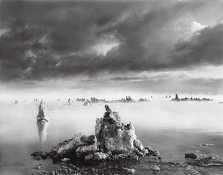
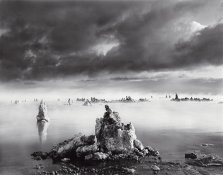
Personally, I don’t have privileges to upload images to the Apug gallery even if I wanted to. I also haven’t gotten around to creating a website. I have placed some images on my Facebook page for my friends to see, but one of the reasons I don't usually post images is that the uploaded images never look the way I want them to. For example, the attached image on the left looked good on my screen before I uploaded it. Now it looks too light. The image on the right originally looked too dark on my screen, but is closer to how I want it to look after the upload. Plus, I have no clue or control of how it looks on someone else's screen. All of which has no relevance to the accuracy of my technical posts.
 

Attachments

  • Winter Sunrise, Mono - Brilliiant.jpg
    Winter Sunrise, Mono - Brilliiant.jpg
    1.2 MB · Views: 155
  • Winter Sunrise, Mono - a.jpg
    Winter Sunrise, Mono - a.jpg
    1.2 MB · Views: 159
Last edited by a moderator:

markbarendt

Member
Allowing Ads
Joined
May 18, 2008
Messages
9,422
Location
Beaverton, OR
Format
Multi Format
A speed index or 'rating' is applicable only to the person using it. It is non-transferable to anyone else,

I totally agree.
 

Trask

Subscriber
Allowing Ads
Joined
Oct 23, 2005
Messages
1,946
Location
Virginia (northern)
Format
35mm RF
I would like to think that most of us on APUG, when we look at an image in one of the galleries, doesn't say "Oh, he printed the photo too light (or too dark)" but that we chalk up any shortcomings in the those respects to our various monitor settings. While I will be attracted to a photo that appears very nice on my screen (Mac laptop), I am primarily interested in the concept of the photo, the placement of objects within the frame, and the ideas being communicated. Technically perfect photos of banal subjects don't interest me. But we stray from the topic of Barnbaum's shadows -- and I'd be interested to know how, in his theory, he handles the fact that all of the higher zones are pushed out on the shoulder of the curve. I watched the YouTube video in which he addresses the shadows, but the highlights are left undiscussed.
 
Joined
Jan 7, 2005
Messages
2,743
Location
Los Angeles
Format
4x5 Format
and I'd be interested to know how, in his theory, he handles the fact that all of the higher zones are pushed out on the shoulder of the curve. I watched the YouTube video in which he addresses the shadows, but the highlights are left undiscussed.

They are not on the shoulder. They are just higher up on the curve.
 

Chuck_P

Member
Allowing Ads
Joined
Feb 2, 2004
Messages
2,369
Location
Kentucky
Format
4x5 Format
and I'd be interested to know how, in his theory, he handles the fact that all of the higher zones are pushed out on the shoulder of the curve.

High shadow "placements" can very well lead to other important high value luminances falling outside the range of printable negative densities, depending on the original subject brightness range----in such cases development modifications are needed to hold those higher important densities (i.e., those that you do not wish to print as paper white; definitely those that you wish to retains some textural quality) in check for subsequent printing.
 

MaximusM3

Member
Allowing Ads
Joined
Jul 11, 2010
Messages
754
Location
NY
Format
35mm RF
And when dealing with long luminance ranges, that does not work very well either. It's a serious problem with Barnbaum's writings on exposure/compensating development. Among other things, he shows you an illustrative H&D curve that has a straight line up to something like zone 15 or 17. This is very misleading. With most films the straight line begins to shoulder around zone 12. Barnbaum repeatedly writes that you can put high values up there and then bring them down in development with compensating procedures. Well, yes you can bring them down to fit onto the paper, but they won't have any detail/texture in them because they will all have been compressed to the point little to no local contrast remains. It is not as simple as using contraction to bring high values down. This is something many new zone system users get wrong.

You are 100% right and I frankly didn't understand that either. He's obviously a great printer so he knows how to squeeze the most out of his negatives. On the other hand, why trying to re-invent the wheel with this zone IV placements and crazy contractions. I ask myself why and where the advantage is and I cannot find a reason why anyone else would want to go through it. That's where I find issues with those sort of books where in essence, the author is describing a method that somehow works for them and presenting it as instructional for others to follow, which is usually only misleading and impossible to follow/emulate.
 

markbarendt

Member
Allowing Ads
Joined
May 18, 2008
Messages
9,422
Location
Beaverton, OR
Format
Multi Format
I think Barnbaum and Adams writings are both a blessing and a curse for newbies in printing and photography both are basicaly landscape photographers and both have a strong following.I thinks it's important to have read both Barnbaum and Adams and "forget" 90% of what's written in there. Both Adams and Barnbaum wrote about their technique that works for their style of picture making. Knowing about sensinometry and such is imho a waste of time on the other hand knowing about the results I will get if I use Film X with developer Y and Paper Z is very important just like I think that the so called previsualisation is extremely important . The technical details like how to find the correct EI for the Film, etc... is technical window dressing. Everyone should develop a personal Style copying the teachings of certain photographers might help but it can also hinder.Please take my comment as what it is a personal opinion and I don't think I have really a personal style or the authority to really comment the quality of master printers yet. Both are great printers and decent photographers.

The blessing and curse thing has been absolutely true for me and with good reason and over the years since Ansel learned his craft and wrote his books things have changed. First and foremost, the tools at hand.

Modern meters are better, most all the modern (and updated) films have more latitude (longer straight lines), the modern VC papers are better, and most importantly for me; the modern directions from Kodak and Ilford for their products reflect a mature knowledge of the craft and the materials; we aren't pioneering here.

Beyond the manufacturer's directions we can surely bias our results to suit a certain preference, such as Burnbaums preference for shadow detail and separation of shadow tones or whatever other criteria we might wish impose but if we don't have a good understanding of normal we truly risk falling into the trap of chasing magic bullets.

These adjustments are simple, there is nothing magical; if we want more/better shadow detail/separation tones, we add more exposure. There's only one variable and when we print our result stares us in the face. In this sense our exposure placement choice is purely artistic, not technical. The film does not care; a given input provides a well proven and given output.

Fitting a scene to a paper via film development is equally easy in theory, short scale scene add some extra development, long scale scene reduce the development; regardless of the exposure placement choice/personal EI.
 

Bill Burk

Subscriber
Allowing Ads
Joined
Feb 9, 2010
Messages
9,479
Format
4x5 Format
It kills me that some of those that have the most to say ... have either never posted an image to gallery or very few.

Guilty as charged. I'll post some more if it kills me.

And it might.

Unless I get a GFCI.

My Flashmaster that I need to shoot the copywork has a "sophisticated" electrical circuit that seems to include me.
 

Harrison Braughman

Member
Allowing Ads
Joined
Nov 18, 2011
Messages
6
Location
Ipswich UK
Format
8x10 Format
"... On the other hand, why trying to re-invent the wheel with this zone IV placements and crazy contractions. I ask myself why and where the advantage is and I cannot find a reason why anyone else would want to go through it...."

In a 1978 white paper John Sexton wrote "...The Zone System is based on the old premise: expose for the shadows and develop for the highlights. The Zone System can function as a vocabulary relating to the photographic process. Contrary to what some may think, it does not describe an optional, or unique, method of manipulating photographic material. It is merely a way to know, with some certainty, what is going to happen when you release the shutter and develop the film. The Zone System should not limit the photographer to making a print that contains a realistic rendering of a scene, as its often misguided use - but should equip the photographer with a systems of controls providing limitless opportunities to achieve whatever type of print desired...." John Sexton 1978
 

Harrison Braughman

Member
Allowing Ads
Joined
Nov 18, 2011
Messages
6
Location
Ipswich UK
Format
8x10 Format
"...Bruce Barnbaum's idea that shadows should be placed well onto the straight-line section. This will make photographs worse, they will be grainier...."

Grain is an inherent film property and is not determined by shadow placement. The appearance of grain in the final print depends, in part on the degree of enlargement, film developer, development techniques (temperature, time, agitation, extended) and of course the selected film.

"...Loyd Jones, for instance, wasn’t known for his image making, but he is one of the most influential figures in the history of photography...."

For those who enjoy sensitometry, Jones, Rockwell, Davenport, Neblette, Clerc or Pitman may very well be the most influential figures in the history of photography. However, for those who believe making beautiful images is the goal, Adams, Weston, Sommer, O'Sullivan, Bravo, Brandt, Steichen, Stieglitz, Strand, Lange, Karsh, Hurrell, or Cunningham (to name a few) may represent the most influential figures in photographic history.

When we trot out our favorite "gods", we should first check to see which side of the burn you are standing.

"...Looking at an image doesn't prove anything. It is commonly known that Ansel Adam's Moonrise over Hernandez was underexposed. And while it is widely regarded as one of his best images, it's more an example of printing prowess than a proof of any exposure concept....

For those who are dependent on the sell of images to the paying public, the final image proves everything. In the real world, we do not always place the shadow and highlights on the proper portion of the curve, expose the film properly or develop the film according to standard. Yet we have to make beautiful images from those under/over exposed/developed negatives. Printing prowess is often the firewall which prevents us from becoming a corpse on the gelatin silver highway.
 
Photrio.com contains affiliate links to products. We may receive a commission for purchases made through these links.
To read our full affiliate disclosure statement please click Here.

PHOTRIO PARTNERS EQUALLY FUNDING OUR COMMUNITY:


Ilford ADOX Freestyle Photographic Stearman Press Weldon Color Lab Blue Moon Camera & Machine
Top Bottom