
• Welcome to Photrio!
    Registration is fast and free. Join today to unlock search, see fewer ads, and access all forum features.
    Click here to sign up

Are there any hand-held rangefinders good for zone focusing?

Pt_PdLilies2-8.jpg

H
Pt_PdLilies2-8.jpg

  • 4
  • 2
  • 47
Pt_Pd_Florence2-8.jpg

H
Pt_Pd_Florence2-8.jpg

  • 2
  • 0
  • 39

Recent Classifieds

Forum statistics

Threads
202,275
Messages
2,837,529
Members
101,187
Latest member
Dfin
Recent bookmarks
0

blee1996

Subscriber
Joined
Jul 25, 2008
Messages
1,514
Location
SF Bay Area, California
Format
Multi Format
I agree you need rangefinder accuracy mostly for short distance and largest aperture opening. For medium format folder, this will typically be about 3-4ft and f/2.8-f/3.5. Almost all folders have DoF on their distance scale, especially for those scale focusing models. So question to @runswithsizzers : does your camera have DoF scale on its lens?

Another key point is that I calibrate BOTH the camera distance scale AND the shoe-mount rangefinder, thus my distance transfer will be always in sync and accurate.

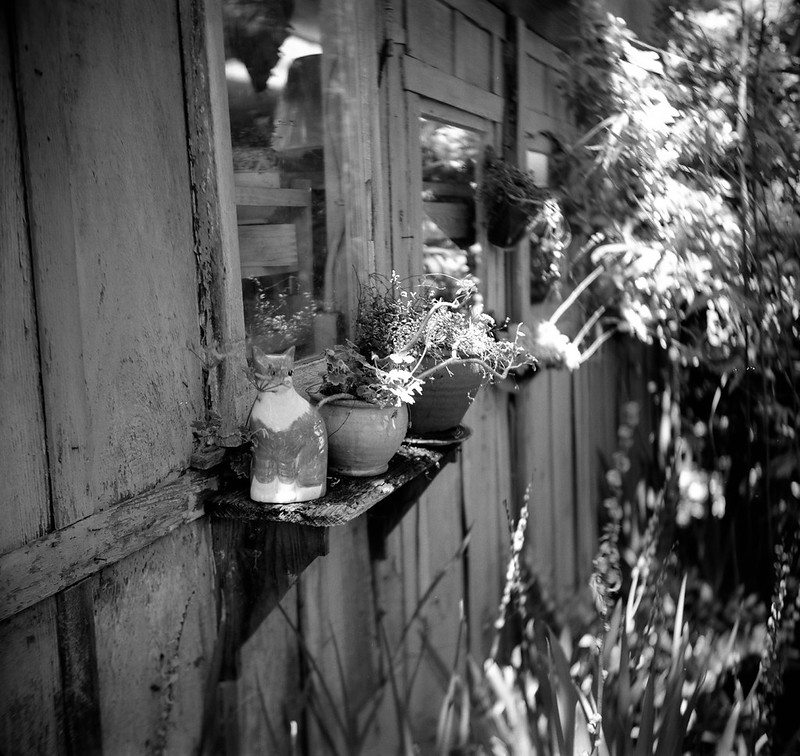
I got pretty good results with medium format triplet lens wide open at f2.9. Here are some example from the Braun Gloria scale-focus folder with 75/2.9 lens, which has uncouple rangefinder so I need to transfer distance.
 

MattKing

Moderator
Moderator
Joined
Apr 24, 2005
Messages
55,480
Location
Delta, BC Canada
Format
Medium Format
A good rule of thumb when using a camera with a depth of field ("D of F") indicator is to use that indicator as if you were using an aperture one stop larger than the one you intend to use.
In other words, if you intend to take your photo at f/8, use the indicator marks for f/5.6.
Then you can determine hyperfocal distance by rotating the focus until f/5.6 on that D of F scale is set against infinity. Your hyperfocal distance will now be set on the camera.
 

Shaps

Subscriber
Allowing Ads
Joined
Mar 29, 2024
Messages
128
Location
Hawaii
Format
Medium Format
One problem with lasers is that it can be difficult to detect where you beam is aimed in bright sunlight. It helps to have a pair of red laser glasses, which also work great for visualizing the effect of a red filter on your camera.

If a "golf rangefinder" is only good for plus/minus a yard accuracy, what use would it be at relatively close distances? At long distances you could simply set your lens to the infinity mark instead.

The Bosch Laser I use has a zoom lens and a very food viewing screen which accurately show what the laser is hitting. To test it out I aimed at a metal street light pole around 75 feet away. Zooming in I could easily adjust the laser so it was reading the pole.
 

Ardpatrick

Subscriber
Allowing Ads
Joined
Sep 7, 2023
Messages
237
Location
Ireland
Format
Med. Format RF
The Bosch Laser I use has a zoom lens and a very food viewing screen which accurately show what the laser is hitting. To test it out I aimed at a metal street light pole around 75 feet away. Zooming in I could easily adjust the laser so it was reading the pole.

Likewise the golf / hunting rangefinders have a viewfinder & generally zoom to 4x or 6x. I don’t think there would be the market for them that there is if they couldn’t be trained on the target easily.
 

Ardpatrick

Subscriber
Allowing Ads
Joined
Sep 7, 2023
Messages
237
Location
Ireland
Format
Med. Format RF
Plus their accuracy is often specified as plus/minus 1 yard/meter. What they don't say, though, is if this is at all measuring ranges or only at long distances. The long-distance aspects of golf/hunting rangefinders doesn't seem to benefit most photography applications of interest to me. The lack of documentation on the close-up performance of those tools (plus the size and cost) make me not willing to try.

For me, the most useful range to get measured accurately is 50 ft and below, assuming a normal FL lens. I've verified a couple of Watameter II rangefinders, as well as a Kodak Retina close-up rangefinder and find them to be accurate and useful tools for photography.

The OP seems to be using lenses up to 105mm.

The lens I’m interested in finding a rangefinder solution for is 210mm. Quite a bit longer.

My lens doesn’t focus closer than 8 metres. Its max aperture is f.8.

As I said to Chan above, it all depends on focal length. The Mamiya 7 50mm for example is a completely different animal to the 210mm, although they’re both part of the same system.
 
OP
OP
runswithsizzers

runswithsizzers

Subscriber
Joined
Jan 19, 2019
Messages
2,046
Location
SW Missouri, USA
Format
Multi Format
I agree you need rangefinder accuracy mostly for short distance and largest aperture opening. For medium format folder, this will typically be about 3-4ft and f/2.8-f/3.5. Almost all folders have DoF on their distance scale, especially for those scale focusing models. So question to @runswithsizzers : does your camera have DoF scale on its lens?
Right now, I have two medium format cameras that require me to know (or estimate) the distance to the subject. These are simple point-and-shoot type cameras, one with fixed focus, and the other with icons for "portrait" "group" and "landscape" but no actual distances on the focusing ring, and no DoF scales. I'm pretty sure I can get by OK without a range finding instrument for these two cameras (although it might be moderately useful to have one, I don't know).

However, I am considering buying a 6x9cm camera, either box type or folding. The reason I started this thread was to explore the kind of issues I will be facing if I get a folding medium format camera which does not have a built-in range finder.
Another key point is that I calibrate BOTH the camera distance scale AND the shoe-mount rangefinder, thus my distance transfer will be always in sync and accurate.

I got pretty good results with medium format triplet lens wide open at f2.9. Here are some example from the Braun Gloria scale-focus folder with 75/2.9 lens, which has uncouple rangefinder so I need to transfer distance.

Thanks for providing those photos! Excellent -- and very similar to the kind of look I am hoping to find.

I never heard of a Braun Gloria before just now. I have seen references to "tube cameras" but I didn't really know what that meant before I looked up some information about the Braun Gloria. Cool!

If I could find a similar camera with a similar lens, but for the 6x9 format (or 6x7 or 6x8), then that would suit me very much! I would love to avoid the potential problems that go along with old bellows. But most box cameras don't offer the controls I want, and I suspect there may not be many rangefinders like yours for medium format that are not-square(?) Will investigate.
 

Ian C

Member
Allowing Ads
Joined
Feb 8, 2009
Messages
1,315
Format
Large Format
In reply to the question of Post #50:

The 6 x 9 cm format most often uses a 0.067 mm circle of confusion diameter. You can use a tighter standard if you wish. A good value would be, say, c = 0.06 mm.

If we compute the hyperfocal distance as a function of focal length f, aperture number N, and circle of confusion diameter c = 0.06 mm, using an 80 mm lens at f/8, we get

H(f, N, c) = H(80 mm, f/8, 0.06mm) gives

H/2 = 6.7 meters, H = 13.4 meters with DOF extending to infinity.


For a 105 mm lens at f/8,

H(105 mm, f/8, 0.06 mm) gives

H/2 = 11.5 meters, H = 23.1 meters, DOF to infinity
 

DREW WILEY

Member
Allowing Ads
Joined
Jul 14, 2011
Messages
14,926
Format
8x10 Format
It would be easier for me to use long tape rule than to unconfuse "circle of confusion" hocus pocus, which certainly wouldn't meet my own standards of focusing anyway. My 6X9's are Fuji RF's ("Texas Leicas"), so no need to guesstimate.
 

Ian C

Member
Allowing Ads
Joined
Feb 8, 2009
Messages
1,315
Format
Large Format
For the 210 mm lens on the Mamiya 7, noted in several posts in this thread, here are the H/2 and H values at f/8, f/11, f/16, and f/22 using the circle of confusion diameter c = 0.059 mm diameter most often used on the 6 x 7 cm format. The value Δ, is the lens increment forward of its infinity position, which you could set with a millimeter scale if wanted. This allows greater precision when setting the focus of a lens that doesn’t couple with the rangefinder. [Of course, this doesn’t work with an internal focus lens.]

f/8, H/2 = 46.8 meters, H = 93.6 meters, Δ = 0.47 mm

f/11, H/2 = 33.1 meters, H = 66.3 meters, Δ = 0.67 mm

f/16, H/2 = 23.5 meters, H = 46.9 meters, Δ = 0.94 mm

f/22, H/2 = 16.6 meters, H = 33.2 meters, Δ = 1.3 mm
 

DREW WILEY

Member
Allowing Ads
Joined
Jul 14, 2011
Messages
14,926
Format
8x10 Format
Shaps - O yeah, thanks for reminding me of that. Bosch themselves didn't have a model with an optical viewer yet when I sold those, but the actual company which manufactured lasers for Bosch did, yet at an awfully high price. Bosch was only interested in mid-level construction lasers; the other company went clear up into satellite responsive survey lasers costing up to around $75,000 apiece (too powerful to legally sell to the public), which would automatically correct for the curvature of the earth!
 

Ian C

Member
Allowing Ads
Joined
Feb 8, 2009
Messages
1,315
Format
Large Format
Regarding Post #63

Yes, that’s the basic idea of hyperfocal focusing. If you can set the focus reasonably accurately at the hyperfocal distance H for the focal length, aperture, and chosen COC of the film, the image recorded on film will be reasonably resolved for subjects from distance H/2 and extending to infinity.

Note that this is not Zone Focusing. In Zone Focusing, we set the focus to a specific FINITE subject distance s and can use the focal length f, aperture number N, and chosen COC value to determine both the near and far (finite) limits of DOF.

In my own work, I like to first choose the near and far limits of DOF. Then I can determine the ideal subject distance s and calculate the required aperture number N that satisfies these conditions. Then I can use N or something slightly greater (larger f-number) to ensure that the DOF will be at least as deep as wanted without choosing an unnecessarily small aperture value.

Both hyperfocal focusing and zone focusing are useful. Which to use depends on the situation. Using hyperfocal focusing is generally easier because you can construct a DOF table quickly for any lens and format ahead of time.

Zone focusing is more practical if you have a device that you can carry with you out into the field for calculation. You’ll also need some way to measure distances on the fly, most often a rangefinder or measuring tape.
 

Ardpatrick

Subscriber
Allowing Ads
Joined
Sep 7, 2023
Messages
237
Location
Ireland
Format
Med. Format RF
Regarding Post #63

Yes, that’s the basic idea of hyperfocal focusing. If you can set the focus reasonably accurately at the hyperfocal distance H for the focal length, aperture, and chosen COC of the film, the image recorded on film will be reasonably resolved for subjects from distance H/2 and extending to infinity.

Note that this is not Zone Focusing. In Zone Focusing, we set the focus to a specific FINITE subject distance s and can use the focal length f, aperture number N, and chosen COC value to determine both the near and far (finite) limits of DOF.

In my own work, I like to first choose the near and far limits of DOF. Then I can determine the ideal subject distance s and calculate the required aperture number N that satisfies these conditions. Then I can use N or something slightly greater (larger f-number) to ensure that the DOF will be at least as deep as wanted without choosing an unnecessarily small aperture value.

Both hyperfocal focusing and zone focusing are useful. Which to use depends on the situation. Using hyperfocal focusing is generally easier because you can construct a DOF table quickly for any lens and format ahead of time.

Zone focusing is more practical if you have a device that you can carry with you out into the field for calculation. You’ll also need some way to measure distances on the fly, most often a rangefinder or measuring tape.

Thank you Ian. Incredibly helpful of you.
 

eli griggs

Subscriber
Allowing Ads
Joined
Nov 15, 2005
Messages
4,041
Location
NC
Format
Multi Format
I bit the bullet and bought the Leica laser rangefinder which gets fairly close, within the eight yards of Hasselblad 500mm and I also have an old mechanic finder for closer use.

My thinking is both travel well and I have a big bag that’ll allow zone focusing set ups, so long as the basic target will fall within my pre targeted range.

The Leica is dead simple and gives angles in degrees, as well as distance.
 
Last edited:

DREW WILEY

Member
Allowing Ads
Joined
Jul 14, 2011
Messages
14,926
Format
8x10 Format
Oh gosh, forgot about Leica. I sold some of those too; they're from the Leica survey optics division, unrelated to the cameras. ... The only thing in common seems to be ludicrous ripoff pricing for junky made-in- China Leica survey tripods with a thousand percent markup on them, just like a Leica branded belt buckle, lapel pin, or beer bottle opener. The laser distance meters, however, were quite reasonably priced. Leica of course didn't actually make those, but had their own little features and tweaks.
 
Photrio.com contains affiliate links to products. We may receive a commission for purchases made through these links.
To read our full affiliate disclosure statement please click Here.

PHOTRIO PARTNERS EQUALLY FUNDING OUR COMMUNITY:


Ilford ADOX Freestyle Photographic Stearman Press Weldon Color Lab Blue Moon Camera & Machine
Top Bottom
