

George Mann
Member
Two trolls accusing me of trolling. Brilliant.


Sure, Dan. Easy peasy. When trolls troll, and others take the bait, resulting wrangles have nothing to do with the thread topic. They're simply the thing that sustains trolls.Will someone please explain what this pointless wrangle about LF lenses and the existence, or not, of active ultra large format photographers has to do with the question of whether, in general, recently designed lenses intended for use with digital sensors are safe to use with film?


They do exist....now.
Essentially, with a DSLR you are still limited by having to provide geometric correction that looks good enough in the viewfinder not to be too offensive.
With newer camera's where all viewing is through a EVF that shows a image that has already been corrected this goes completely out of the window.
For example on the L Mount platform, the 24-105mm zoom has such strong and complex distortion at the wide end that i couldn't ever imagine disabling correction.
That said, unless you explicitly disable it you would never know as it's corrected throughout the whole pipeline of viewfinder -> on camera preview -> editing -> output.
Also, in my personal testing the 24-105 f/4 is sharper then my Summicron-R 50 at f/4 so i suppose the engineers know what they are doing
Will someone please explain what this pointless wrangle about LF lenses and the existence, or not, of active ultra large format photographers has to do with the question of whether, in general, recently designed lenses intended for use with digital sensors are safe to use with film?
That said, given that throughout the whole image pipeline this is never visible to the end user i have 0 problem with this, especially given the performance otherwise of the system-as-a-whole.
Phone lenses have shown us that the final image bears little relation to our emotional expectation of the optics. A lens the size of a raindrop delivers what many brass and glass behemoths failed to provide.That said, given that throughout the whole image pipeline this is never visible to the end user i have 0 problem with this
A Plasmat is not a Planar. Plasmat is a development of the Dagor; the Planar is a double Gauss - just like the Summicron, and most other fast 50s for 35mm.a modern plasmat (aka planar) is inferior ?
to what?
and in what way exactly?

A Plasmat is not a Planar. Plasmat is a development of the Dagor; the Planar is a double Gauss - just like the Summicron, and most other fast 50s for 35mm.

Are you sure this is a fact? I reacll a very good thread on the internet on Robert Monaghan's website where this claim was discussed and then disproven.and pointed out the fact that large format lenses have less resolution than good 35mm primes.
Are you sure this is a fact? I reacll a very good thread on the internet on Robert Monaghan's website where this claim was discussed and then disproven.
How can we ever be sure of anything beyond what our own experience tells us?

How can we ever be sure of anything beyond what our own experience tells us?
Is this a philosophical question?
Show me a large format lens that will out-resolve a good 35mm prime.
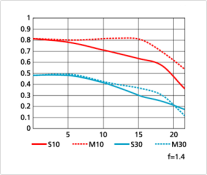
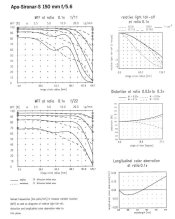
I long ago determined that any popular lens that wasn't broken or damaged, met my quality expectations. There are plastic optics whose aberrations are sufficient to exclude potentially important detail, and likewise there are lenses that will resolve a few more lines per millimetre - at a price. On the whole however, any decent quality lens occupies a set of expectations within its design and photographic format. Or put a different way, the subject - and to a lesser though important extent it's processing and printing - are more important than the exact rendering of a lens.Is this a philosophical question?
I have a Sigma Art lens which is great for digi so i wonder how this would work on film.
It seems that I was the only one that answered the question. Seeing that is what I use.
And it was ignored...
SNIP
That's less true of some digital formats, where peak performance is wide open or within one stop of it. Micro four thirds is into diffraction territory by f5.6, and f4 gives front to back sharpness which is wide open for many zoom lenses.Sorry. But the results of a wide open lense does not equated to it's optimal performance potential.
I long ago determined that any popular lens that wasn't broken or damaged, met my quality expectations. There are plastic optics whose aberrations are sufficient to exclude potentially important detail, and likewise there are lenses that will resolve a few more lines per millimetre - at a price. On the whole however, any decent quality lens occupies a set of expectations within its design and photographic format. Or put a different way, the subject - and to a lesser though important extent it's processing and printing - are more important than the exact rendering of a lens...
We have our preferences for sure. I've done a few editorial portraits recently, and use a couple of vintage lenses on digital which render nicely, whereas others do not. They are f2 and look better than my f1.4 alternatives. Except for portraits, the bokeh obsession is lost on me. Extreme subject isolation for its own sake is not something I'm interested in. At f5.6 and f8 most lenses look pretty similar, and that's where I mostly shoot.To some degree that may be true, but some lenses have a nice "look", while others create a fair image but are neutral (and that is ok for many shots). Even if you do not care about "bokeh", some lenses have disturbing or otherwise lousy bokeh, and that can distract of a photograph.
That's less true of some digital formats, where peak performance is wide open or within one stop of it. Micro four thirds is into diffraction territory by f5.6, and f4 gives front to back sharpness which is wide open for many zoom lenses.
| Photrio.com contains affiliate links to products. We may receive a commission for purchases made through these links. To read our full affiliate disclosure statement please click Here. |
PHOTRIO PARTNERS EQUALLY FUNDING OUR COMMUNITY:  |
