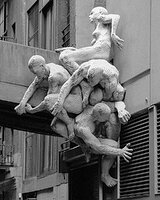
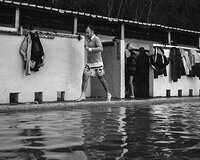
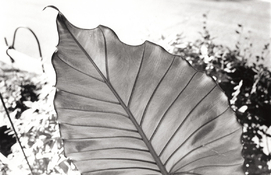
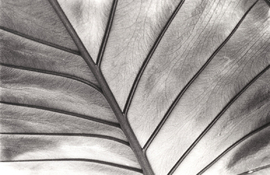
Of late, I've been doing a lot of fiddling with developers to optimize acutance - which typically is expressed as images appearing more "sharp". A lot of this has to do with edge transitions (see the examples below) rather than absolute sharpness.
It is also my experience that maintaining good local contrast in the midtones, especially, improves the perception of sharpness.
There is no magic here. Digital can do unsharp masking to improve edge transitions, and there is plenty of post processing possible to improve local contrast. Moreover, tools like Topaz can do all manner of automated image repair.
The perception the digital is magically sharper stems from two things I think.
First, analog is a lot clumsier to post process in the darkroom than something from a digisnapper going onto a Mac for quick fixes. I have worked in the darkroom for 50 years and I am well aware how much effort it takes to really get a silver print right. I see tons of promising analog images that have not been sufficiently "tuned" in the darkroom after capture. The photographers just seem to give up after a certain point or - perhaps - lack the darkroom technique. IOW, it's more likely - IMHO - that someone will take the extra time with digital post production, because it's just easier.
Secondly, the overwhelming majority of digital images I see are dreadfully over produced with post processing adjustment, Excessive HDR "fixes", over saturation, and - yes - too much unsharp masking gives so many promising digital images a kind of garish, bordering on cartoon like look. And that look absolutely can appear astonishingly sharp, if not terribly aesthetically interesting.
Here are a couple images shot handheld with a Nikon F3 and a 35mm Ai-S f/1.4. I was experimenting with what Double-X would do in a small format with respect to edge transitions and apparent grain. I have no doubt that a mirror lockup and tripod would have made these even sharper. Even so, note the nice edge transitions and how the midtone local contrast is held by means of highly dilute, low agitation (EMA) in Pyrocat-HD.
These are scans of my "workbook" silver prints. The only post scanning adjustments I make is to try to match the physical print as best as possible to overcome scanning artifacts. They're not final and could still bear futher refinement. But these are 8x10s I make as a record of work I may later want to make into wall hangings. These are printed pretty much edge-to-edge from the negative onto an 8x10 sheet: