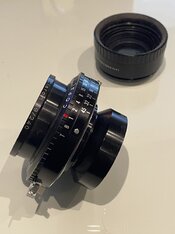
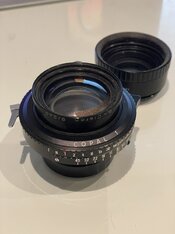
According to Schneider the G-Claron's were approprate for distance focus (as opposed to macro) when stopped down to ƒ22. Not that plenty of people haven't shot them open wider. If the old aperture scale was for a 210 ƒ4.5 lens then then you may not need to change anything, other than knowing that anything reading wider than ƒ9 won't get you more light. You can get a ballpark estimate on that by doing the folloing:
- open the shutter into focusing mode and open the aperture wide open.
- look through the lens with enough light behind it that you can easily see the opening. At this point the opening will look perfectly circular because it is hiding behind a circular max opening on the lens elements themselves
- while looking through the lens slowly close the aperture down until you see the blades come into view. This will be obvious because these later copal shutters don't have that many blades so the aperture will go from geing perfectly circular to being pentagonal or hexagonal (not sure how many aperture blades)
- move the aperture back and forth a couple times to narrow down to the exact spot where the blades start to become visible
- without accidentally moving the aperture adjuster, take a look at where it is indicating. If it is just higher than ƒ8, i.e. ƒ9, then congrats--the shutter doesn't need an aperture scale, just know that it will never be wider than ƒ9, but any reading above ƒ9 will be close to accurate.
I've transplanted a number of lenses into shutters and made my own aperture scales. The above steps are the second half of that process, and essentially allow you to find the maximum aperture. I've done that on 4 G-Clarons (2 210s, a 270 and a 355) and a bunch of other lenses and frequently spot check my work with calipers to confirm correctness.
If you find that the steps above place the max aperture some other spot than ƒ9, then I can post the easy steps to create the entire aperture scale on a piece of tape. I've posten them in other places, but I'm not sure where, so I can't provide a link. The only work on later shutters (like the one you have) that have stops equidistant on the scale (i.e. 1 stop is always the same distance of movement on the selector whether at the wide end (ƒ5.6-ƒ8) or the narrow end (ƒ45-ƒ64). It takes me 5 minutes to do the whole process.