• Welcome to Photrio!
    Registration is fast and free. Join today to unlock search, see fewer ads, and access all forum features.
    Click here to sign up

Algorithm to find characteristic curve

Recent Classifieds

Forum statistics

Threads
203,199
Messages
2,851,172
Members
101,718
Latest member
ClassyJ
Recent bookmarks
4
What is x and what is y?
I hope y is density and x is log of exposure in lux.seconds?
 
This means that for a characteristic curve, you'd better include some points through the shoulder and toe regions, and the further out you can get data from those regions, the better.

I found that things went a lot easier when I realized that you can simply add more points in the base+fog region with not calculations as exposures less than what gives base+fog always give base+fog density. So it's easy to add more points there.

Sometimes, when I do N minus developments, I don't get enough density range to exceed the exposure range of the paper, so I take the last 3 or 4 points on the curve (the ones with the most exposure) and then linear fit a line going out from those points. It's close enough to get me where I need for what I wanted.
 
What is x and what is y?
I hope y is density and x is log of exposure in lux.seconds?
Yes, those are the values I used. I calculate exposure by metering with my ambient meter with a flat dome and then I convert EV into lux. I use 1 second exposures so the exposure is lux-seconds.
 
You don't really need to bother with fitting all the stuff on the straight line portion, so why bother with it!

Actually some film developers seem to have a very wavy straight line portion. The FineArt Photo Supply stuff that was so hyped by them was terrible in this regard. Terrible, unless it happened to increase and decrease contrast just where you wanted it. But it would be a crap shoot (literally) for any image. SO it's at least good to check the straight line portion.
 
The problem is building the integrating light "sphere".

You don't necessarily need a integrating sphere. It all depends on what you find acceptable.

An intergrating sphere is needed for "diffuse" density readings. Anon Ymous may be fine with a non-diffuse or specular density reading. It makes things a little off when comparing to density readings by other people, but as long as his "system" is set up using it, it may be just fine.

Keep in mind that you can make a densitometer that has a light source that is either specular or diffuse, and you can combine it with a light sensor that is likewise specular or diffuse. This give one the possiblity of 4 types of densitometers:

  1. diffuse light/diffuse sensor,
  2. diffuse light/specular sensor,
  3. specular light/diffuse sensor, and,
  4. specular light/specular sensor.

Most commercial densitometers use the type listed in #1, while a person that puts film in the enlarger's film stage and then meters off the baseboard is using type #2 if it is a diffusion/color or cold light head, a person with film in a condensor or point-source enlarger's film stage and then meters off the baseboard is using the design in #4, and finally, if you use the enlarger light source and then place the film ontop of the sensor with the sensor on the baseboard, then you have a design of type #3 (well, close to #3 depending on how narrow the view of the sensor is of the film).

There's a lot of ways to make a densitometer.
 
Actually some film developers seem to have a very wavy straight line portion. The FineArt Photo Supply stuff that was so hyped by them was terrible in this regard. Terrible, unless it happened to increase and decrease contrast just where you wanted it. But it would be a crap shoot (literally) for any image. SO it's at least good to check the straight line portion.

Are you trying to determine film speed and paper range? Well, you really only need to know the data at the toe and at some point up the "straight line" portion of the density range. What's between is not needed to determine film speed and paper range.

Certainly you can learn a lot about a film and how it acts in a developer by looking at the whole range, but you don't need it for calculations here.
 
Yes, those are the values I used. I calculate exposure by metering with my ambient meter with a flat dome and then I convert EV into lux. I use 1 second exposures so the exposure is lux-seconds.

The curve using your function doesn't look right. Can you send me something like a spreadsheet?
 
Sure - can you PM me your email address?
 
Oh, and yes, I use log(exposure) as I forgot to mention that above.
 
Are you trying to determine film speed and paper range? Well, you really only need to know the data at the toe and at some point up the "straight line" portion of the density range. What's between is not needed to determine film speed and paper range.

Certainly you can learn a lot about a film and how it acts in a developer by looking at the whole range, but you don't need it for calculations here.

I'm not just trying to determine film speed. My immediate goal is to automate the paper profiling for my Analyser so I can try out a range of papers all at the exact same contrast grade and effective exposure. But if I get this film and paper function part down I can expand the tool to do film speed and development tests.
 
L Gebhardt,

As you are already busy with making a sensitometric tool: What about a tool for making that 4-quadrant Tone Reproduction graph?
 
I've found that film curves are fairly easy to get a polynomial to fit with, but paper curves don't work so well. I hope the cubic spline is going to work well for this.

The solving for Y=.1 is exactly what I am hoping to accomplish programatically. I may need to go to an iterative estimate (just now looking at some CubicSpline code), but it should be more than good enough for what I want. It's not like I will need to efficiently solve millions of them a second.

A cubic spline should easily handle either of those curves. If you post some values, I can fit a spline to it and give you F(y=.1). I would imagine you can piece-meal a function together too for a characteristic curve since it has 3 well defined zones...
 
Your best bet is to find a spline and then make a piecewise function, if you're making a webpage or something to be integrated into your analyzer directly, all you have to do is keep a database of the functions, and there are assembler (for your analyzer) and python/ajax/perl/every language imaginable ways to solve your functions for a certain point.

Ben
 
But solving it for Y=0.1 is time consuming, even with a computer.

Sounds like you just need a better algorithm. This should be blazingly fast on any vaguely modern computer. Use the Newton-Raphson method. You should be able to find code for this online in any number of languges (much better than having to verify, test, and debug a numerical algorithm yourself). An implementation is in Numerical Recipes in C as well.
 
This stuff is fascinating, but a little over my head- could one of you guys explain in layman's terms how this type of analysis fits into your image making process?

Is it that, knowing the density curve of the film enables you to place your image densities on the optimal portion? :confused:
 
This stuff is fascinating, but a little over my head- could one of you guys explain in layman's terms how this type of analysis fits into your image making process?

Is it that, knowing the density curve of the film enables you to place your image densities on the optimal portion? :confused:

Yes!

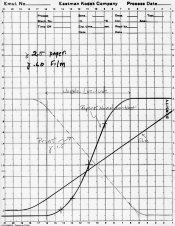
Here is an overlay with negative, paper and print superimposed to show their approximate relationship.

The film contrast is 0.6, the paper is 2.5 and the print is the product of these two or 1.5. Normally, print contrast may vary from 1.5 - 1.8 depending on the contrast of the paper and other factors such as flare. The toe and shoulder will also determine the degree of contrast needed in the print to satisfy the eye of the beholder.

I should add that with enought points such as a 21 step chart, you don't much need an algorithm to fit a curve as the curve is so smooth and self drawing in the sense that the points generally fall into alignment with great precision.

PE
 

Attachments

  • film-paper-print curves.jpg
    film-paper-print curves.jpg
    157.2 KB · Views: 128
Thanks for taking the time to share your knowledge-

So, with the papers inherent contrast being so much higher, the range of densities on the film must be radically compressed to fit between the toe and shoulder of the paper?

...is there a way to make paper "longer scale"? wouldn't such a paper be far superior?
 
The longer the scale, the lower the contrast. Paper does not limit the tone scale in and of itself. The tone scale is limited by physical considerations such as the dmax of the paper, which is limited to about 2.2 on glossy paper due to internal reflections of light.

PE
 
Photrio.com contains affiliate links to products. We may receive a commission for purchases made through these links.
To read our full affiliate disclosure statement please click Here.

PHOTRIO PARTNERS EQUALLY FUNDING OUR COMMUNITY:



Ilford ADOX Freestyle Photographic Stearman Press Weldon Color Lab Blue Moon Camera & Machine
Top Bottom