• Welcome to Photrio!
    Registration is fast and free. Join today to unlock search, see fewer ads, and access all forum features.
    Click here to sign up

Acetic acid as stop bath for film?

Wheels within Wheels

D
Wheels within Wheels

  • 1
  • 0
  • 0
R-A-O-B Club

A
R-A-O-B Club

  • 0
  • 0
  • 8

Recent Classifieds

Forum statistics

Threads
203,220
Messages
2,851,642
Members
101,730
Latest member
joswr1ght
Recent bookmarks
0
I have read all of the Kodak Technical Publications for B&W film processing and they all state the same as the reference I originally gave.

BTW. The last definitive work on image stability of B&W done at Ilford was post Mason. It was done by D. Beveridge et al. and never published, just delivered as a lecture at a conference. Dr. Beveridge is now working on digital products at Ilford from my understanding, unless he has retired. I do not have details of his talk.

PE
 
I use Glacial Acetic Acid diluted 3:8 then I add 1.5 ounces of this dilution to 32 ounces of filtered water to make a working stop bath for paper. For film I add 1.0 ounce of the dilute form to 32 ounces of water for working stop bath. I usually use a Brita water filter set to remove contaminates from tap water that I then use to dilute the Glacial Acetic Acid and make the working stop bath. One gallon of Glacial Acetic Acid lasts me for about year!
Bill
 
Ron, why don't you ever read the references you post/quote properly ?

The Ilford datasheet you linked to states:

For spiral tank use, when a non-hardening Fixer has been used, the following method ot washing is recommended. This method of washing is Faster, uses less water yet still gives negatives of archival permanence.


1 Process the film in a spiral tank.
2 Fix it using ILFORD HYPAM fixer.
3 After fixation, fill the tank with water at the same
temperature as the processing solutions, and invert it five times.
4 Drain the water away and refill. Invert the tank ten times.
5 Drain and refill it for the third time and invert the tank twenty times. Drain the water away.

Also when taking data from a Kodak source one has to remember their wash recommendations are based on the possible use of Kodafix - a Sodium Thiosulphate based fixer with a hardener.

Ian
 
Mixing all of your chemicals and creating a water bath for them to sit in half an hour or so before processing will help you keep temperatures the same from chemical to chemical. Keep lids on the air-sensitive chemicals to cut down on oxidation. In moderate weather you need not make the bath anything but room temperature, and use time-temperature compensation to your development. That will make things the most stable throughout the process, rather than trying to maintain a temperature other than ambient, which requires constant tinkering. In cold weather, you will have to tinker with hot and cold taps to try and find a good balance. (Hint: do not run the water too fast, or you will run out of hot water.) In hot weather, you can use pitchers of cold water to cool the bath.

I now use an automatic tempered water bath; it is similar to a Jobo, but without the motor. (It was designed so that a water jet hits ridges on the tanks, causing the tanks to spin, but I just use it for its automatic temperature maintenance abilities.) I am thinking about designing a cover for it and insulating the bottom and sides of the tray to help keep the temperature from drifting.
 
Ron, why don't you ever read the references you post/quote properly ?

The Ilford datasheet you linked to states:

For spiral tank use, when a non-hardening Fixer has been used, the following method ot washing is recommended. This method of washing is Faster, uses less water yet still gives negatives of archival permanence.


1 Process the film in a spiral tank.
2 Fix it using ILFORD HYPAM fixer.
3 After fixation, fill the tank with water at the same
temperature as the processing solutions, and invert it five times.
4 Drain the water away and refill. Invert the tank ten times.
5 Drain and refill it for the third time and invert the tank twenty times. Drain the water away.

Also when taking data from a Kodak source one has to remember their wash recommendations are based on the possible use of Kodafix - a Sodium Thiosulphate based fixer with a hardener.

Ian

Ian;

I read the Kodak data sheets and they are all the SAME, not DIFFERENT as you claim. I read the entire Ilford data sheet and it FIRST states wash in running water but THEN states what you did above. I mentioned BOTH of these options in my post which refers to Ilford, but you mention only the one that suits your purpose.

I am not opposed to either method, but prefer running water! It is, after all, the safest method. The reasoning here is that the dump method can lead to variations more easily if you have 1 print or a stack of prints, as the volume of water needed will vary and the agitation becomes more critical. Simple logical reasoning can lead you to this conclusion easily.

ALL books and instruction mention the running water option FIRST or as the ONLY option (Kodak which does not differentiate between fixers at all even though all are listed). Kodak does differentiate fixing times though, so they could split out wash times as well, but they do not.

In the final analysis, if your prints or negatives test free of retained hypo and silver you have done the job washing them.

PE
 
66 million liters of stop on the wall, 66 million liters of stop... you take one down, pass it around.....
 
65.999999 million litres of stop on the wall, 65.999999 million litres of stop... you take one down, pass it around....

(Hey Sirius Steve! Guess what is going to be the longest thread on APUG now?!)
 
You guys might be right!

Washing, why is it always washing. If it isn't washing it is stop baths. IDK why, when Kodak states clearly that continuous washing and the use of a stop bath is preferred. Ilford gives continuous washing the pride of being placed first in their list of wash methods too and also suggest a stop bath. Oh well.

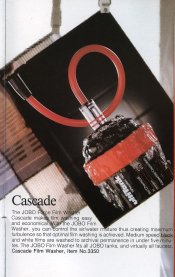
Here is (or was) an ad for a standard film (and print) washer back in the good old days of Jobo and spiral reels and all that other nice stuff.

You will note that it is designed for continuous washing as are all of the finest archival print washers that I have seen.

You might be right. With this, it is time to quit.

PE
 

Attachments

  • jobo washer.jpg
    jobo washer.jpg
    271.3 KB · Views: 136
Joking aside, you are too easily ignoring the fact that the dump and refill method too will not reach 'zero' concentration. Certainly not in the three times refill method you are now advocating.

Taken out of context : THAT 3 times was referring to qualitative chemical analysis, which you most likely have no clue what is.

ILFORD states that 3 times is enough.

Or 30 minutes of running water, which Kodak also says ...... but recommends a thiosulphite test to make sure the thiosulphate levels has "decreased to a safe level" - which is a very serious qualifyer in my book.

I recommends and does 6 changes, just the same as I earlier did 60 minutes of running water instead of 30 minutes, just to make sure......

The interesting bit, from a chemical analysis standpoint, is that going 60 minutes of running water will decrease whatever concentration there was at 30 minutes to about half of that.

While doing 6 changes instead of 3 times will decrease the concentration to between 1/1000 to 1/10 000th of the concentration there ever was at 3 changes of water.

That is a very significant difference! Besides it saves hundreds if not thousands of gallons of clean water!


I simply fail to understand what is so hard to accept or hard to understand here. If you don't understand it, simply trust those that know better!
 
Not meaning to egg you on, but which would be correct stop and wash for HABS/HAER?

I don't think my negatives will last 500 years the way I currently process and store them, so maybe I need to touch base with a standard I can follow that will.
 
Bill, from my POV, the best wash is continuus such that for the number of rolls or sheets processed give a negative test for retained silver or hypo at the end. Once you establish that, then you can keep that process as your standard.

Remember that a tiny amount of hypo must remain for ultimate stability so you can overwash. This has been covered elsewhere.

PE
 
Taken out of context : THAT 3 times was referring to qualitative chemical analysis, which you most likely have no clue what is.

[...]

I simply fail to understand what is so hard to accept or hard to understand here. If you don't understand it, simply trust those that know better!

Yes, Erik. Just keep fooling yourself that you are right because noone else has a clue.

When you get tired of trusting only yourself, you might want to look for the errors in your thinking.

But before you do, why not test both methods: try them both and test the drops collected from the film at the end of the process for residual thiosulphate.

Should be easy for someone so versed in analytical chemistry as you are.

And it doesn't tax your mental skills at all, so circumvents the problem you have understanding the milions of litres fallacy.
Can you grasp that concept: you not being able to understand something?
 
Yeah the millions of liters thing is ridiculous. It's only valid if the volumetric space of the tank keeps increasing to hold it all. Lame.
 
Interestingly Kodak suggest a 5 minute wash in running water after HCA but:

Run the wash water fast enough to provide a complete change of water in the container in 5 minutes.


OK that means in a Paterson 35mm tank you use 275ml water in 5 minutes. This is not enough to provide sufficient dilution.

However this makes more sense:

For rapid washing in a small tank, fill the tank to overflowing with fresh water and then dump it all out. Repeat this cycle 10 times

That means a film gets washed well with 2.75 litres of water.

Both statements taken from Kodak J86 "Tmax Developer" but the same is in other current Kodak Publications.

Ian
 
I don't think the debate was really over dumping the tank vs constant water, etc. it was really around the crazy analogies of 66M litres of water needed to achieve the same dilution as 6 fill/dumps.
 
I don't think the debate was really over dumping the tank vs constant water, etc. it was really around the crazy analogies of 66M litres of water needed to achieve the same dilution as 6 fill/dumps.

I missed that bit :D

However if you put some food dye in water in a tank it needs a lot of running water before the last trace disappears while the fill & dump system gets there very much faster with far less water usage.

Ian
 
I used the Kodak technical publications for the films, and the Kodak B&W Darkroom Dataguide.

In all cases, Kodak suggests using a stop bath, but they give up to 6 different wash cycles. There are 4 for paper and 2 for film. One set is for normal wash and the other is for archival washing. All washes involve running water, but some include dumps with running water as noted above, 10 dumps using running water to fill the container.

The paper instructions include both RC and FB. It also gives instructions for washing with and without HCA. The wash times with HCA are much shorter.

In the final analysis, the Kodak instructions always conclude with the recommendation to test the paper or film with test solutions for retained Hypo and Silver, something I have said all along.

PE
 
You idiots are making me want to shoot digital! :wink:
 
Interestingly Kodak suggest a 5 minute wash in running water after HCA but:

Run the wash water fast enough to provide a complete change of water in the container in 5 minutes.


OK that means in a Paterson 35mm tank you use 275ml water in 5 minutes. This is not enough to provide sufficient dilution.

Ian

Ian - I always took the "complete change of water" to mean that all the water that was in the tank at the start of the 5 minute period was replaced by the end of the 5 minute period. While you state that it will only take 275 mls to do that, I think the variability of mixing will require that much more than 275 mls will be needed. As you mention, do the drop of dye test on that tank and see if all if the dye is gone after flowing only 275 mls into the tank. I don't think it will and it will take much more water than that to do a "complete change".
 
Ian - I always took the "complete change of water" to mean that all the water that was in the tank at the start of the 5 minute period was replaced by the end of the 5 minute period. While you state that it will only take 275 mls to do that, I think the variability of mixing will require that much more than 275 mls will be needed. As you mention, do the drop of dye test on that tank and see if all if the dye is gone after flowing only 275 mls into the tank. I don't think it will and it will take much more water than that to do a "complete change".

My comment was really saying the same as you it's just that the way Kodak write that part is rather vague and open to possible washing errors if taken literally.

The food dye test is a very good way of showing just how good the dilution effect is. Most people who use running water would use a flow rate way in excess of that literal interpretation because for a 35mm film in a small tank that would be barely more than a dripping tap :D

Ian
 
All the posts, literature, testing and recommendations on washing won't change one's own HT-2 test results.
 
Photrio.com contains affiliate links to products. We may receive a commission for purchases made through these links.
To read our full affiliate disclosure statement please click Here.

PHOTRIO PARTNERS EQUALLY FUNDING OUR COMMUNITY:



Ilford ADOX Freestyle Photographic Stearman Press Weldon Color Lab Blue Moon Camera & Machine
Top Bottom