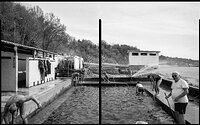
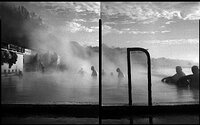
In my youth, I despised middle grays. It seemed that a big, middle gray smudge was all you got from the Kmart photo from your B&W roll. A big, fuzzy, gray mess.
And in school, we worked with Polycontrast paper, but I never once used the contrast filters to print my enlargements. Not once.
I was more concerned with not blowing the highlights to paper white than to anything else.
Not until much later, did I understand than yes, midtones are great. Highlights must be protected. But what makes or breaks a B&W image are the blacks: rich, deep, dark. And they must be substantial and anchor everything else. I think artists speak of positive and negative space sometimes. I think of it as blacks and whites balancing each other.
As to your post, a friend in school did a lot of contrasty stuff for music and bands, especially staged shows. It helps that pushing a roll of film kinda does this anyhow. Seems like music is perfect for that. Punk rock. Ha. Ha.
I prefer creamy, almost sugar powdery grain, beautiful full 10-11 Zones of gradient variance, but deep solid blacks. Slow film. Fine grain. Gentle processing.
And not just in B&W, lately I’ve been experimenting a lot pulling film. I tend to shoot lazy, ie at less than optimal times of the day, when the sun is high and shadows are at their worse….
Exposing for the shadows and pulling processing a bit does wonders.
Thanks for posting this.