• Welcome to Photrio!
    Registration is fast and free. Join today to unlock search, see fewer ads, and access all forum features.
    Click here to sign up

Getting to the bottom of Cinestill E6 Dev kit

Dump Truck Hat Trick

D
Dump Truck Hat Trick

  • 0
  • 0
  • 0
Street-Lamp

A
Street-Lamp

  • 2
  • 2
  • 65

Recent Classifieds

Forum statistics

Threads
204,296
Messages
2,866,842
Members
102,216
Latest member
Orthophlegmatic
Recent bookmarks
0
Jumping into discussion out of nowhere 🙂 from what I have learned from Stefan Lange, a guy who reverse engineered the E6 formulas here https://www.photrio.com/forum/threads/e6-homebrew-chromebrew-warnig-longer-than-assumend.32721/ (starting from patent formulas of Fuji and Derek Watkins) the yellow-blue axis is controlled by the amount of potassium iodide while the magenta-green axis is controlled by the color developer pH [higher -> more green, lower -> more magenta]. Indeed, the pH can be raised with sodium hydroxide and lowered with acetic acid, but that's just for magenta-green. I think the yellow tint is acquired by changing the iodide content
Oh please join in whenever! I'm definitely adding to this over years for whoever to stumble upon when they need it. This is a goldmine of info for this, ty for sharing! will have some vital info now :D
 
Jumping into discussion out of nowhere 🙂 from what I have learned from Stefan Lange, a guy who reverse engineered the E6 formulas here https://www.photrio.com/forum/threads/e6-homebrew-chromebrew-warnig-longer-than-assumend.32721/ (starting from patent formulas of Fuji and Derek Watkins) the yellow-blue axis is controlled by the amount of potassium iodide while the magenta-green axis is controlled by the color developer pH [higher -> more green, lower -> more magenta]. Indeed, the pH can be raised with sodium hydroxide and lowered with acetic acid, but that's just for magenta-green. I think the yellow tint is acquired by changing the iodide content

My empirical experience disagrees, but that was 25 years ago...things change.
 
From my lab days, running Kodak E6 chems, adding sodium hydroxide (alkali) to the color developer was used to keep the blue/yellow axis in check.
Based on that, my suspicion is that the Cinestill "T6" color developer is quite acidic to obtain blue results.

I can' t comment on CineStill, as it is not a standard 6 bath E6 process. But standard E6 has a built in problem because of carryover of reversal bath, which is acidic, into the color developer. The reversal actually happens only when the film immersed in reversal bath hits the alkaline color developer. This means that in replenished process with substantial output (machines in labs), the pH of the color developer needs to be monitored and corrected when it gets too acidic. You can't add a wash step here, as the reversal would not work.
 
But standard E6 has a built in problem because of carryover of reversal bath

Indeed you are right about this carryover. If you develop at home your films, you can try an .. E5 process 🙂 replacing the reversal bath (fogging bath) with old-school light fogging. You simply take the reel out from the tank an keep it under a lamp for few minutes, or you can fire a flash few times around the reel. That's not something to do in a lab, but it's ok for home, where you are trying to keep your chemistry as healthy as possible. I am doing it and it's just fine.
 
Jumping into discussion out of nowhere 🙂 from what I have learned from Stefan Lange, a guy who reverse engineered the E6 formulas here https://www.photrio.com/forum/threads/e6-homebrew-chromebrew-warnig-longer-than-assumend.32721/ (starting from patent formulas of Fuji and Derek Watkins) the yellow-blue axis is controlled by the amount of potassium iodide while the magenta-green axis is controlled by the color developer pH [higher -> more green, lower -> more magenta]. Indeed, the pH can be raised with sodium hydroxide and lowered with acetic acid, but that's just for magenta-green. I think the yellow tint is acquired by changing the iodide content

By citrazinic acid, not by pH(or not only by pH). It competes with magenta couplers
 
Using an online OCR and a document translator, I managed to extract 2 pages out of Shadrin's scanned book that was shared before by @LeoniD . I am attaching my PDF. I was interested in processing errors, that's why I spent time only on these pages.
 

Attachments

  • E6_Processing_Defects_Shadrin-1992.pdf
    33.6 KB · Views: 329
Using an online OCR and a document translator, I managed to extract 2 pages out of Shadrin's scanned book that was shared before by @LeoniD . I am attaching my PDF. I was interested in processing errors, that's why I spent time only on these pages.

This is also important to note:
"
Citrazinic acid is one of the key reagents of the E-6 process. The reason is that
by the technology for the production of color reversal photographic films the purple dye component is introduced into the material in
excess. This is explained by complex optical reasons. If we
treat the photographic film with a solution of color developer that does not contain
pressing citrazic acid, the image balance will be greatly
shifted to the purple side, due to the excess formation of magenta dye. Even a pinkish fog will appear in light areas.
Other dyes are formed only in slight excess.
It becomes obvious that the purple component
requires lower color developing agent concentration than other components
. This means that, in one solution
the concentration of CD-3 should be both high and low. Satisfying this seemingly absurd requirement
achieved by introducing citrazinic acid into the solution. Mechanism
here's the next one. At the moment of merging parts “A” and “B” of the developer
citrazinic acid interacts with color developing agent and forms a complex colored complex (by the way,
This is why the solution takes on a tea color). Concentration of the
acid is selected so that not the entire amount of CD-3 in solution participates in the formation of the complex, and some of it remains free. This way
the content of free CD decreases approximately 1.5 times.
Adding more citrazinic acid to the prepared
developer is useless: the reagent will not react with the color
developing substance.
Cyan, yellow and other components easily destroy the bond of
CD-3 with citrazic acid and form a dye. These components are
practically “indifferent” whether CD-3 is bound into the complex or not."

 
I just finished my first roll with the Cinestill e6 Dynamic chemistry. The trannies are definitely dark by about one stop. They are fine for scanning and shadow detail is really well preserved.

This was Provia that expired in 2019, but has been kept frozen. The first developer time was 9 min 15 sec, which is the shortest they recommend. Temperature was at 105 initially and it drifted down thru 104 during development. I'll try the next roll at 11 minutes.
 

Attachments

  • 20240627_150223.jpg
    20240627_150223.jpg
    1.5 MB · Views: 121
There also seems to be a color balance anomaly/problem/special-effect/whatever-you-want-to-call-it. The slides look abnormally blue to me!

It's Provia. Provia can always benefit from a warming filter. The additional saturation from the underexposure could explain explain the look of these. We'll what happens with the next roll.
 
Umm, I have completely opposite experience with Provia. Kodak is objectively the cold one, no?

I didn't like Sensia in Dynamic Chrome, the kit sits at the shelf, rotting. I'm lucky to have proper E-6 service available for the price if 1 film development in the kit.
 
Hmmm... I shot a lot of Provia and Sensia over a decade ago, and I used Kodak and Tetenal chemical and they did come out blue-heavy for me as well...
 
That's... weird then.


Here's some of my shots on 100F, local lab service and scanned by yours truly - color cast is set dependent?

 
Last edited:
When I regularly shot E6, I had it lab developed. Colors on Sensia and Provia always came out quite neutral.
1719570513808.png

1719570538741.png

1719570717521.png


Of course, everything shot in cool light came out blue for me, too...but that's just the quality of the light.

I don't know if there is/was anything particular about the combination of Kodak/Tetenal chemistry and Fuji slide film. The lab I used was operated by Fuji, so they used Fuji chems.
 
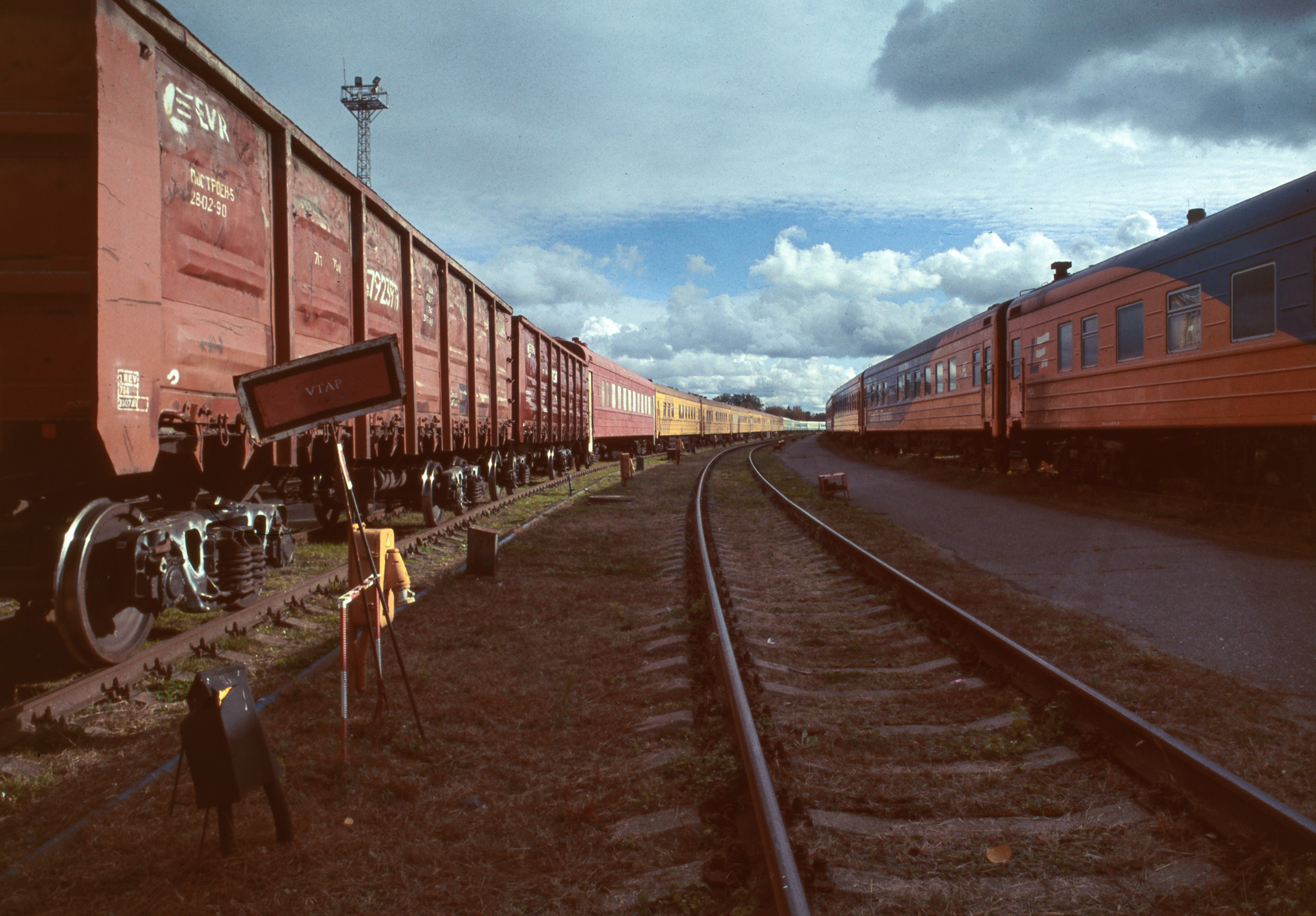
Here's my Sensia in Cinestill D9 - whilst I'm pleased with the latitude and warmth, I find the overall sharpness disturbing and unfit for projection. Unless shooting some soft subjects like portraits where it could probably shine


Abandoned train by Ivo Stunga, on Flickr
 
Yes and on the right side one can seen that it could be mechanically removed, which I didn't do back then - a residue of sorts. First time I worked with the kit, temps fluctuating by a degree or two.

Overall the slide is quite dark to the eye with low dmax, but works in projection.
 
I use the Film Photography Project E-6 kit, which is from Unicolor. Provia and Sensia are both pretty neutral for me if they are dated within 20 years, the older dated ones tend to go pink-purple but it's correctable. I've encountered just about every cast color from experimenting with outdated slide films, green (old Ektachrome EPN), pink-purple (Sensia, Provia, Astia), red (Velvia), but I've never gotten a too-blue result. Fresh Ektachrome E100 is the coldest but it's really neutral.
 
I've seen so many poor E-6 scans from Cinestill E-6 kit that I would strongly suggest to use ANY other E-6 kit (3 or 6 bath) that is not from Cinestill, compare the results and then decide if you still want to waste trust your expensive E-6 film with Cinestill E-6.
 
Photrio.com contains affiliate links to products. We may receive a commission for purchases made through these links.
To read our full affiliate disclosure statement please click Here.

PHOTRIO PARTNERS EQUALLY FUNDING OUR COMMUNITY:


Ilford ADOX Freestyle Photographic Stearman Press Weldon Color Lab Blue Moon Camera & Machine
Top Bottom