• Welcome to Photrio!
    Registration is fast and free. Join today to unlock search, see fewer ads, and access all forum features.
    Click here to sign up

Zone System Question

Recent Classifieds

Forum statistics

Threads
203,219
Messages
2,851,589
Members
101,729
Latest member
Luis Angel Baca
Recent bookmarks
0
Perhaps this matter has been covered. Just in case
it has not been I'll offer my understanding of the
Zone System's reason for being.

In times gone by there were only Graded Papers.
The Zone system and it's methods of execution were
devised so that a negative would print as well as it
might ever print and do it on Grade 2 paper.

So don't forget the paper. It may say Grade 2 on
the box but same Grade papers, depending on
source, can and do vary. Dan

Oh, so true!
 
Brandon

What are the obvious times you would chance your EI? I do change development time based on the range of zones; do I want to expand or contract the range.

But, I guess I've never encountered a time when I thought I should change the EI based on the scene.

Can you provide some detail on this?

Thanks

Mike


Mike

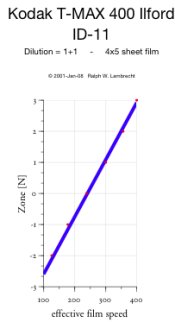
The EI changes with the development for the film. Attached is a sample table I use for Tmax-400 in ID-11. Check out the graph in the bottom right-hand corner.
 

Attachments

  • Tmax400 ID11.pdf
    54.2 KB · Views: 360
After rereading the above posts and thinking about the way I use Fred Pickers process, I guess I use the EI I found from testing and place values where I want them to fall in the final print. Sometimes this requires expansion (N+).

N+ tests let me know what a tone will look like in the print with the expansion through increased development. If I'm reading your chart right, you indicating I've effectively changed the EI by increasing the development time to reach N+1?

Thanks

Mike
 
Correct!

Roughly speaking, we expose for the shadows and develop for the highlights. Unfortunately, shadows are also effected by the development, not as much as the highlights, but they are effected. Consequently, whenever we change the development for the highlights, we need to change the EI as well, or in other words, there is an EI for each development scheme, as my previous attachment illustrates.

This sounds more difficult than it sounds. I just do the test and then carry a pocket card with me in my camera case (see attached).
 

Attachments

  • Tmax400.jpg
    Tmax400.jpg
    30.5 KB · Views: 182
Just two comments Bill

1. You can't compensate for film underexposure with printing.
2. You can compensate for under- or overdevelopment but at the expense of having less contrast to play for print optimizations.
3. There are good darkroom technicians who understand little about photography, and there are good photographers who understand little about the darkroom work. But be assured, the latter would make even better photographs if they'd let the former do their printing, or at least, spend the time to learn it themselves.

Giving up, never is the answer.

I hear what you're saying Ralph and yes, in the case of underexposure: you can't print on paper what isn't there in the negative - ie: shadows which look like clear film base. I did say slight errors in exposure/ development though. Perhaps this should be very slight.
I tend to follow the good old 'Expose for the shadows - dev for the highlights' rule and let my printing and material flexibility take care of the slight errors.

One thing I'd like to know about using the zone system out in the field is; when you're faced with light which is changing very rapidly (literally by the second !) and your'e working with a large format camera ..... how do you have the time to: measure the SBR, make the calculations, decide where shadow details fall etc - plus - fumble about with dark cloths, slides shutters and all ?? Sometimes with this type of 'rapidly changing light' a typical scene can go from very high to very low contrast in a matter of seconds and there simply isn't time to make all the adjustments ?

Guess I'm just too slow:rolleyes:
 
One thing I'd like to know about using the zone system out in the field is; when you're faced with light which is changing very rapidly (literally by the second !) and your'e working with a large format camera ..... how do you have the time to: measure the SBR, make the calculations, decide where shadow details fall etc - plus - fumble about with dark cloths, slides shutters and all ?? Sometimes with this type of 'rapidly changing light' a typical scene can go from very high to very low contrast in a matter of seconds and there simply isn't time to make all the adjustments ?

Guess I'm just too slow:rolleyes:

That's a common problem, which begs for a simple solution. Here is what I do:

1. Visualize the image possible. I like dramatic scenes and dramatic lighting does not wait for me. It there one second and gone the next. But it often repeats itself or is, within reason, predictable.
2. Measure the highlights when they receive the light you want. Measure the shadows when they receive the light you want. This does not need to be the same moment or even. There can be 20 minutes between them.
3. set your camera to this anticipated light situation and...
4. wait, and wait, and wait until... yes, now is the time, oh, wait...
5. This looks good too, and that one, and that one.

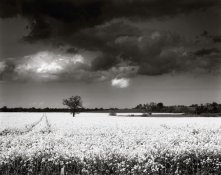
I have attached an example of this. It took me 30 minutes to set up and I waited almost two hours, while my wife was waiting in the car for me. Thank God for knitting!

By the way, any drama nature is not willing to provide, gets added in the darkroom. Photography is not about reality. Reality is ugly, photography is art.

 

Attachments

  • RapeFieldFinal.jpg
    RapeFieldFinal.jpg
    61 KB · Views: 216
I'll keep working at it !! :smile:
 
Correct!

Roughly speaking, we expose for the shadows and develop for the highlights. Unfortunately, shadows are also effected by the development, not as much as the highlights, but they are effected. Consequently, whenever we change the development for the highlights, we need to change the EI as well, or in other words, there is an EI for each development scheme, as my previous attachment illustrates.

This sounds more difficult than it sounds. I just do the test and then carry a pocket card with me in my camera case (see attached).

The idea of exposing for the shadows and developing for the highlights is good for large format, but is there away to accomplish this with 35mm, where you have 24 or 36 exposures that are all different? I am wondering about a pseudo zone system where we can get the exposures as close to the same as possible and then developing to get a good result.
 
The idea of exposing for the shadows and developing for the highlights is good for large format, but is there away to accomplish this with 35mm, where you have 24 or 36 exposures that are all different? I am wondering about a pseudo zone system where we can get the exposures as close to the same as possible and then developing to get a good result.

While I know this is going to piss off the zone system zealots - for an entire roll you can always (available light withstanding) pull your EI and develop (under) to compensate. This will compress more tonal information into the frame. It's easier to work with a lower contrast image and increase contrast after the fact, rather than vice-versa.


I also found that alot (but not all) of the work I looked at where the photographer had promoted zone system methods was technically excellent but not necessarily interesting.

Ding, ding, ding! We have a winner! :smile:
 
Brandon

Zone System folks don't push film. They are too concerned to lose shadow detail. In order to answer your question, how much shadow loss are you willing to except? The answer will define your EI for pushing film.

Thanks!

But to be quite frank, with respect to pushing, I'm more concerned with finding a testing method to determine development times to control the highlight areas. If I was at all concerned about losing shadow detail, I wouldn't even consider pushing the film. When I want shadow detail, I'll just shoot at my optimal/personal E.I. Don't get me wrong, I definitely want to learn the Zone System, but I don't want to become completely stuck/reliant on it. I think there are valid reasons to push/pull film as well as valid reasons not to do so.
 
Yes. I have used Fred Picker's techniques to find development times for TriX and HP5+ films for EI 1600, with which I have shot dance and theater for 25 years.

I'll have to check that out! Thanks for the reference! :smile:
 
Brandon

What are the obvious times you would chance your EI? I do change development time based on the range of zones; do I want to expand or contract the range.

But, I guess I've never encountered a time when I thought I should change the EI based on the scene.

Can you provide some detail on this?

Thanks

Mike

Great question.

I'd increase my E.I. mainly when I want to compress the range of shadow detail, per my taste (haha... I can see Ansel Adams rolling over in his grave :smile:). Basically, I'd do it to increase contrast without being forced to use a different method of agitation, or without being forced to increase contrast during printing, or etc. It's just a personal preference. When I previsualize an image, there are times where I like a lot of shadow detail, but then there are times where I actually want a lot less shadow detail. That's just my taste. I like variety!

In addition, I shoot a lot of naturally lit scenes where the shutter speed and aperture combination is too slow for the way I want to shoot it. So if I can shoot at a higher E.I., I can use a faster shutter speed or a smaller aperture.

There will also be times where I'll previsualize a scene, and I'll want more grain in the image. Again, that's my taste. And for the time being, I just want to stick with one film (i.e., Delta 100) and one developer (i.e., XTOL) to learn the craft.
 
I'd increase my E.I. mainly when I want to compress the range of shadow detail, per my taste (haha... I can see Ansel Adams rolling over in his grave :smile:). Basically, I'd do it to increase contrast without being forced to use a different method of agitation, or without being forced to increase contrast during printing, or etc.

Not to nit-pick, but within the context of dynamic range, I think you mean expand (rather than compress).
 
Not to nit-pick, but within the context of dynamic range, I think you mean expand (rather than compress).

I actually meant that I want to increase contrast in order to simultaneously decrease dynamic range.
 
The idea of exposing for the shadows and developing for the highlights is good for large format, but is there away to accomplish this with 35mm, where you have 24 or 36 exposures that are all different?

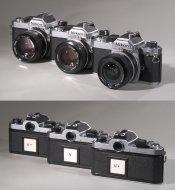
Sound crazy at first, but I have three Nikon FM bodies for that, nicely labeled N-, N and N+. A used 35mm body is cheaper than a MF film back!
 
While I know this is going to piss off the zone system zealots - for an entire roll you can always (available light withstanding) pull your EI and develop (under) to compensate. This will compress more tonal information into the frame. It's easier to work with a lower contrast image and increase contrast after the fact, rather than vice-versa.

No, no, this works just fine and combined with VC paper, let's call it New Age Zone System. This is a logical approach.
 
Thanks!

But to be quite frank, with respect to pushing, I'm more concerned with finding a testing method to determine development times to control the highlight areas. If I was at all concerned about losing shadow detail, I wouldn't even consider pushing the film. When I want shadow detail, I'll just shoot at my optimal/personal E.I. Don't get me wrong, I definitely want to learn the Zone System, but I don't want to become completely stuck/reliant on it. I think there are valid reasons to push/pull film as well as valid reasons not to do so.

Brandon

Look at clayne's approach above. This might work for you. You'll be giving up on the opportunity to go very hard locally but it will get you shadow and highlight detail.
 
There will also be times where I'll previsualize a scene...

I know, I'm nit-picking now, but the word 'previsualize' does not exist. Contrary to popular believe, Ansel Adams did not come up with it, and he never used it either. It's not mentioned once in any of his books. The right word simply is 'visualize'. There is nothing prior to visualization.
 
Set your spotmeter at 4 times the film speed. Read the deepest shadow where you want to see the shape of something. That is the exposure to use. Read the highlight where you want to see the shape of something. Note the number of stops difference. If you can develope each frame separately, you can calculate how to do it from this difference. If you must develop a roll at the same time, you will just have to make sure you do not overdevelop or underdevelope outside the range of available printing contrast. There is no real calculation to be done at the scene.
 
Sound crazy at first, but I have three Nikon FM bodies for that, nicely labeled N-, N and N+. A used 35mm body is cheaper than a MF film back!

I just wanted to add my NikonFM Zone System line-up, which ended up being cheaper than a single Hasselblad back (comparing used vs used).
 

Attachments

  • 35mmZoneSystem.jpg
    35mmZoneSystem.jpg
    61.1 KB · Views: 134
Brandon

Look at clayne's approach above. This might work for you. You'll be giving up on the opportunity to go very hard locally but it will get you shadow and highlight detail.

Sounds like a great idea except that a lot of the scenes I shoot are in dim natural light, so pulling the film won't always be an option. In those situations, I'd like to keep the shutter speed as fast as possible so that I don't have to dip too far into long exposures and reciprocity failure/compensation. Really, I don't mind pushing film, and there will be times where I'll want to decrease shadow detail while keeping the highlight areas in check. Although, I know there are many ways to skin a cat (i.e., increasing contrast). :smile: I understand why people have an aversion to pushing film; I just don't have that aversion.
 
Sounds like a great idea except that a lot of the scenes I shoot are in dim natural light, so pulling the film won't always be an option. In those situations, I'd like to keep the shutter speed as fast as possible so that I don't have to dip too far into long exposures and reciprocity failure/compensation. Really, I don't mind pushing film, and there will be times where I'll want to decrease shadow detail while keeping the highlight areas in check. Although, I know there are many ways to skin a cat (i.e., increasing contrast). :smile: I understand why people have an aversion to pushing film; I just don't have that aversion.

Me neither. I do it all the time. But when I have ample light, I usually pull. :smile:

If you're without a tripod and available light is low, you can pretty much throw the zone system out the window.
 
Me neither. I do it all the time. But when I have ample light, I usually pull. :smile:

If you're without a tripod and available light is low, you can pretty much throw the zone system out the window.

haha... yeah, that's why I want to learn how to push, how to pull, and how to use the Zone System! The best of all worlds! :smile:
 
Sound crazy at first, but I have three Nikon FM bodies for that, nicely labeled N-, N and N+. A used 35mm body is cheaper than a MF film back!

True, seems to be a complicated task in either case, what if you need N+2 or N-3 though. Most of my shooting is done from a bicycle (seriously) and adding the weight of a body and a few lenses is bad enough, carrying three (or four or five) bodies is not an option. So without multiple cameras it's not possible. Guess I need to skip it then.
 
Photrio.com contains affiliate links to products. We may receive a commission for purchases made through these links.
To read our full affiliate disclosure statement please click Here.

PHOTRIO PARTNERS EQUALLY FUNDING OUR COMMUNITY:


Ilford ADOX Freestyle Photographic Stearman Press Weldon Color Lab Blue Moon Camera & Machine
Top Bottom