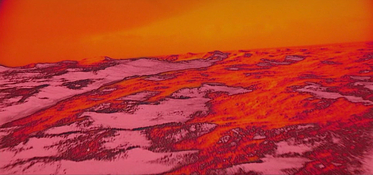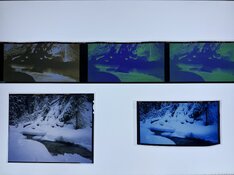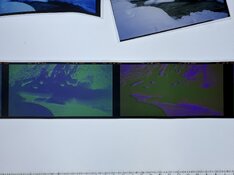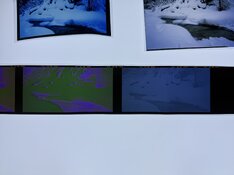


Does anyone know (in detail) about the YCM process for technicolor and or color negative film, I wish to replicate it, but need to further my understanding. For context I am trying to replicate the landscape sequences in the stargate (from 2001) but with a photo workflow. My tools are a light table, YCM wratten filters, and a camera+tripod. Lots of research has led me to confusion and differing answers as to what the YCM process actually means. My goal is to start from a color positive or negative, apply these changes, and end up with a final color positive reflecting these effects.
In the case of space odyssey,
This was done from references:
A) “Separation Masters… a photographic technique in which each of three colors of developed color negative film are reprinted on fine-grained black-and-white stock… Once the three colors- yellow, cyan, and magenta- had been teased apart, much more control could be exercise over each color. Working with the new machine (65mm optical printer), Loftus discovered that if he made certain fortuitous mistakes- for example, by reprinting the separated colors back onto color negative stock in the wrong order, or using the ‘wrong’ aperture settings- he could produce vividly improbable color inversions.”
and B) https://www.tvstoreonline.com/blogs...a-space-odyssey-interview-series-bryan-loftus
"You had three color strips, and you took those and made three high contrast versions off of the negative, and then three low contrast versions. Effectively you would be creating twelve different stripes of film for every shot in the Stargate off of the positive and negative film. So by effectively combining those the wrong way you would end up getting lots and lots of different colors on the film. "
I am confused about what happens from mainly the recombination of these elements, and how the pipeline works (unsure of the color negative -> color negative). From my understanding the ‘correct/baseline process’ is:
regular color negative film
|
v
Shoot copies of this onto BNW negative stock, with corresponding filters (YCM) and correctly (exposure) compensating for each, so they have the same gamma
|
v
in rejoining them with a triple exposure, you shoot the corresponding BNW strips onto color negative film with the same filters they were made from (YCM) ?
|
v
You then arrive at a color negative with the separated channels combined, and can recombine back onto a slide with a triple exposure through YCM filters.
I want to know how this process works as clear as possible in order to establish what a correct pipeline looks like. And my final question would be: Could you also accomplish this starting from a color positive rather than a color negative and what would this look like.
I would greatly appreciate any insight on this, and/or if anyone could help point me in the proper direction. This is my first time posting on a forum. Thank you!
In the case of space odyssey,
This was done from references:
A) “Separation Masters… a photographic technique in which each of three colors of developed color negative film are reprinted on fine-grained black-and-white stock… Once the three colors- yellow, cyan, and magenta- had been teased apart, much more control could be exercise over each color. Working with the new machine (65mm optical printer), Loftus discovered that if he made certain fortuitous mistakes- for example, by reprinting the separated colors back onto color negative stock in the wrong order, or using the ‘wrong’ aperture settings- he could produce vividly improbable color inversions.”
and B) https://www.tvstoreonline.com/blogs...a-space-odyssey-interview-series-bryan-loftus
"You had three color strips, and you took those and made three high contrast versions off of the negative, and then three low contrast versions. Effectively you would be creating twelve different stripes of film for every shot in the Stargate off of the positive and negative film. So by effectively combining those the wrong way you would end up getting lots and lots of different colors on the film. "
I am confused about what happens from mainly the recombination of these elements, and how the pipeline works (unsure of the color negative -> color negative). From my understanding the ‘correct/baseline process’ is:
regular color negative film
|
v
Shoot copies of this onto BNW negative stock, with corresponding filters (YCM) and correctly (exposure) compensating for each, so they have the same gamma
|
v
in rejoining them with a triple exposure, you shoot the corresponding BNW strips onto color negative film with the same filters they were made from (YCM) ?
|
v
You then arrive at a color negative with the separated channels combined, and can recombine back onto a slide with a triple exposure through YCM filters.
I want to know how this process works as clear as possible in order to establish what a correct pipeline looks like. And my final question would be: Could you also accomplish this starting from a color positive rather than a color negative and what would this look like.
I would greatly appreciate any insight on this, and/or if anyone could help point me in the proper direction. This is my first time posting on a forum. Thank you!