• Welcome to Photrio!
    Registration is fast and free. Join today to unlock search, see fewer ads, and access all forum features.
    Click here to sign up

Would you buy a Nikon FM2n in 2020?

Recent Classifieds

Forum statistics

Threads
202,848
Messages
2,846,414
Members
101,563
Latest member
Nobuyuki Ushiiwa
Recent bookmarks
0
At this point I might wait a week and buy one in 2021 and thus avoid this tarbaby of a tread!
iu
iu
 

Attachments

  • upload_2020-12-26_13-19-10.png
    upload_2020-12-26_13-19-10.png
    112.9 KB · Views: 76
I have both an FM2n and an FM3a. Where are these “plastic’ gears? I performed an internet search without any hits on plastic gears or cogs in either camera.
 
I have both an FM2n and an FM3a. Where are these “plastic’ gears? I performed an internet search without any hits on plastic gears or cogs in either camera.
I remember seeing one post in some forum in which an FM3a owner said his repairman said there's a plastic gear in the FM3a's shutter mechanism that "begins to wear from day one." Maybe that one post is the source of the rumor?
 
I have both an FM2n and an FM3a. Where are these “plastic’ gears? I performed an internet search without any hits on plastic gears or cogs in either camera.

The gears I see are in the shutter speed selection assembly.
 
I remember seeing one post in some forum in which an FM3a owner said his repairman said there's a plastic gear in the FM3a's shutter mechanism that "begins to wear from day one." Maybe that one post is the source of the rumor?

All gears wear.
 
The plastic gear in the FM3A is this one (the white one):
history10_fm3a_7.jpg

(photo courtesy of Nikon Imaging)

All gears wear.

Yes and no. Some wear fast and others take ages to wear. I have cameras with gears quite old (60+ years), a lot older than me, that still do not miss a bit. Some cleaning and lubrication is all it takes to make them last longer.
Electronics from the other hand aren't so replaceable or repairable. Usually, while being always dead accurate, they fail faster or more frequent to mechanical parts. It certainly requires skills to repair them. Nowadays it is not always possible, due to either parts no longer being available, or pieces of code that was not made publicly available (patents, etc).
Decent cameras have a rating of minimum shutter cycles before they give in. So, if you buy a not much used one, will serve you for quite a lot, while a beaten like hell one might fail you sooner than expected. Note that electronic cameras have plastic gears too.
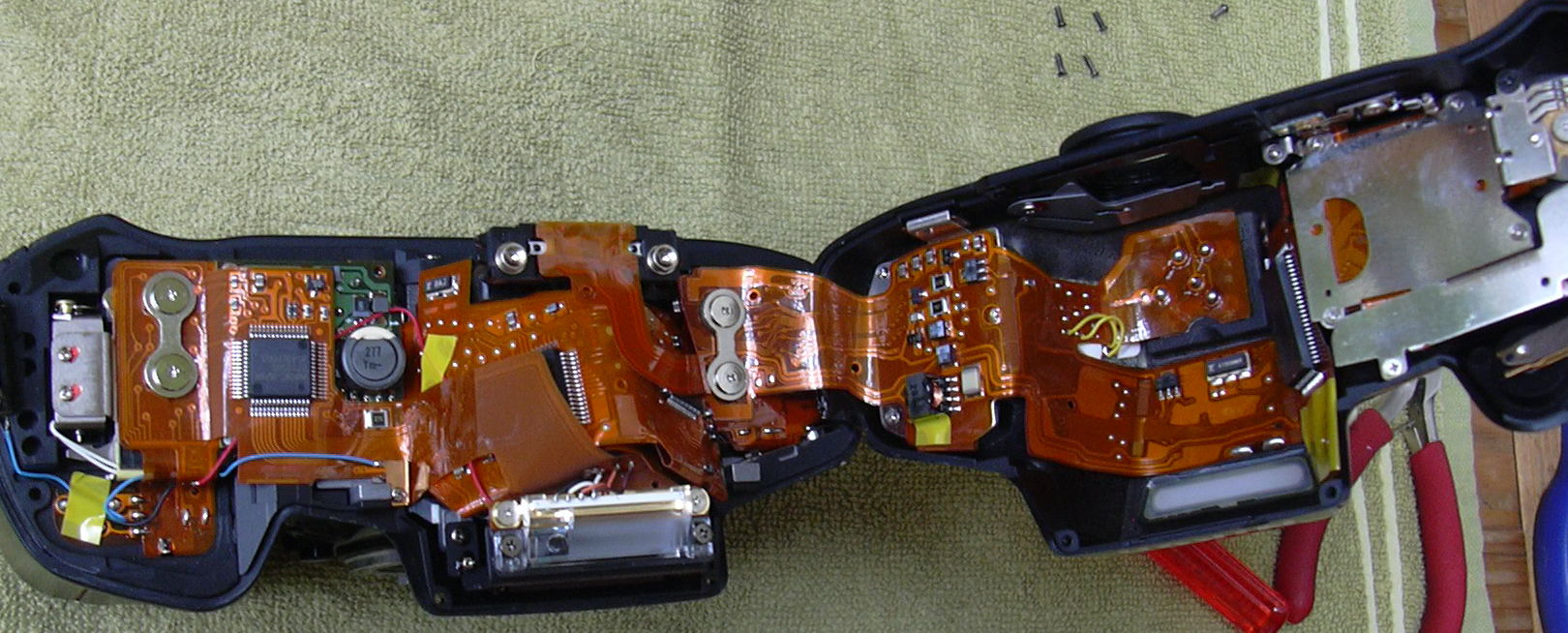
Look what there is inside an electronic camera:
opencap.jpg


This one is from an F90. For sure, besides the shutter mechanism there is a lot more that can go wrong in here. I am not saying it is unreliable, but as with everything, the simpler the better.
 
It beggars belief why Nikon would include a plastic gear in the FM3a having spent so much on the rest of the camera, even down to the detail such as a machined shutter speed dial, and brass top and bottom plates.
 
It beggars belief why Nikon would include a plastic gear in the FM3a having spent so much on the rest of the camera, even down to the detail such as a machined shutter speed dial, and brass top and bottom plates.
Reduce weight is one thing and smoother rolling is another. That gear is teflon made and nothing beats these in terms of smoothness. Also, nobody builds cameras meant to live forever. It is just us that still lurk around for these.
 
Reduce weight is one thing and smoother rolling is another. That gear is teflon made and nothing beats these in terms of smoothness. Also, nobody builds cameras meant to live forever. It is just us that still lurk around for these.

I wasn't in the design team but another consideration could have been noise level. And of course no one here knows if this is the weakest link that would determine the longevity of the whole design.
 
People need to check their assumptions. Nikon aren’t stupid, careless, inept or malevolent. If they used plastic, there’s a damn good reason and it was well thought out, analyzed and tested.
 
People need to check their assumptions. Nikon aren’t stupid, careless, inept or malevolent. If they used plastic, there’s a damn good reason and it was well thought out, analyzed and tested.

I agree. The decisions are made bases on good engineering principles not on what one had for breakfast or if they had a fight with their spouse the night before.
 
I agree. The decisions are made bases on good engineering principles not on what one had for breakfast or if they had a fight with their spouse the night before.

Absolutely! An amateur's opinion is one think and an engineer's design (and in this case top and proven) is another.
 
One indication of the design philosophy used on the FM3A was in the choice of the needle metering and how they had to purchase a used FE2 from a second hand store to disassemble and analyze the ammeter for incorporation into the design -> https://imaging.nikon.com/history/chronicle/history-fm3a/index.htm. As someone who appreciates these marvelous works of industrial art, these design factors certainly motivated me even more to acquire the FM3A and not just because of it's historic hybrid design. It could be marketing hype, but I'm all in - hook, line and sinker . . . :wink:

Besides, I have to maintain a symmetry . . .

xlarge.jpg
 
Absolutely! An amateur's opinion is one think and an engineer's design (and in this case top and proven) is another.

I am a world renouned engineer, not an amateur! There are at least 5 plastic gears in the FM3a.

They may last the usable lifetime of the camera, but this camera is in no way a Nikkormat!
 
OK for something like a camera where size and form factor play important role then it's easier to fabricate mechanical parts than electronics. For a machine where the size and shape of the electronics doesn't matter it's easier to build new electronics that perform the same function and much better.
I’ve seen this sentiment a few times. I would like to know where these people are who can repair the electronic cameras more easily, in case I need a repair. If it’s easier, it ought to be cheaper, too.

This makes me wonder why someone hasn’t started a business buying broken electronic cameras for cheap and repairing them for resale. There are a lot of fashionable P&S cameras that command a high price.

Every camera repairman I’ve spoken with says the electronic cameras can’t be repaired unless they have a donor body.
 
A Nikkormat can!

True. The FM3A is no Nikkormat. The FM3A is much, much better!

you may be shocked and amazed to learn that there are plastic parts in the nikkormat ftn too. Maybe even a plastic gear!!!

oh, the horror!
 
I’ve seen this sentiment a few times. I would like to know where these people are who can repair the electronic cameras more easily, in case I need a repair. If it’s easier, it ought to be cheaper, too.

This makes me wonder why someone hasn’t started a business buying broken electronic cameras for cheap and repairing them for resale. There are a lot of fashionable P&S cameras that command a high price.

Every camera repairman I’ve spoken with says the electronic cameras can’t be repaired unless they have a donor body.
Did you read carefully?
 
Did you read carefully?
No, clearly not! :smile: My apologies.

I’ve read a couple of times on Photrio that electronic cameras are easier to fix. While I don’t doubt it (I can’t fix either), I’ve yet to find a camera tech who will fix them. I’m genuinely curious.
 
Last edited:
No, clearly not! :smile: My apologies.

I’ve read a couple of times on Photrio that electronic cameras are easier to fix. While I don’t doubt it (I can’t fix either), I’ve yet to find a camera tech who will fix them. I’m genuinely curious.
Electronic cameras are not easier to fix because the parts for them has to be custom and made in large quantity to be possible. No one off part is possible. However, before my post my argument was the electronics in my view are more reliable than mechanical although they tend to go bad without any warning.
 
True. The FM3A is no Nikkormat. The FM3A is much, much better!

you may be shocked and amazed to learn that there are plastic parts in the nikkormat ftn too. Maybe even a plastic gear!!!

oh, the horror!
Plastic is a general term and we all envision a Christmas cracker sort of novelty. But the ‘plastics’ in high end products are ‘engineering polymers‘, advanced polymers designed to accept the loads, torsion, compression etc.
 
Yep. Some kinds of plastics are more durable than many metal alloys. They can also mesh more quietly and smoothly. I'm using original plastic focus tracks on my Sinar Norma that is now 50 years old, and will probably go another 50 before there's an issue with these - some kind of early Delrin-like material. No serious camera is going to employ ordinary soft nylon. They aren't that dumb. And it's not necessarily for sake of cost saving; some of these materials can be trickier to machine than metals. It's not like a made in China disposable rubber bathtub duck. I had other reasons for selling off my FM3a and keeping only the FM2n.
 
Photrio.com contains affiliate links to products. We may receive a commission for purchases made through these links.
To read our full affiliate disclosure statement please click Here.

PHOTRIO PARTNERS EQUALLY FUNDING OUR COMMUNITY:



Ilford ADOX Freestyle Photographic Stearman Press Weldon Color Lab Blue Moon Camera & Machine
Top Bottom