• Welcome to Photrio!
    Registration is fast and free. Join today to unlock search, see fewer ads, and access all forum features.
    Click here to sign up

Windisch Surface Developer _ what's correct

Recent Classifieds

Forum statistics

Threads
202,825
Messages
2,846,027
Members
101,548
Latest member
Underexposed
Recent bookmarks
0
Ian;
Here is an example. We were trying to determine the optimum concentration of an additive to a developer and found that 1.5 g/l gave the effect we wanted and 1.4 did not. We ran 1.6, 1.7, 1.8 and 1.9 and found that 1.5, 1.6, 1.7 and 1.8 were pretty close giving just a hair more activity but at 1.9 there was some fog.

We used 1.6 g/l. Why? Well, 1.5 was the low threshold, and 1.7 and 1.8 were just going to waste money by adding a line width of activity in the characteristic curve while 1.9 was overkill. The rule of thumb became, "look for the onset of activity and go just one step beyond". That seems to work in general production to keep values centered around usable weights. Of course, in emulsion making things are even more precise most of the time.
PE

Also is a 7% bulk manufacture error buffer :smile:. Sounds like a colour thing.
Thanks for the tale
Murray
 
  • lrvv
  • Deleted
I've bought it for less than a Euro from Germany 1944 edition then a few days later I found a UK copy from 1937? for 99 pence :D

The cover looks amazing in the photo's but unfortunately they are back in the UK until my next trip back.

Ian
 
Ian - you need to buy two of everything. One for the UK, and one for Turkey!
 
Just for our new APUG member lrvv, welcome to the Forum

Kirk, I now copy & PDF the formulae it saves weight etc when flying and I'm always just over the limit. In truth I do have multiple copies of books, around 6 Ilford Manuals of Photography, 3 or 4 Kodak Formulae books, many BJP Almanacs etc they are all slightly different.

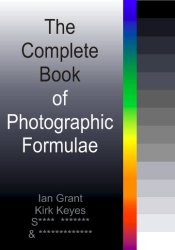
And for you both here's my humble attempt at a modern version :D I was thinking of asking an APUG member to design a special typeface for the forthcoming book of formulae :smile:

Ian
 

Attachments

  • new-book.jpg
    new-book.jpg
    34.4 KB · Views: 170
Last edited by a moderator:
Well, thanks Ian. Please let me see a copy of it when it gets published. I'll edit it then.

And no need for special fonts, as it seems to me there are more than enough fonts out there in the world. Perhaps kind of like developer formulas?
 
Oh, and I've copied a few of my books into pdfs as well. Takes a good day to copy 300 pages and clean it all up (at least with my setup) but it sure is handy to have all that info right in my computer.
 
I once copied a book from 1665 and and OCR'ed it put it online, it was very hard work.

Now my works being sold !!! All because there's no copyright. If the company was larger and more Capitalist I'd sue them :smile: But they are very small and penniless so there's no point.

Actually the issue of the number of dev formulae and similarities is something that will be addressed in a very appropriate manner :D Recent posts on APUG have shown that certain formulae aren't quite what they seem, I'd add once in a database/spreadsheet the wild claims are actually the same as Agfa, Kodak, Ilford etc. And no Bill Troop you have zero to do with my comments.

Ian

Ian
 
Ian,

At what stage is this book project?

Tom

In theory quite advanced because so much work was done back in the 70's, the section on Print Developers was compiled & completed by the early 80's but really as my own resource.

How much is the same as in the Darkroom Cookbook I'm not sure, I've never used either the DCB or FDC as a a resource because the first time I ever saw either was last year.

The dilemma is it's pointless actually putting out another book of Formulae competing with Steve Anchell's DCB which is already an excellent & well written resource, however there may be a case for something that compliments and expands on the DCB in a different way.

Ian
 
Ian;

There is as much new work as old to cover, and the rest of the process is not covered well in existing books. I've said before that fixers, stops and the other solutions are useful material for incorporation into a book.

PE
 
Those are all in the pipeline much data already prepared, I did a lot of work on Toners for instance for commercial reasons back in the 70's & 80's and here again it's a case of not trying to re-write Tim Rudmans books but add something extra.

Over the years I've done a lot of research and archived it away, countless Patents etc, and some very interesting developer formulae that need trying and testing, taht are unlike anything published in existing books.

Some of the formulae I'm not so interested in now, that's the emulsion & alternative processes, but rather than let them go to waste sat on my PC (& on film or in books still) I'll pass them on to someone like Denise Ross rather than let them go to waste. There shouldn't be anything you haven't already got somewhere or other, but there's some Formulae for POP etc that she'd probably like to put on The Light Farm. Maybe someone like Kirk Keyes might like to transpose them to a text format first.

Most of what I need is ready,,some needs editing, Gerald Koch & Tom Hoskinson were going to do the cross checking and validating, and add one or two I'd missed. Now it's really just a case of designing a good way of making the data available.

Ian
 
Ian - I'd be happy to help where I can! I can certainly help convert them to text. My email is listed in my member info.
 
No problem, thanks Kirk. They will be shared between Denise & Kirk so hopefully available to anyone else on APUG via their websites in a few weeks.

Ian
 
Hello Ian,

What is the title of your book? I'm quite interested. Sorry for bumping this thread. But the thread is quite fascinating and educational even for a novice like me. :smile:

Bests,

Ashfaque
 
Hi Ashanque, the book project ran into some major hold ups as we had to move back to the UK to care for my mother, now I have to look after my wife. So at the moment progress is slow, in addition I was getting help from another member here who died 3-4 years ago.

As an aside I came across a reference for the incorrect version of the Windisch Surface developer in a post WWII British Journal Photographic Almanac which called it an American version of the Windisch developer. It's possibly yet another of the large number of formulae published incorrectly in the Photo Lab Index.

Ian
 
Ian, I wish your wife a quick recovery. Please take as long as you need. Family is more important than photo and photo-chemistry.

I'll get back to this thread after reading it entirely.

Bests,

Ashfaque
 
Best wishes to you and your family Ian. I hope that your wife and mother are doing well. I also hope that your book project moves ahead and if there is anything I can do to help just let me know. I'll do what I can.

PE
 
I have from Sammlung Fotografischer Rezepte, Windisch high surface developer:
Solution A:

Water 100ml
Brenzkatechin (=Pyrocatechine) 8,00g
Sodiumsulfite (Sicc.) 1,25g

Solution B:
10% Sodiumhydroxide solution
Solution B in destilled water.

Working solution:
Tap- Water 500ml
Solution A 12ml
Solution B 7ml


This is almost the recepture of Amaloco AM20/AM50 unfortunately now discontinued.
EJ Wall and FI Jordan give the same formula on p64 of their 1940 book:
http://babel.hathitrust.org/cgi/pt?id=mdp.39015007557666;view=1up;seq=7
 
I have from Sammlung Fotografischer Rezepte, Windisch high surface developer:
Solution A:

Water 100ml
Brenzkatechin (=Pyrocatechine) 8,00g
Sodiumsulfite (Sicc.) 1,25g

Solution B:
10% Sodiumhydroxide solution
Solution B in destilled water.

Working solution:
Tap- Water 500ml
Solution A 12ml
Solution B 7ml...

Hi,

just mixed this Windisch developer last night...

I found some more informations about its use, from Windisch "Die neue Foto Schule" 1943:
A and B are prepared like Robert wrote above.

To be used with medium/low contrast films:
Working solution:
Water 500ml
Solution A 12ml
Solution B 7ml
Temperature 18 to 19°C
Time 8 to 10 minutes for max. compensating effect
Time 12 to 16 minutes for normal contrast

To be used with high contrast films:
Working solution:
Water 500ml
Solution A 20ml
Solution B 5ml
Temperature 18 to 19°C
Time 8 to 10 minutes for max. compensating effect
Time 12 to 16 minutes for normal contrast

I'll give it a first try with some Kodak Super-XX the next days...

Best
Jens
 
Hi,

just mixed this Windisch developer last night...
...

Hi,

One more mixture out of the same book:

A zero sulfite Pyrocat variant found in a vintage reciepe in Hans Windisch "Die neue Foto Schule" 1943, pages 104/105:
It is meant to be a highly compensating developer for thin films.

I call it Pyrocat W-0. ;-)

Solution A
Brenzkatechin (=Pyrocatechine) 10,00g
Destilled water to make 100ml

Solution B:
10% Sodiumhydroxide solution
Solution B in destilled water.

Working solution:
Water 500ml
Solution A 10ml*
Solution B 5ml...

With Ilford PanF Plus and 10 minutes @ 18°C, you get an ca. N-2 result with much compensation, EI 16.
The working solution exhausts really quickly, so nothing for rotary dev.
* 16ml of A give denser negatives. I like it better this way with PanF Plus...

When developing faster films this should work too soft, even when doubling the volume of B?

Best
Jens
 
A zero sulfite Pyrocat variant found in a vintage reciepe in Hans Windisch "Die neue Foto Schule" 1943, pages 104/105:
It is meant to be a highly compensating developer for thin films.

I call it Pyrocat W-0. ;-)

This is similar to Jay DeFehr's Obsidian Aqua. A little amount of Sulphite/Metabisulphite can go a long way in extending the shelf life of the stock solution while not affecting the staining/tanning behavior of the developer significantly.
 
This is similar to Jay DeFehr's Obsidian Aqua. A little amount of Sulphite/Metabisulphite can go a long way in extending the shelf life of the stock solution while not affecting the staining/tanning behavior of the developer significantly.

Hi Raghu,

indeed these Windisch formulars are close relatives to Obsidian Aqua. I've used them with Carbonate, too.
This version has a shelf life of the stock solution of some months only - the standard mix with a little Sulfite keeps up to 3 years...

Best
Jens
 
indeed these Windisch formulars are close relatives to Obsidian Aqua. I've used them with Carbonate, too.
This version has a shelf life of the stock solution of some months only - the standard mix with a little Sulfite keeps up to 3 years...

Hi Jens,

Good to know that Windisch stock solution does have a useful shelf-life of a few months. Interestingly, Windisch working solution is much stronger (in Catechol) than Pyrocat and OA and yet "too soft on fast films". Could this be also due to the absence of Sulphite?
 
Photrio.com contains affiliate links to products. We may receive a commission for purchases made through these links.
To read our full affiliate disclosure statement please click Here.

PHOTRIO PARTNERS EQUALLY FUNDING OUR COMMUNITY:


Ilford ADOX Freestyle Photographic Stearman Press Weldon Color Lab Blue Moon Camera & Machine
Top Bottom