• Welcome to Photrio!
    Registration is fast and free. Join today to unlock search, see fewer ads, and access all forum features.
    Click here to sign up

Why do people think TMAX is unforgiving?

Forum statistics

Threads
203,266
Messages
2,852,121
Members
101,753
Latest member
Janek201
Recent bookmarks
0
The minimal care that makes a good TMax neg will make better or more dependable negs from almost everything else too. I wouldn't want to be wondering whether imprecise processing technique was making my printing more difficult.
 
The funny thing is, Brad, that when you're used to working with a specific film, and you don't think about the alternatives out there, it's easy with any kind or brand.
I don't do anything differently with Tmax 400 than I do with Tri-X. And all I have done is some rudimentary testing with contact prints and full blown prints, and produced three basic processing times and agitation schedules that are applied based on the lighting conditions. I don't even think about what I'm doing when I process film anymore. I just write on the roll whether I need plus, minus, or normal development. Then I gang films that need the same treatment in piles, and grab as many as the tank will hold every time I process. It doesn't take any extra time out of my day.

Ilford FP4+ and HP5+ are amazing films, and if they work for you, then you really don't have a reason to change it up. I like how you focus on making pictures. I do the same.


Yes. I see what you mean. When we form habits we save energy. Hopefully, we habituate ourselves to a process or processes that lead to good results. My process is kinda the same as yours but I am sure that many would judge my method perfectly slovenly.

I have a notebook and I keep notes, or used to, about every sheet and even some rolls of film I expose, process and print. I could never really remember the N+1 and N-1 thing so, I usually just look at the scene and think something like...2:00PM, harsh, bright sun, strong shadows...Over expose and under develop. I'll write that in the notebook.

In the back of the notebook, I have a table of films and developers and times. I have continuously refined the content of that table over the years.

I never could tame TMX but, I love TMY. There is nothing quite like it. I used to shoot it in small format with a B+W 060 (yellow/green) filter and process it in HC-110 (which was the only film developer I used for several years). My notebook has many entries concerning this combination. When I took up large format, I stopped using HC-110 because I could never get it to reliably do what I wanted with continuous rotational agitation.
I switched back to home brew D-76/ID-11 and D-23...and since my notebook doesn't say much about TMY in those developers, I quit using it.

Similarly, my notebook has many entries concerning Tri-X in D-76 and FP4+ in D-76 and D-23. I use D-23 in summer because I find that temperature compensation with D-76 is too much of a crap shoot (read, I don't have good notes on this) and D-23, in my experience, doesn't really require any temperature compensation when used within the temperature range that characterizes ambient summer temps here. Sometimes, in summer, I don't even bother to measure the temp of the developer....it just doesn't matter that much. I mix D-23 the same way I saw my mom do it when I was a kid, using teaspoons and tablespoons and a quart sized kitchen measuring "cup"....it just isn't that critical.

Thanks, Thomas, for your kind reply. :smile:
 
Last edited by a moderator:
Photographers used to films with distinct shoulders claimed than Tmax films created 'blocked highlights'. Nothing could be further from the truth...

Exactly!

...All the highlight detail you could ever want is in a TMax negative and can be retrieved with careful highlight burning. The same is not true of traditional films where there is no highlight detail and burning the highlights just produces a featureless grey...

Right on!

Try reducing developing time by 20% and exposing a 1/2 stop more - that can give negatives that are much easier to print.

Bingo!!!
 
I have a question....

If you have a scene and you'd meter EXACTLY and you'd process it EXACTLY as Kodak recommends. Then compare the results.... Tmax400 and Tri-X400.... What would you see?

I'm beginning to think, using different film and trying to achieve a result *just like* the other film is not something I should be doing. If I wanted *just like* Tri-X, I can just use Tri-X. (I already have both films in my frig)
 
Perhaps the best way to determine how responsive a film is in a particular developer is through the use of a CI/Time curve. By plotting contrast index against the processing time, you are able to graph the development rate or development velocity. The steeper the curve, the more responsive the film is in that particular developer. Depending on the developer, the development velocity of a film can change dramatically. Maybe that is why we have conflicting opinions on how the T-Max films respond.

I've attached a CI/Time curve comparing TMX, TMY, and TX 135 in Xtol. The development velocities for TMX and TX are practically identical. Of the three films in this example, TMY has the highest development velocity and is the most responsive in Xtol, but may reach gamma infinity sooner than the other two films.
 
Last edited by a moderator:
when i shot for a newspaper years ago ( in the 1990s )
i bought bricks of tmx ( 100 ) and tmy ( 400 )
i got an incredible deal on them .. 1.19 each (roll)
so i got as much as i could. i did a ton available light and
hand held flash with both films.
i learned early on that tmx blocked highlights like mad
with a flash, but was great in all other conditions
and tmy was less trouble with the flash -
yes i stopped down 2 stops and processed the same way ..

they are both nice films ...
and they both process in coffee very well ...
 
Last edited by a moderator:
Photographers used to films with distinct shoulders claimed than Tmax films created 'blocked highlights'. Nothing could be further from the truth.

All the highlight detail you could ever want is in a TMax negative and can be retrieved with careful highlight burning. The same is not true of traditional films where there is no highlight detail and burning the highlights just produces a featureless grey.

To give an idea of the magnitude of TMax range: film density can reach 4.0 OD (12 stops of density) with no shouldering while grade 2 paper has a 4 stop straight-line range, 5 stops toe to shoulder.

I've shot Tri-X religiously for the last 12 years. Then last year I started to experiment with the new TMY-2 400.

At first I was frustrated by the results I was getting. Mostly by blown highlights and high contrast. But the clarity of the images intrigued me. I continued to shoot and after a while I got it dialed in.

Using Barry Thornton's 2 bath developer I started to get some very, very impressive results. Ironically it was the highlight performance that caught my eye. Tonality just goes on forever and the highlights just wouldn't blow. Shooting straight in to the sun etc. No problem. IMO using a 2-bath developer really contributes to this behavior. I found it a lot more difficult to get these kind of results consistently with a one shot developer.

TMY-2 400 really is an astonishingly good film- once you figure out how it works. On running the risk of being struck down by lighting, I'm almost willing to say that in sheer technical terms it's a better film than Tri-X

I agree that TMY-2 400 it is a little more temperamental to develop, but then again I also had to learn how to get the results I wanted from Tri-X...
 
I don't get it, because I don't find this to be the case at all. What does that MEAN? I don't see how it could have more exposure latitude than TMAX by any measure, so people must mean something else when they say "more exposure latitude".

I agree. I think some descriptions of "exposure latitude" I've seen are quite misled.

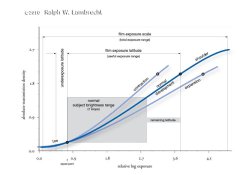
The exposure latitude of a film is evident in scenes with low SBR's and a characteristic curve that does not shoulder-off too quickly. The film can tolerate additional exposure in the shadows of a low contrast subject without losing the ability to control the negative densities for necessary detail and high value tonality at the high end up around Zone VIII and IX.

As SBR increases, the exposure latitude decreases. When reducing exposure to keep control of the desired highlight ends up making your important shadow area lose detail in the negative, then the subject contrast is very high and you have little or no exposure latitude to play with.
 
...As SBR increases, the exposure latitude decreases. When reducing exposure to keep control of the desired highlight ends up making your important shadow area lose detail in the negative, then the subject contrast is very high and you have little or no exposure latitude to play with.

Quite correct.

Film exposure latitude is defined as the range of exposures over which a film yields images of acceptable quality.
 

Attachments

  • Latitude.jpg
    Latitude.jpg
    33.1 KB · Views: 132
This thread has inspired me to give TMAX and Delta one more try. I used Delta once about a year ago. I couldnt get results I liked, so I was like "this stuff is crap!" The problem with me was I used HP5 and FP4 exclusively for like a year, then I picked up a roll of Delta (close enough to TMAX :smile: )with no idea of how to shoot and develop it. I didnt get good results with the two rolls I bought, so I went back to HP5 and FP4.

Now that I'm a little wiser, I realized that I didnt get good results with HP5 and FP4 the first time I used them, either. I had to work with ithem for a while before I got something that I was really happy with. I think I might pick up a couple rolls of TMAX or Delta and try again. :smile:
 
I'm sure I will as long as I follow the directions.

I think following directions may have been my problem. I developed my Delta the way I developed my Ilford "regular" films: In rodinal and with my normal agitation method. I did use the recomended developing time for Delta. (I know Delta isnt TMAX, but they should be similar enough to compare. I probably would have had the same problem with TMAX :D )
 
Photrio.com contains affiliate links to products. We may receive a commission for purchases made through these links.
To read our full affiliate disclosure statement please click Here.

PHOTRIO PARTNERS EQUALLY FUNDING OUR COMMUNITY:


Ilford ADOX Freestyle Photographic Stearman Press Weldon Color Lab Blue Moon Camera & Machine
Top Bottom