• Welcome to Photrio!
    Registration is fast and free. Join today to unlock search, see fewer ads, and access all forum features.
    Click here to sign up

Why did drum scanners give way to other technology?

Watch Your Step

H
Watch Your Step

  • 0
  • 0
  • 0
The Royal Mile.

A
The Royal Mile.

  • 3
  • 2
  • 82

Recent Classifieds

Forum statistics

Threads
201,633
Messages
2,827,492
Members
100,858
Latest member
Evan_Mathis
Recent bookmarks
1

koraks

Moderator
Moderator
Joined
Nov 29, 2018
Messages
26,617
Location
Europe
Format
Multi Format
However, one thing that is not as widely known as it should be is that solid state photo sensors can't compete with PMTs in terms of signal to noise ratio for point detectors.
The question is not which conceptual approach is technically better in this specific respect. The question is ultimately which one gives the best tradeoff, and it's evident that it's at this point in time, silicon. While you're technically right that PMT tech can produce a cleaner signal, in reality, we don't need that badly enough when scanning film. Silicon, despite its somewhat lower performance, is just plenty good enough, and offers many other advantages that make it a better solution.

Of course, predicting the past is always easy to do.
 

Sean

Admin
Admin
Allowing Ads
Joined
Aug 29, 2002
Messages
13,580
Location
New Zealand
Format
Multi Format
I only just now stumbled across this question...and it's a very Good Question! Storytime...

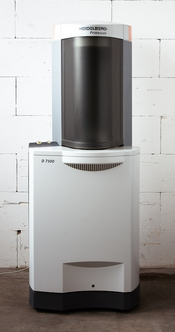
I started my career "traveling with a tool bag" in 1984 for Dr. HELL in Kiel, Germany. I was fresh out of college with a B.S.E.E.T. I worked for the Atlanta office of HELL Graphic Systems (as it was called in the USA). These drum scanners were created for the commercial printing industry. Before digital photography, everything you saw around you, that was printed in color, had to be color-separated and output to film as rasterized dots for eventual transfer to an aluminum printing plate (one for each ink color). That's how the photographer's color shots were transferred to paper tens or hundreds of thousands of times over. The scanners were nicknamed "cash machines" back then, because there were so many scanning jobs available everywhere. Catalogs, brochures, magazines, packaging...basically everything that was being produced in volume on a printing press originated in a film camera by a photographer. This went on for decades and my customers were usually "color houses" where the film separations (CMYK) were produced by the HELL scanner and then "stripped" together with the typesetting films from the "black & white" houses down the street or across town. These were usually family-owned businesses that specialized in one or the other. The color seps were pretty expensive, so one would usually find a large room full of light tables just outside the scanner room, where the color seps and the black & white typesetting films were stripped together by hand using an Exacto Knife on a light table with a small jar of "opaque" and a paint brush on the side to blot out any dust or specks in the "paste-up" film negative. Yep, it was all pasted together by hand using ruby-lith scotch tape. The final page assembly was then placed in a vacuum frame and transferred to a final composite film which was then sent out to the printing company. There, the composite film was transferred under a UV Light (vacuum frame again) to a conventional aluminum press plate which was going to pick up the ink from the ink blanket and land the image on the paper using at least four passes (CMYK).

Some of these color houses invested in the million dollar HELL Chromacom System Interface for the drum scanner which would pick off the picture signal and send it to a 300MB disk drive (which resembled a washing machine and required a clean room environment). All the other (non digital) color houses were outputting the film seps on-the-fly, using the exposing half of the drum scanner (six modulated laser beams building 1/2 a screen dot per drum revolution). A poster would require scanning the same image four times (once for each color sep). If the image was small enough to fit on the large 8-up output drum (in the case of the HELL CP-341 "Chromagraph Poster"), then the scanner could output four separate color separations during a single scan process. The HELL Chromacom had an Image Memory Unit (IMU) and allowed an experienced operator to airbrush images, merge images, etc. at a rate of $600/hour. The Chromacom was the forerunner of Photoshop. Publications like National Geographic were being assembled four to six months ahead of time, were heavily retouched in D.C. or Charlotte, NC and printed in Corinth, MS. Because of the super huge press run, they engraved copper cylinders using the digital data from the Chromacom. Back then it was about a pound of paper and a pound of ink in each issue. The HELL Helio-Klischograph engraves copper cylinders to this day and there's still a remnant of the HELL company in Kiel, Germany called HELL Gravure. They have close to a worldwide monopoly on rotogravure manufacturing and are now in the process of moving into a new building in Klausdorf (just outside of Kiel).

Desktop publishing came along in the 90s as a natural marriage between typesetting, color separations, and photo retouching, all came under one roof. The acre of light tables disappeared and the Chromacom was replaced by a Mac Department where my customers were purchasing Macs ten at a time. Towards the end of the 90s digital cameras came out and at first they were viewed as "cool toys" but unable to come anywhere close to the quality of a drum-scanned film. As we all know, the quality improvements happened rapidly and by 2001, the Desktop-Publishing departments were receiving Kodak Photo CDs in the front door instead of physical film shots from an analog camera.

NOTE* The famous typesetting company Linotype embraced Adobe's Postscript Language early on and made their RIPs (Raster Image Processors), "Postscript language compatible". This is why Linotype remained while their competition all went out of business (Varityper, Compugrahic, and others). With color and typesetting merging on the desktop, it was a natural progression for the German leader in color to merge with the German leader in typesetting, creating the Linotype-HELL company in 1991. I told my colleagues back then that the next natural progression would be for the German leader in Press technology to merge with the newly formed Linotype-HELL company. In 1996, while attending the Summer Olympics in my hometown of Atlanta, I received the text message on my digital pager that "Heidelberg just bought us!". This new company comprised nearly 25,000 employees worldwide and the cashflow in the printing industry was insanely high. Everyone was riding high until the world changed during the Chicago Print Show on September 11, 2001. Air traffic was halted across the USA and what had looked like a really successful year at "Print '01" became a bust. Heidelberg management deferred decison-making over to the Accounting department as did management decision-making across corporate America. The question on what to do to make the quarter look good became the driving force for a very long time in America. Corporate culture changed into squeezing & extracting from that point onward.

Meanwhile digital cameras had come a long way and in the first half of 2002 Heidelberg management reviewed the Marketing Department's Annual Report for 2001 activity where it was revealed that Heidelberg held about 60% of the global high end scanning market, but they had only delivered 80 units that year. It was clear that digital photography was good enough for magazines, catalogs, brochures, and packaging. The hammer dropped that same day with a global email to all 25,000 employees announcing an immediate end to drum & flatbed scanner assembly lines in Kiel, Germany, and an immediate end to all software development (Newcolor). The sales force was told separately about a 75% reduction in price on all currently held scanner inventories.

THAT is why photomultiplier-based drum scanning technology came to a sudden and abrupt halt!

In early 2001 I had met a girl during a factory training class in Germany who liked me a lot and wanted me to move over to Kiel, so I quit my good job at Heidelberg in 2003 to expand my horizons. I continued with selling and servicing second-hand thermal platesetters (computer to plate or 'CTP') up until that became no fun (due to the number of printing companies stiffing me on the bill by going bankrupt or just behaving like criminals). Much of the commercial printing industry was shrinking and gradually switching over to short run, variable data digital printing (toner based high speed copiers in a sense). The Age of Junk Mail was on track to plague humanity indefinitely. I had about $40k in open invoices when I heard about an online Yahoo Group for Tango / Primescan enthusiasts (started by Ernst Vegt in Vancouver). That was 2010 and I was member number 35! I thought well, I grew up working on drum scanners and I'm still amazed to this day what a drum scanner can see in a piece of film, so I'll happily help out anyone trying to keep these babies going into the 21st Century. I mean scanners are cool, man...I hated to see them die. I never intended to make it a new career move, but by 2013 I was having a lot more fun traveling around Europe and N. America (w/ toolbag) meeting some of the coolest humans ever: Analog Photographers! I sold my whole stock of thermal platesetters to one dude who still greets me every Christmas to this day. His name is Yousef and he told me, "Karl, you are manna from heaven" while I was helping him crate up all those systems in 2013 and I told him, "Yousef, I hope you make a ton of money off this stuff". I was making room for my new mission of rescuing vintage Heidelberg drum & flatbed scanners. Analog was making a comeback in the audio world, so I took my cue to keep high quality analog film scanning alive for those seeking "museum quality" digitization of prized shots. It's all about Art now for these machines and it's mostly associated with medium and large format photography. That Yahoo Group has since moved over to groups.io and there are over 235 members.

Now it's 2025 and I am active on five continents. I have a collection of over a hundred vintage Heidelberg drum & flatbed scanners resting comfortably in my "scanner orphanages" on two continents. I've really enjoyed my new work environment and I applaud all of you who do their part to educate the next generation on scanning one pixel at a time versus thousands or millions. Yeah, it takes more time and effort, but for me it's always fun to see the socks fly and the huge grin when examining that first scan on an install. Love it. Keep up the good work and long live analog!
-Karl


Wow, what an amazing journey! Thanks for sharing this.
 

alanrockwood

Member
Allowing Ads
Joined
Oct 11, 2006
Messages
2,195
Format
Multi Format
I only just now stumbled across this question...and it's a very Good Question! Storytime...

I started my career "traveling with a tool bag" in 1984 for Dr. HELL in Kiel, Germany. I was fresh out of college with a B.S.E.E.T. I worked for the Atlanta office of HELL Graphic Systems (as it was called in the USA). These drum scanners were created for the commercial printing industry. Before digital photography, everything you saw around you, that was printed in color, had to be color-separated and output to film as rasterized dots for eventual transfer to an aluminum printing plate (one for each ink color). That's how the photographer's color shots were transferred to paper tens or hundreds of thousands of times over. The scanners were nicknamed "cash machines" back then, because there were so many scanning jobs available everywhere. Catalogs, brochures, magazines, packaging...basically everything that was being produced in volume on a printing press originated in a film camera by a photographer. This went on for decades and my customers were usually "color houses" where the film separations (CMYK) were produced by the HELL scanner and then "stripped" together with the typesetting films from the "black & white" houses down the street or across town. These were usually family-owned businesses that specialized in one or the other. The color seps were pretty expensive, so one would usually find a large room full of light tables just outside the scanner room, where the color seps and the black & white typesetting films were stripped together by hand using an Exacto Knife on a light table with a small jar of "opaque" and a paint brush on the side to blot out any dust or specks in the "paste-up" film negative. Yep, it was all pasted together by hand using ruby-lith scotch tape. The final page assembly was then placed in a vacuum frame and transferred to a final composite film which was then sent out to the printing company. There, the composite film was transferred under a UV Light (vacuum frame again) to a conventional aluminum press plate which was going to pick up the ink from the ink blanket and land the image on the paper using at least four passes (CMYK).

Some of these color houses invested in the million dollar HELL Chromacom System Interface for the drum scanner which would pick off the picture signal and send it to a 300MB disk drive (which resembled a washing machine and required a clean room environment). All the other (non digital) color houses were outputting the film seps on-the-fly, using the exposing half of the drum scanner (six modulated laser beams building 1/2 a screen dot per drum revolution). A poster would require scanning the same image four times (once for each color sep). If the image was small enough to fit on the large 8-up output drum (in the case of the HELL CP-341 "Chromagraph Poster"), then the scanner could output four separate color separations during a single scan process. The HELL Chromacom had an Image Memory Unit (IMU) and allowed an experienced operator to airbrush images, merge images, etc. at a rate of $600/hour. The Chromacom was the forerunner of Photoshop. Publications like National Geographic were being assembled four to six months ahead of time, were heavily retouched in D.C. or Charlotte, NC and printed in Corinth, MS. Because of the super huge press run, they engraved copper cylinders using the digital data from the Chromacom. Back then it was about a pound of paper and a pound of ink in each issue. The HELL Helio-Klischograph engraves copper cylinders to this day and there's still a remnant of the HELL company in Kiel, Germany called HELL Gravure. They have close to a worldwide monopoly on rotogravure manufacturing and are now in the process of moving into a new building in Klausdorf (just outside of Kiel).

Desktop publishing came along in the 90s as a natural marriage between typesetting, color separations, and photo retouching, all came under one roof. The acre of light tables disappeared and the Chromacom was replaced by a Mac Department where my customers were purchasing Macs ten at a time. Towards the end of the 90s digital cameras came out and at first they were viewed as "cool toys" but unable to come anywhere close to the quality of a drum-scanned film. As we all know, the quality improvements happened rapidly and by 2001, the Desktop-Publishing departments were receiving Kodak Photo CDs in the front door instead of physical film shots from an analog camera.

NOTE* The famous typesetting company Linotype embraced Adobe's Postscript Language early on and made their RIPs (Raster Image Processors), "Postscript language compatible". This is why Linotype remained while their competition all went out of business (Varityper, Compugrahic, and others). With color and typesetting merging on the desktop, it was a natural progression for the German leader in color to merge with the German leader in typesetting, creating the Linotype-HELL company in 1991. I told my colleagues back then that the next natural progression would be for the German leader in Press technology to merge with the newly formed Linotype-HELL company. In 1996, while attending the Summer Olympics in my hometown of Atlanta, I received the text message on my digital pager that "Heidelberg just bought us!". This new company comprised nearly 25,000 employees worldwide and the cashflow in the printing industry was insanely high. Everyone was riding high until the world changed during the Chicago Print Show on September 11, 2001. Air traffic was halted across the USA and what had looked like a really successful year at "Print '01" became a bust. Heidelberg management deferred decison-making over to the Accounting department as did management decision-making across corporate America. The question on what to do to make the quarter look good became the driving force for a very long time in America. Corporate culture changed into squeezing & extracting from that point onward.

Meanwhile digital cameras had come a long way and in the first half of 2002 Heidelberg management reviewed the Marketing Department's Annual Report for 2001 activity where it was revealed that Heidelberg held about 60% of the global high end scanning market, but they had only delivered 80 units that year. It was clear that digital photography was good enough for magazines, catalogs, brochures, and packaging. The hammer dropped that same day with a global email to all 25,000 employees announcing an immediate end to drum & flatbed scanner assembly lines in Kiel, Germany, and an immediate end to all software development (Newcolor). The sales force was told separately about a 75% reduction in price on all currently held scanner inventories.

THAT is why photomultiplier-based drum scanning technology came to a sudden and abrupt halt!

In early 2001 I had met a girl during a factory training class in Germany who liked me a lot and wanted me to move over to Kiel, so I quit my good job at Heidelberg in 2003 to expand my horizons. I continued with selling and servicing second-hand thermal platesetters (computer to plate or 'CTP') up until that became no fun (due to the number of printing companies stiffing me on the bill by going bankrupt or just behaving like criminals). Much of the commercial printing industry was shrinking and gradually switching over to short run, variable data digital printing (toner based high speed copiers in a sense). The Age of Junk Mail was on track to plague humanity indefinitely. I had about $40k in open invoices when I heard about an online Yahoo Group for Tango / Primescan enthusiasts (started by Ernst Vegt in Vancouver). That was 2010 and I was member number 35! I thought well, I grew up working on drum scanners and I'm still amazed to this day what a drum scanner can see in a piece of film, so I'll happily help out anyone trying to keep these babies going into the 21st Century. I mean scanners are cool, man...I hated to see them die. I never intended to make it a new career move, but by 2013 I was having a lot more fun traveling around Europe and N. America (w/ toolbag) meeting some of the coolest humans ever: Analog Photographers! I sold my whole stock of thermal platesetters to one dude who still greets me every Christmas to this day. His name is Yousef and he told me, "Karl, you are manna from heaven" while I was helping him crate up all those systems in 2013 and I told him, "Yousef, I hope you make a ton of money off this stuff". I was making room for my new mission of rescuing vintage Heidelberg drum & flatbed scanners. Analog was making a comeback in the audio world, so I took my cue to keep high quality analog film scanning alive for those seeking "museum quality" digitization of prized shots. It's all about Art now for these machines and it's mostly associated with medium and large format photography. That Yahoo Group has since moved over to groups.io and there are over 235 members.

Now it's 2025 and I am active on five continents. I have a collection of over a hundred vintage Heidelberg drum & flatbed scanners resting comfortably in my "scanner orphanages" on two continents. I've really enjoyed my new work environment and I applaud all of you who do their part to educate the next generation on scanning one pixel at a time versus thousands or millions. Yeah, it takes more time and effort, but for me it's always fun to see the socks fly and the huge grin when examining that first scan on an install. Love it. Keep up the good work and long live analog!
-Karl


Wow! That's an amazing and highly informative story.
 
Photrio.com contains affiliate links to products. We may receive a commission for purchases made through these links.
To read our full affiliate disclosure statement please click Here.

PHOTRIO PARTNERS EQUALLY FUNDING OUR COMMUNITY:


Ilford ADOX Freestyle Photographic Stearman Press Weldon Color Lab Blue Moon Camera & Machine
Top Bottom