• Welcome to Photrio!
    Registration is fast and free. Join today to unlock search, see fewer ads, and access all forum features.
    Click here to sign up

Why 'chrome' ??

Recent Classifieds

Forum statistics

Threads
202,870
Messages
2,846,787
Members
101,579
Latest member
And ee
Recent bookmarks
0

Chris Nielsen

Member
Allowing Ads
Joined
May 11, 2008
Messages
491
Location
Waikato, New
Format
Multi Format
I couldn't find this on a quick google search and it's been bugging me..

Why is slide film referred to as 'chrome' ????

Thanks!

 
Kia ora Chris,
Maybe after 'Fujichrome'? Or Kodachrome? Or Ektachrome...
It's common 'speak' to refer slides being prepared for printing "going to 'chrome", but this refers to Ilfochrome/Cibachrome print process (sometimes also the high-end inkjet Ultrachrome jobbing).

Hmmmm. Happy now you've got us all bugged!?:tongue:
 
LOL :smile:

Kia ora mate!

I thought it might be something to do with the various marketing frenzies over the years, like the time when everything had 'matic' on the end of it...
 
Well, Kodachrome dates back to the 30s. I've always kind of subconsciously assumed it had something to do with either using chromium in processing, or referring to how bright polished chrome is. I'd be very curious to what the origin is.
 
We had this before, the name was used to denote the fact that a film gave a full Chromatic response to the visible colour spectrum. As Thomas say's above from the Greek

It's origin has zero to do with Kodak, Fuji, Agfa and their slide films, instead it goes back to the early 1900's and the first Colour reversal plates Patented in France in 1903 - Autochrome Lumière.

The term "Chrome" was also used for B&W films Wratten & Wainwright's 1907/8 Verichrome (Kodak bought the company 4/5 years later), in the 30's Ilford Selochrome and the term is still in use in the word Panchromatic in Kodak Panchromatic-X, Ilford Pan-chromatic F, Fine Grain Panchromatic 4, and Hypersensitive Panchromatic 5.

With the advent of colour slide films though in the late 30's and 40's the therm chrome was used at the end of a films name just as in Autochrome to denote full colours and became a slang term for transparencies despite Verichrome Pan continuing well into the 1980's or 90's

Ian
 
We had this before, the name was used to denote the fact that a film gave a full Chromatic response to the visible colour spectrum. As Thomas say's above from the Greek
[...]


Aye, that's what I like to hear!!
Beats the colour out of dig*** "my prints are better than your prints!" :D
 
It has become synonymous with slide though when the manufactureres started calling their positive films [something]chrome, their negative films [something]color.

So it is after Kodachrome, Fujichrome, Agfachrome, etc. (vs Kodacolor, Fujicolor, Agfacolor, etc.)

We had this before, the name was used to denote the fact that a film gave a full Chromatic response to the visible colour spectrum. As Thomas say's above from the Greek

I don't think that's correct.
It was because the thingy produced colour pictures, rather than monochrome.

Monochrome film that gave/gives a full chromatic response also exist, and the fact that they produce a full chromatic response is denoted by the prefix "pan".
 
I don't think that's correct.
It was because the thingy produced colour pictures, rather than monochrome.

Monochrome film that gave/gives a full chromatic response also exist, and the fact that they produce a full chromatic response is denoted by the prefix "pan".

It is correct, but many early monochrome films had poorer red sensitivity, but they were fully chromatic in the case of Verichrome etc. Remember that Kodak made Verichrome right into the mid 1950's before introducing Verichrome Pan, many people preferred the look and feel of films like Verichrome it was particularly good for portraits. Adox/EFKE 25 is the closest in response to these older films.

Orthochromatic means not sensitive to the red end of the spectrum, athough the degree can vary.

Panchromatic means increased red sensitivity over films like Verichrome, Selochrome etc, Wratten & Wainwright also made Panchromatic plates before 1910, so did Lumiere.

Ian
 
It is correct, but many early monochrome films had poorer red sensitivity, but they were fully chromatic in the case of Verichrome etc. Remember that Kodak made Verichrome right into the mid 1950's before introducing Verichrome Pan, many people preferred the look and feel of films like Verichrome it was particularly good for portraits. Adox/EFKE 25 is the closest in response to these older films.

Orthochromatic means not sensitive to the red end of the spectrum, athough the degree can vary.

Panchromatic means increased red sensitivity over films like Verichrome, Selochrome etc, Wratten & Wainwright also made Panchromatic plates before 1910, so did Lumiere.


Just about, i'd say.

First efforts were orthochromatic, only blue (and a bit of green) sensitive.
Panchromatic emulsions began to appear, and became common, in the 1910s, certainly 1920s. Verichrome was introduced in 1931, as one of the new generation of panchromatic (!) monochrome films.
The "chrome" in Autochrome however is not about spectral sensitivity, but about the image produced being in colour, and not monochromatic, and dates from the period that people were trying to figure out how to produce images in colour (1870s - 1890s).
The spectral sensitivity of the plates used however is another matter.

The use of the term "chrome" to denote slide films is due to the choice made by the manufacturers to give their slide films the "chrome" suffix, their colour negative films the "color" suffix.
Not a hard and fast rule, but still the origin of "chrome = slide".
 
Just about, i'd say.

First efforts were orthochromatic, only blue (and a bit of green) sensitive.
Panchromatic emulsions began to appear, and became common, in the 1910s, certainly 1920s. Verichrome was introduced in 1931, as one of the new generation of panchromatic (!) monochrome films.

That misses out the bulk of films made between the early 1900's and WWII, many were made right up to the 50's. These were also usually the company's highest selling films.

Verichrome was never a Panchromatic film, neither version, Mees was involved with both the Wratten & later Kodak version, it was only replaced by Verichrome Pan in 1956. Kodak's equivalent speed (roughly) Pan film in the 30's was Panatomic.

In between true Orthochromatic (Blue/green sensitive) and Panchromatic are the sub class of films with extended (high) sensitivities to Green , Yellow and often bordering on reds, it's these that the big manufacturers called "chrome"

Some B&W Chrome films.

Wrattern & Wainwright - Verichrome, Allochrome
Kodak - Verichrome
Agfa - Isochrom
Ilford - Selochrome
Bauchet - Hyperchromw
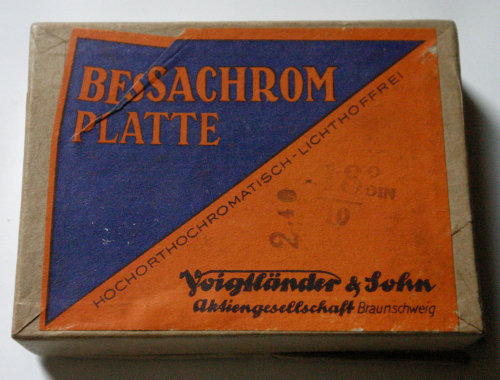
Voigthlander - Bessachrom (made by Gevaert)
and there would be others.

bessachrom.jpg


Ian
 
Still: "The use of the term "chrome" to denote slide films is due to the choice made by the manufacturers to give their slide films the "chrome" suffix, their colour negative films the "color" suffix.
Not a hard and fast rule, but still the origin of "chrome = slide"."
 
IT'S BECAUSE IT'S SHINY!!! GAWD!!!
 
Thomas wrote: "I'd suggest the greek word for colour (χρώμα - chroma)." That suggestion isn't gaining much acceptance here.
 
Thomas wrote: "I'd suggest the greek word for colour (χρώμα - chroma)." That suggestion isn't gaining much acceptance here.

It is generally accepted, as far as i can see.

But it is the answer to the wrong question: the question is not what "chrome" is a derivation of, but why slides are called chromes.
And that is not because "chroma" is greek for colour. :wink:
 
Ian, my hat's off to you. And I don't even wear a hat...
 
Ian, my hat's off to you. And I don't even wear a hat...

Well that's my pack of "Bessachrom" Voigthlander plates, and my father shot rather a lot of images on Selochrome on his regiments (IEME light tanks) long march from Karachi, through the mountains on the Afgan border, Persia, Lebaon, Syria, Palestine and Egypt and witnessed Rommel and Montgomery's epic El Alamein tank battle, they were on the edge of the fighting closing off bolt holes :D

My mum took a few picture of me as a kid on Verichrome, then later when my sister was born Werichrome Pan

So you see "Chrome" could mean different things to different people.

I said earlier it's a purely slang term mainly US for colour slides but actual usage goes back far further.

In the UK it was rare to here the word Chrome used for transparencies, clients would say can you shoot B&W & tranny, or specify colour neg,, but usually they said what the work was for and that governed the choice.

Then when I went to the lab early 70's I'd have to say E4 or Agfa for some professional development because Agfa transparency and negative films weren't E4 or C-22 compatible a fact that labs hated.

Ian
 
It is generally accepted, as far as i can see.

But it is the answer to the wrong question: the question is not what "chrome" is a derivation of, but why slides are called chromes.
And that is not because "chroma" is greek for colour. :wink:

Here'e how I see it. The first REAL color film was Kodachrome. They just happened to call it 'chrome' because it is a color film. But when Kodak later came out with color negative film, they could not call it Kodachrome since 'chrome' was already taken by the famous positive film. So they called it Kodacolor. Thus started the convention of calling slide films 'chrome', and using the 'color' suffix for negative films. Other manufacturers followed suit.
 
You should look at the quality of Autochromes they are the first "real" colour film/plate, if you've never seen original prints made from them then you should make an effort, the colours are extraordinarily good considering the technology :D and why Kodachrome has that name.

There were a number of colour slide films prior to Kodachrome all additive processes like Lumiere Filmcolor, Dufaycolor, and Agfacolor, but Kodak needed to differentiate their new film which was the first subtractive process from its competitors so used Chrome instead of Color, to indicate the better colour fidelity, for the same reasons Lumiere had used the term in Autochrome aboutb 30 years earlier.

In fact it was some time before a major competitor used Chrome to denote slides, Agfacolor-Neu launched in 1936 a year after Kodachrome and was their subtractive Transparency film. The next chrome transparency films were Ektachrome, again from Kodak.

In 1954 Gevachrome is a B&W film, Gevacolor R (reversal) N (neg), Agafacolor Neg or Reversal, Ilford Colour D (reversal),, same in the early 60's. Probably the first company to copy Kodak is Fuji with the release of Fujichrome in the late 1950's.

The term "Chrome" for other colour transparency films began being added slowly with Agfa and Perutz using it with new films (1964 Agfa had merged with Gevaert and rationalised it's film products) but it only became common to all with the release of the E6 in 1977 when all company's outside the Eastern block moved to E6 as a fully compatible processing system.

Ian
 
You should look at the quality of Autochromes they are the first "real" colour film/plate, if you've never seen original prints made from them then you should make an effort, the colours are extraordinarily good considering the technology :D and why Kodachrome has that name. [...]

That will proof impossible to proof. :wink:

I think StorminMatt's explanation is the better one.
 
Photrio.com contains affiliate links to products. We may receive a commission for purchases made through these links.
To read our full affiliate disclosure statement please click Here.

PHOTRIO PARTNERS EQUALLY FUNDING OUR COMMUNITY:



Ilford ADOX Freestyle Photographic Stearman Press Weldon Color Lab Blue Moon Camera & Machine
Top Bottom