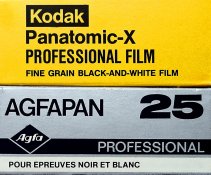
First, there is no black and white film that cannot be developed in *any* black and white developer, so you don't need to worry about what films will "work" in what developers. What you perhaps should worry about in this department is doing enough testing to be able to get predictable and consistent results.
As for a slow film, there are numerous options. Each will be more suitable for certain things than others, and less so for others.
As for slow films, I am very familiar with Ilford films, and have some experience with Efke films. The only Kodak films I know are Tri-X 320 and T-Max 400.
Pan F gives an astounding amount of sharpness, while retaining a "classic" look. Its problem is its extremely high contrast. It has a very short dynamic range, thus low latitude, out of the box. As such, it gives killer results only when tested thoroughly and used very precisely. I have to rate this film at 16 or 20 (depending on which shutter I am using) in order to predictably place a zone I. (Contrary to what some people do, I place things at zone I all the time.) Also of note is that its spectral sensitivity is a bit different than most films. Similarly to Tri-X, it is nearly as responsive to blues as it is to reds, unlike most films, which are significantly more responsive to reds than to blues. Also, the sensitivity curve is rather "odd", dipping or jumping at certain wavelengths while the other films have more smooth and gradual changes in sensitivity. This can lead to slightly unexpected tones, even in a well controlled "system". I love this film, but it is a bitch to work with, plain and simple.
FP4 is another "classic" film that is easier to pin down than Pan F, though notably grainier (but not grainy in the grand scheme of things). It is sharp, but without being overly so like Pan F and Delta 100 can often be, IMO. It is good choice for controlling highlights and having relatively subdued shadow and midtone contrast. I love this film very much for exactly these reasons.
Delta 100 is probably what you want, based on what you said. It is very sharp and very contrasty. It has a straight characteristic curve compared to Pan F and FP4. It is very responsive to minor changes in exposure and development. It is another one that has to be nailed down pretty tightly for killer results, but if you want a more modern, sharp, detailed look with healthy amounts of shadow and midtone contrast, this is your film (from Ilford, at least).
Efke 25, 50, and 100 are good, IMO. They require very careful technique in my experience, just like Pan F, and can tend to get a bit flat, like FP4. They don't respond as well as other films to overexposure. But they do have a very classic and unique look, and are nice and cheap. I use the 25 and sometimes the 50, almost always in my Speed Graphic with flashbulbs.
As for Kodak Plus-X and T-Max 100, they are probably similar to their respective Ilford films, but I don't know this via my own experience, so will hold any further comment on them. I am only really familiar with Tri-X 320 and T-Max 400 from Kodak.

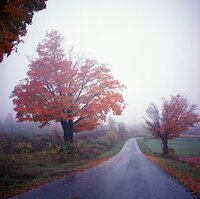
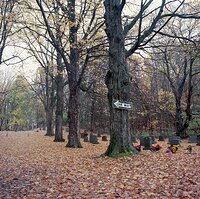


 but I shoot some that satisfy me.. It's just the "b+w" thing that is new.