
• Welcome to Photrio!
    Registration is fast and free. Join today to unlock search, see fewer ads, and access all forum features.
    Click here to sign up

What's the point?

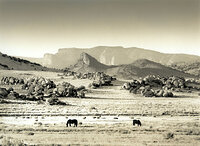
Two Horses

A
Two Horses

  • 6
  • 1
  • 41
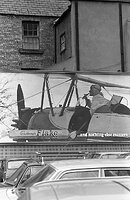
Billboard, Cork city 1977

H
Billboard, Cork city 1977

  • Tel
  • Mar 17, 2026
  • 1
  • 0
  • 33

Recent Classifieds

Forum statistics

Threads
202,802
Messages
2,845,708
Members
101,541
Latest member
ΦÆdon
Recent bookmarks
1
Youth is often (not always) the enemy of "Street Photography".
As Buildings, buses, signage, clothing styles, taxis, and small business change...the photos become more interesting to a wider range of viewers.
A person in San Francisco circa 2015 can easily appreciate frames taken of Gary Indiana in 1977.
It becomes a Visual History Of The World. Photography is, perhaps, the most generic form of communication. Any person that can see, can appreciate a certain photo.
During (or perhaps soon after) the Apollo Missions for example, The Whole World looked at pictures of the moon.....no text necessary. :smile:
 
I personally have little interest in street photography, but did recently come across a book put out by a local press in the town in which I grew up, where they collected photographs taken over a 80 year period by a father and son photography team and then sent a could of photographers to take current pictures from the same locations. It was very interesting to see how things had changed over time, and even when the buildings themselves hadn't changed, their surroundings, cars, and pedestrians where quite different.
 
I'm not trying to question the credibility of it as an art form. I'm just wondering what exactly it is that it tries to capture or convey. Other genres of photography are easy to answer the same question for. What's the point of sports photography? To capture the excitement, struggle, or peak of the action. What's the point of landscape photography? To capture the beauty/grandeur of a particular scene. I just can't seem to figure out the answer for street photography quite as easily. Several of the responses given here do make sense to me though. Thanks.

To capture the excitement, struggle, beauty, grandeur, action, scenes, and temporality of being.
 
What is the point of your question? Street photography is no different than portrait or landscape: you have a lot of bad pictures and among them some jewels.

Don't worry, HCB, Koudelka or Winogrand certainly has their share of bad shots but this is not what hangs on the museums walls.

If you have the opportunity, please watch short videos named "Contacts". In 12-15 minutes per photographer are reviewed contract prints with comments from the photographer (or curator) about the circumstances shots were made. If I remember well, HCB, William Klein, Robert Doinsneau, Josef Koudelka and Marc Riboud or Leonard Freed contracts sheets are explained. You clearly see that they all shot A LOT to get 1 valid picture, certainly much more than any amateur photographer.

And I fully agree with MartinCrabtree: Street photography is a very demanding exercise.
I seem to remember a quote from Henri Cartier Bresson " your first 10,000 pictures are the worst", or something similar.
 
What's the point of street photography? I mean, most of the street shots I see are of some gnarly old Asian dude missing a couple teeth, or a guy in an apron standing behind a counter full of smelly fish. Don't get me wrong, I love seeing many of these images but I don't know what it is that draws me to them. Why do we like this genre and what is it about this genre that makes it a credible art form?

While street photography can produce some interesting photographs, I never felt motivated to expend the effort.
 
I live in a city, I enjoy photography, I enjoy walks. I end up taking "street" photos. No toothless men or smelly fish in mine. :smile:
 
OP
there is no point in any of it :smile:
if you don't like photographing outside, there's no point
if you don't like photographing people, there's no point,
if you don't like photographng in a city, and people and society there is no point
if you don't like social situations, or photographing humanity, or beauty or truth, there is no point ...

since you mightnot be making a living at doing streetwork or photography ( ingeneral ) the point is
to do what you might enjoy doing, so if you enjoy allthethings i mentioned before, that's the point ..
 
Well, it's all subjective when all is said and done. For me Photography is about capturing a moment. Street photography offers a variety of subjects, animals, people, place, food and so on captured at a specific point in time. I love looking through the old stuff and seeing how times have changed, and I find the best examples of the change in culture to be captured in Street photography. I think it's a terrific medium for capturing life in general.
 
I saw the Mona Lisa when I was in Paris a number of years ago. I wasn't any more impressed with that painting than I am with most street photography. I guess my lack of understanding of this genre comes from my experience with life in general. We photograph our families, pets, and friends because we love them and want to remember them and the moments we share together. We photograph scenery because we find beauty in nature that we try to preserve on film. We photograph sports because it's our kid out there playing, or it's our favorite team, or we are selling our work. We photograph our cars because we are impressed with the styling or engineering. We photograph war because it is a significant event in human history. We photograph toothless strangers and smelly fish why exactly? We don't know them, we don't spend special moments with them that we want to preserve, and the typical street scene isn't a significant historical event.
 
Who said that the purpose of street photography is to shoot toothless people and smelly fish??? If you do not find anything else in street photography, it is pointless to argue anymore.
 
It's not an argument really, just a plea to help me find the value in it that I can't seem to see as readily as in other genres.
 
My father would do street photography. He would first ask if he could take a photograph. When the victim said yes, my father would move in so close with his Mamiya C330 that he would practically shove the two lenses up the victims nose. Many times I saw the look of horror on the victims' faces. No street photography for me.
 
a plea to help me find the value in it that I can't seem to see as readily as in other genres.
You have not already seen Thousands upon Thousands of photographs taken by Vivian Mayer, Henri Bresson, William Kline, Robert Frank, Mary Ellen Mark, Garry Winogrand, Gordon Parks, Diane Arbus, Dorothea Lange, Charles Sheeler, Paul Strand, Etc etc etc.?
I would say it is Completely Impossible to help you see "The Value" of a genre that has been one of The Biggest Parts of photography since its inception.
You simply do not like it.
 
I don't like cloves and can't understand why anyone would want to eat food flavored with it. Nobody is going to convince me there's culinary value in cloves.

I think a lot of street photography is redundant, without value (to me) and leaves a bad taste in my mouth like cloves, but there's always some good among the bad and some people like cloves. I could say the same about just about any type of photography. Unlike ctrout I rarely try to preserve "memories" or "moments" with photographs. I prefer memories to be just that-memories. There is little more boring than having to watch a slideshow of someone elses favorite memories. Those types of images generally have value only to those present.
 
I don't like cloves and can't understand why anyone would want to eat food flavored with it. Nobody is going to convince me there's culinary value in cloves.

Unlike ctrout I rarely try to preserve "memories" or "moments" with photographs.

Like it or not, most every photo you shoot preserves a moment in time, no matter if you try to do it or not. That is basically the gist of photography.
 
There is no point. Just grab a rusty razor blade, slash your wrists and get it over with. But when you do make sure there is some "street shooter" around so he can document it. Better yet wear a "Black Lives Matters" tee shirt. Oh ya I hope you aren't some old wrinkled Asian guy, because if you are then there is no point in anyone taking your picture.
 
WTF dude? "Don't understand street photography? Go kill yourself." Might as well have told me to die of cancer or go surrender myself to ISIS so they could cut my head off. WOW! Just WOW!
 
Here's a shot on the street I took today with my cell phone in NYC while driving in Midtown. I think the unordinary is what makes street shots interesting.

Checking the Oil - NYC
Checking the oil - NYC 10-23-17 1200W.jpg
 
Like it or not, most every photo you shoot preserves a moment in time, no matter if you try to do it or not. That is basically the gist of photography.

There are many approaches to photography where the moment never existed at all. Thats not usually the case for street photography so I'll just leave it at that.
 
There are many approaches to photography where the moment never existed at all. Thats not usually the case for street photography so I'll just leave it at that.

LOL that sort of photography where the moment never existed started in about 1839. ansel adams practicd it too.
as soon as one uses a shutter or f-stop, the moment never existed as it was presented infront of the camera ,,,
 
I agree,

Street is one of those things that I understand from the masters but not from its modern standpoint. Now you MUST shoot with A, B, C, D, and you must NOT do 1, 2, 3, 4, and 5. I've done street with color, digital and a long lens. I was called a heretic and blasphemer who's preying on the public, oh and you're subject is too isolated/not standing out enough.

In the end I feel for most of the streetist is more about the hunt and getting lucky than the skill of taking a great photograph.

There's luck in all forms of photography. Look at Ansel Adams most famous photo, Moonrise. Aside from his quick exposure calculation in his head, that shot was all luck.
 
There's luck in all forms of photography. Look at Ansel Adams most famous photo, Moonrise. Aside from his quick exposure calculation in his head, that shot was all luck.

Luck was part but read how he developed the photo, also the amount of darkroom work he did. Ansel was a darkroom master. From what I recall he developed that negative by holding part of it in the solution for longer and the putting the rest in. If that's not a gamble I don't know what is.

You can have all the luck in the world but if you have no skill to back it there's not much that's going to happen.
 
Photrio.com contains affiliate links to products. We may receive a commission for purchases made through these links.
To read our full affiliate disclosure statement please click Here.

PHOTRIO PARTNERS EQUALLY FUNDING OUR COMMUNITY:


Ilford ADOX Freestyle Photographic Stearman Press Weldon Color Lab Blue Moon Camera & Machine
Top Bottom
