
-
Welcome to Photrio!Registration is fast and free. Join today to unlock search, see fewer ads, and access all forum features.Click here to sign up
- Home
- Forums
- Analog Workflow Forums (100% Analog/Traditional)
- Analog Equipment
- Large Format Cameras and Accessories
You are using an out of date browser. It may not display this or other websites correctly.
You should upgrade or use an alternative browser.
You should upgrade or use an alternative browser.
What long lens for 4x5 should I go for? 210/240/250/270/300
-
A
- Thread starter Capan
- Start date
Recent Classifieds
-
For Sale Omega Audible Repeating Timer II
- Started by davela
-
Want to Buy Widelux
- Started by Jeff Bennett
-
Sold ULF Camera 7X11, 8X10 Eastman Improved #2
- Started by jimgalli
-
Want to Buy Workhorse Canon F-1
- Started by BHuij
Forum statistics

ags2mikon
Member
I have a 300mm and 400mm Fujinon-t that I use with my Super Graphic. It's great until you want to do tilts and swings. All tele types are like that. The Swollensak tele raptar 10" and 15" work nice for portraits too. Just make sure that the shutter is working. They have a different look than the Fujinons.
Perspective (driven by shooting distance) is the goal to achieve, because wrong perspective can result in facial distortion as illustrated by this comparison (using 135 format)
In 2d photography all perspectives distort facial features that is the nature of capturing a 3d object in 2d.
It is possible however to choose a perspective such that the distortion introduced would appear most similar to the perspective of the viewer when viewing the image from a particular distance.
If your image viewing distance is greater a greater distance from the subject is required for this effect but if the image viewing distance is closer a closer subject distance would be required for this effect.
Nowadays people are very familiar with viewing images that are both shot from a closer and further perspective than is natural for the viewing distance as movie directors will do this intentionally for effect very frequently.
So there’s no audible gasp from the audience when a 180° fish eye lens is used inches from an actor’s face.
You can choose to distort the face as you see fit for your artistic vision and nobody will notice that you chose an unnatural perspective.
In fact many people prefer a perspective that is slightly closer than natural when viewing images of themselves as they feel it is more flattering because it makes them look thinner.
Most people don’t like to see the “the camera adds ten pounds” look of a more distant perspective on their own face. Especially since they’re used to seeing their own face from about 2 feet away in the bathroom mirror

In 2d photography all perspectives distort facial features that is the nature of capturing a 3d object in 2d.
It is possible however to choose a perspective such that the distortion introduced would appear most similar to the perspective of the viewer when viewing the image from a particular distance.
If your image viewing distance is greater a greater distance from the subject is required for this effect but if the image viewing distance is closer a closer subject distance would be required for this effect.
Nowadays people are very familiar with viewing images that are both shot from a closer and further perspective than is natural for the viewing distance as movie directors will do this intentionally for effect very frequently.
So there’s no audible gasp from the audience when a 180° fish eye lens is used inches from an actor’s face.
You can choose to distort the face as you see fit for your artistic vision and nobody will notice that you chose an unnatural perspective.
In fact many people prefer a perspective that is slightly closer than natural when viewing images of themselves as they feel it is more flattering because it makes them look thinner.
Most people don’t like to see the “the camera adds ten pounds” look of a more distant perspective on their own face. Especially since they’re used to seeing their own face from about 2 feet away in the bathroom mirror
I will add the anecdotal story, from another photography forum (POTN) years ago, about the mother who looked at the photo of her son, shot from the slightly longer distance required for framing when using 135mm FL on 135 format, who complained quite vociferously that the photo was not an accurate representation of her son.
These days, I am continually amazed that folks take selfies from very close distances using the rather standardized wide angle FL that is the default of their smartphones, never complaining about facial distortion or the fact that their bulky bodies are exaggerated even rounder by the very close distances of the shot. I surmise that they have gotten accustomed to seeing themselves rounder!
Last edited:
- Joined
- Jul 14, 2011
- Messages
- 15,214
- Format
- 8x10 Format
'T' - you've got it backwards.
Why pay a photographer to take a tasteful image if a grotesque balloon one done by the average cell phone is "acceptable". I've done exactly one "portrait" shot with a cell phone so far in my entire life - our pet tree squirrel with its twitchy nose looking ginormous so close up. That might flatter a squirrel or make people laugh, but most humans don't like their own faces laughed at. Longer lenses don't distort like that.
Why pay a photographer to take a tasteful image if a grotesque balloon one done by the average cell phone is "acceptable". I've done exactly one "portrait" shot with a cell phone so far in my entire life - our pet tree squirrel with its twitchy nose looking ginormous so close up. That might flatter a squirrel or make people laugh, but most humans don't like their own faces laughed at. Longer lenses don't distort like that.
'T' - you've got it backwards.
Why pay a photographer to take a tasteful image if a grotesque balloon one done by the average cell phone is "acceptable". I've done exactly one "portrait" shot with a cell phone so far in my entire life - our pet tree squirrel with its twitchy nose looking ginormous so close up. That might flatter a squirrel or make people laugh, but most humans don't like their own faces laughed at. Longer lenses don't distort like that.
Longer lenses, or more accurately a greater distance, most certainly do distort, just in the opposite way. Bringing the perceived distance between the front and back of the head closer together making the face look flatter and wider.
Of course there is a comfortable middle ground where viewers tend not to notice the distortion in either direction.
Outside of that range it’s possible to make any subject distance look natural by moving the viewing distance of the image closer or further from the viewer. Even a super wide angle shot like you object to will look natural if you put your eyes close enough to the image.
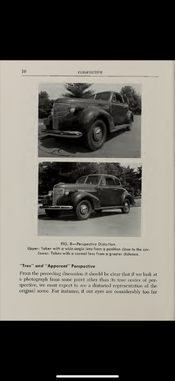
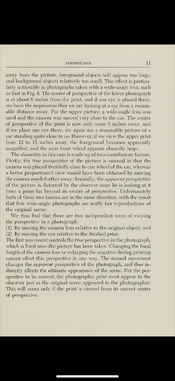
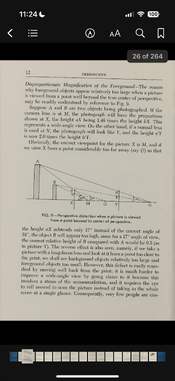
Attached is my reference, a couple pages of “Lenses in Photography” by optics designer and author Rudolf Kingslake
Attachments
Last edited:

I use my Nikkor W 210 a lot with 4x5.

Hi, I have a 4x5 camera with a 135mm lens, and a 90mm on the way. I would like to also have a long lens for portraits.
I’ve been mainly looking for 210mm as they are the more common length, but the are some 250/270/300 mm lenses for a better or similar price than some 210.
Another reason I would like to ask for advice is that according to some charts a 210mm would be equivalent to 63mm on 35mm film, and I like to shoot portraits with 80 to 100 mm focal length which would be equivalent to 270 and 300mm on 4x5.
Are there any lenses I should stay clear away from? I know that I should avoid the 270 rotelar as it has a small image circle for 4x5, but is there any other ones?
From what I found the Fujinon 250 f6.3 is very affordable, similarly to the Fujinon 210 f5.6
So far the list of lenses in my budget are:
Fujinon w 300 f5.6
Fujinon T 300 f8
Schneider symmar-s 300 f5.6
Schneider tele arton 270 f5.5
Schneider tele arton 250 f5.6
Fujinon sf 250 f5.6
Fujinon w 250 f5.6/f6.3/f6.7
Schneider symmar 240 f5.6
Fujinon w 210 f5.6
Nikkor w 210 f5.6
Schneider symmar-s 210 f5.6
Moderator edit: this question is also posted on Reddit
for portraits,go for a fast 300mm if you can afford it!
- Joined
- Jul 14, 2011
- Messages
- 15,214
- Format
- 8x10 Format
T - shallower depth of field does NOT equate to "wider" faces etc - how on earth did you come up with that idea? Maybe some really funky old zoom lenses might have had some distortion, but in general, longer focal lengths are among the most distortion-free.
I have Kingslake's book too; and he writes almost entirely about the design history of lenses prior to modern mfg techniques. Just how many of us still drive around cars like the ones depicted by Kingslake? And especially on a thread like this one, involving mostly modern long focal lengths for large format use, the amount of distortion is minimal - in certain cases, within graphics repro standards. I use a number of the cited ones!
I have Kingslake's book too; and he writes almost entirely about the design history of lenses prior to modern mfg techniques. Just how many of us still drive around cars like the ones depicted by Kingslake? And especially on a thread like this one, involving mostly modern long focal lengths for large format use, the amount of distortion is minimal - in certain cases, within graphics repro standards. I use a number of the cited ones!
for portraits,go for a fast 300mm if you can afford it!
There are some fast 300mm lenses that are reasonably affordable, like the Fujinar & Rectar, and plain Fujinon f4.5 -- all in barrel. The Fujinon was also sold in a #3 shutter as an Fujinon L f5.6.
Last edited:
For portraiture, somewhat longer than "normal" is recommended. You are more apt to get a generous image circle that way too, allowing for greater movements.
When my older brother way in a prestigious photo academy in the 60's, they advised all the students to buy A 210 portraiture and general commercial shoots, and a 90mm wide angle for indoor architectural use. I followed suit, and the only lens I owned and used for an entire decade was a 210/5.6 Symmar S. I used it for everything, but eventually needed to replace it due to thousands of miles of high altitude and desert backpacking. I've never owned a 150 'normal" in my entire life, though I have nothing against them.
Analogously, even when using 35mm, 6X7 MF, or even 8x10, I always go for longer than normal lenses when portraiture is involved.
I always like to build a basic set of lenses for all formats out of 'normal' focal length plus double and half that. That has served me well for 35mm, MF and LF photography.
- Joined
- Jul 14, 2011
- Messages
- 15,214
- Format
- 8x10 Format
xkaes - the preferred Fuji lenses for portraiture were their single coated L series tessars - 210/5.6 for 4x5, and 300 and 420/9 for larger formats. A lot has to do with the gentler rendering compared to their general purpose and speciality plasmat designs, which can simply over the top when it comes to contrast and resolution in portrait applications. The 210 L is in a small no. 1 shutter, the other two are rather heavy, being in no.3 shutter and having thick elements.
My only 300 is a Nikkor M f/9, itself ridiculously crisp and contrasty, but lightweight for a tessar due to thin elements. I generally skip over 4x5 when it comes to portraits, and go straight to 8x10 with a 14 inch Kern dagor lens. It would be nice to have a 420L Fuji too; but I don't do enough portraiture anymore to warrant it.
My only 300 is a Nikkor M f/9, itself ridiculously crisp and contrasty, but lightweight for a tessar due to thin elements. I generally skip over 4x5 when it comes to portraits, and go straight to 8x10 with a 14 inch Kern dagor lens. It would be nice to have a 420L Fuji too; but I don't do enough portraiture anymore to warrant it.
T - shallower depth of field does NOT equate to "wider" faces etc - how on earth did you come up with that idea? Maybe some really funky old zoom lenses might have had some distortion, but in general, longer focal lengths are among the most distortion-free.
I have Kingslake's book too; and he writes almost entirely about the design history of lenses prior to modern mfg techniques. Just how many of us still drive around cars like the ones depicted by Kingslake? And especially on a thread like this one, involving mostly modern long focal lengths for large format use, the amount of distortion is minimal - in certain cases, within graphics repro standards. I use a number of the cited ones!
I’m not sure if you’re arguing in good faith as you have clearly misinterpreted my post on every count. But I will give you the benefit of the doubt and explain your mistake.
Nowhere did I mention depth of field. It’s not relevant to the effect I’m describing. In fact nothing about the lens or its design is relevant to the distortion I described. It is simply an effect of perspective.
The book you’re referring to is different book by Kigslake than the one I referenced. He wrote many.
And the effect I described is literally referenced in the pages I posted.
Here’s a further quote from another page out of “Lenses in Photography”
“The reverse effect (of wide angle distortion) is also seen, namely, if we take a picture with a long-focus lens and look at it from a point too close to the print, we shall see background objects relatively too large and foreground objects too small. However, this defect is easily remedied by moving well back from the print.”
The rest of the page shows the geometry of why this is so.
So using too long of a subject distance for the distance at which the image is intended to be viewed results in the back of the head appearing proportionally larger than it should in relation to the front of the head, which makes the apparent distance between the front and back of the head appear less and the shape of the face appear flatter and wider in all lateral directions.
In my experience many subjects do not appreciate being distorted in this way as it can make them appear fatter than they really are
Attachments
the preferred Fuji lenses for portraiture were their single coated L series tessars - 210/5.6 for 4x5, and 300 and 420/9 for larger formats
The others that I mentioned are the same 4/3 design and single coated, but in-barrel, and faster -- f4.5. These can be found for much less because they don't have a shutter, but they are harder to find, and not everyone's "cup-o-tea".
For that type of work -- not just portraits -- I use home-made 1/1 Wollaston or 3/2 Verito lenses, on a #3 shutter. A 300mm is about f6.7, and a 200mm is about f4.5.
ags2mikon
Member
I have the Fujinar 30cm f4.5 and it's 3 little brothers, and it is a beast. 82mm filter and is not going to fit the OP's Super Graphic. Mine has got an adapter for a Shanel 5a shutter and it is a good mach for a heavy monorail like my Toyo 45g. The focusing is real easy at f4.5, you almost don't need a focusing cloth.
Nopo
Member
I am shopping on yahoo auctions. In my country the price limit for a single parcel is 400 usd including shipping. The issue is we only get 4 per year, so I would like to take advantage and buy a long lens to go with the 90 f5.6 I got. I guess I have a budget of 150, 180 max.
There is a Schneider 240 f5.6 for 150$, a couple of Fujinon 250 f 6.3 in varying conditions from 100 to 170$, a Schneider tele-arton 250 f5.6 for 180 and a Fujinon T 300 f8 for 160$. This one’s can be bought right now, there are others which auction ends these next days.
Hello, @Capan, I don't know where or who informed you about Argentina's import guidelines, but they are wrong!!!.
I have been making five imports a year, and the shipping cost is not taken into account.
The US$400 is exclusively the value of the item without freight or customs procedures.
So using too long of a subject distance for the distance at which the image is intended to be viewed results in the back of the head appearing proportionally larger than it should in relation to the front of the head, which makes the apparent distance between the front and back of the head appear less and the shape of the face appear flatter and wider in all lateral directions.
In my experience many subjects do not appreciate being distorted in this way as it can make them appear fatter than they really are
It is traditionally described that too far away with telephoto FL 'flattens' appearance, while too close with WA FL can exaggerate closer features (to exaggerate bosoms or to make an upper arm look overly large). If one looks at the link which I included in an earlier post in this thread (post #50), one can readily see the exaggeration of WA vs. 'normal' but the telephoto vs. normal is less apparent. But certainly one cannot say that the telephoto (350mm on 135 format) 'fattens! Taken from that link...

Exaggerating one hand size, with WA FL (actualy, 'too close' camera position) ...

...one hand is NOT twice as big as the other in reality (and the shot was not in a 100' long room)!
Last edited:
It is traditionally described that too far away with telephoto FL 'flattens' appearance, while too close with WA FL can exaggerate closer features (to exaggerate bosoms or to make an upper arm look overly large). If one looks at the link which I included in an earlier post in this thread (post #50), one can readily see the exaggeration of WA vs. 'normal' but the telephoto vs. normal is less apparent. But certainly one cannot say that the telephoto (350mm on 135 format) 'fattens! Taken from that link...
I should say many subjects feel that the look of a longer perspective makes them look fatter although it is just a matter of geometry. You can see in this very image set you posted of the 350mm example that the shape of the neck and face in relation to its features (the eyes, nose, mouth, etc.) appears quite a bit larger than the image directly next to it of the 19mm example, in which the size of the neck and face is relatively small compared to the size of the features. Some subjects feel that this shorter perspective makes their face look thinner.
It's the same effect that is was referred to in the days of broadcast television, in which studio cameras filming on a set were placed relatively far away from the subjects appearing on the show as to have a clear view of the entire set, thus rendering the perspective from a distance quite a bit greater than is natural when viewed from a comfortable distance for the television screen sizes of the era. It's a well known phenomena which people would commonly refer to by saying, "The camera adds 10 pounds."
So if you have a subject who requests that you help them look thinner in their photos, you can do quite a bit to improve their perception of the impression of their figure by using a shorter subject distance and a wider lens.
Actually most people, especially young people now, are much more familiar with the look of photos of their faces from a subject distance of about an arms length because of the wide, front facing cameras on their phones. The old way of making portraits of using a full frame equivalent of 80mm is no longer perceived by many to be a desirable perspective of their own features.
I should say many subjects feel that the look of a longer perspective makes them look fatter although it is just a matter of geometry. You can see in this very image set you posted of the 350mm example that the shape of the neck and face in relation to its features (the eyes, nose, mouth, etc.) appears quite a bit larger than the image directly next to it of the 19mm example, in which the size of the neck and face is relatively small compared to the size of the features. Some subjects feel that this shorter perspective makes their face look thinner.
It's the same effect that is was referred to in the days of broadcast television, in which studio cameras filming on a set were placed relatively far away from the subjects appearing on the show as to have a clear view of the entire set, thus rendering the perspective from a distance quite a bit greater than is natural when viewed from a comfortable distance for the television screen sizes of the era. It's a well known phenomena which people would commonly refer to by saying, "The camera adds 10 pounds."
So if you have a subject who requests that you help them look thinner in their photos, you can do quite a bit to improve their perception of the impression of their figure by using a shorter subject distance and a wider lens.
Actually most people, especially young people now, are much more familiar with the look of photos of their faces from a subject distance of about an arms length because of the wide, front facing cameras on their phones. The old way of making portraits of using a full frame equivalent of 80mm is no longer perceived by many to be a desirable perspective of their own features.
I suppose that one could say that the WA seems to thin the face, usd at the relative distance from the lens (used at the level of the face) also 'thins' '(makes smaller) the body when the WA lens is used close (relative to the portrayal of the 'normal' lens), and that the telephoto lens does the inverse ('fattens') relative to the actions of the WA lens close. OTOH, the telephoto does not make face broader, relative to the portrayal of a 'normal' FL.
abruzzi
Member
I always like to build a basic set of lenses for all formats out of 'normal' focal length plus double and half that. That has served me well for 35mm, MF and LF photography.
I like 1.4x to fill in some space between those doublings--75mm, 105mm, 150mm, 210mm, 300mm is my 5-lens kit on 4x5.
Mine is more like 1.5x. for 4x5 - 65mm, 90mm, 135mm, 203mm 300mm. Although I usually on carry the middle three. For 5x7 I change out the 65mm for a 75mm.
- Joined
- Jul 14, 2011
- Messages
- 15,214
- Format
- 8x10 Format
Again, T, you're referencing some Jurassic era stereotypes.
And long lenses aren't necessarily telephoto design; most aren't. I have a number which are superbly close range corrected, as well as excellent clear out to infinity, with very very little distortion over the whole range.
You still have it all backwards. Getting up close with something wide angle isn't going to "thin" anything. If you want to open a portrait studio based on wide angle lenses, it's your right to do so; but it would be counterintuitive to what the trade has done for many decades. You'd be in the less than 1% category of opinion.
And long lenses aren't necessarily telephoto design; most aren't. I have a number which are superbly close range corrected, as well as excellent clear out to infinity, with very very little distortion over the whole range.
You still have it all backwards. Getting up close with something wide angle isn't going to "thin" anything. If you want to open a portrait studio based on wide angle lenses, it's your right to do so; but it would be counterintuitive to what the trade has done for many decades. You'd be in the less than 1% category of opinion.
Last edited:
chuckroast
Subscriber
Again, T, you're referencing some Jurassic era stereotypes.
And long lenses aren't necessarily telephoto design; most aren't. I have a number which are superbly close range corrected, as well as excellent clear out to infinity, with very very little distortion over the whole range.
You still have it all backwards. Getting up close with something wide angle isn't going to "thin" anything.
Yeah, I have both a 14" RD Artar and 19" APO Artar for use on my 4x5 and they work just fine. The challenge with the 19" isn't its close range correction. It is the fact that my Wisner Technical Field has limited bellows draw beyond 19" for closer in subject. The other drawback is that the bellows extended that far make the camera kind a sail if there is any wind at all, due to the huge cross sectional area. For this reason, the 19" primarly gets used only at a distance and then only when it is calm outside. The 14" gets way more use.
FGAS "fat girl angle shot" was a popular meme in the early days of the internet. The idea was that a chubby girl trying to hide her weight would use a wide angle lens (usually around 28mm equivalent) and a close, high angle. This would both increase the eye size in relation to the rest of the face, making them look younger, and reduce the size of anything far from the camera.
A person of healthy weight photographed at a normal angle and distance on the other hand, usually looks best in the 85-135mm range.
So you can both be right.
A person of healthy weight photographed at a normal angle and distance on the other hand, usually looks best in the 85-135mm range.
So you can both be right.
- Joined
- Jul 14, 2011
- Messages
- 15,214
- Format
- 8x10 Format
Why not just wear a dress with vertical stripes?
I had a friend who would accentuate the shading on one side of wide-faced or wide-bodied women to make them look narrower. I'd do just the opposite and leave them as they actually were, and make the print itself beautiful and delicate, and therefore them within it.
I had a friend who would accentuate the shading on one side of wide-faced or wide-bodied women to make them look narrower. I'd do just the opposite and leave them as they actually were, and make the print itself beautiful and delicate, and therefore them within it.
Last edited:
| Photrio.com contains affiliate links to products. We may receive a commission for purchases made through these links. To read our full affiliate disclosure statement please click Here. |
PHOTRIO PARTNERS EQUALLY FUNDING OUR COMMUNITY:  |