• Welcome to Photrio!
    Registration is fast and free. Join today to unlock search, see fewer ads, and access all forum features.
    Click here to sign up

What long lens for 4x5 should I go for? 210/240/250/270/300

Recent Classifieds

Forum statistics

Threads
202,604
Messages
2,842,909
Members
101,401
Latest member
Boloop
Recent bookmarks
1
... and don't forget that excellent portraits can be taken with "normal" focal length lenses and cropped. A 300mm lens, 12-inch Kodal Commercial Ektar, was the last LF lens I bought after decaded of LF photography. It's a great lens but for 4x5 is somewhat of more limited utility than it is for larger film formats. And much too big and heavy for use on a Graphic press camera.

Another option to consider for press camera portraiture is normal FL lens and roll film backs. It's actually a very effective option. Trust me...

One of the lenses you mention in your initial list I'd like to advocate for, although I've never used it on a press camera. The Fujinon 250SF is a splendid lens for portraiture. There is a lesss common 180mm version that might be also worth considering. Just make sure that you buy that lens with both "diffusion strainers" as at least one of them tends to get separated from the lens and are very difficult to source separately.
 
Last edited:
The thing is, I want something that is versatile, I can always make a sharp lens soft, but not the other way around. Plus, I can just get a lens with fungus and repair it myself, it will end up softer.

You can always make a sharp lens soft -- by smearing Vasoline on it, etc. -- but that's not the same effect as a true soft-focus lens. Plus, the soft-focus lenses lose the soft-focus effect simply by stopping down -- so you can make a soft lens sharp.

I learned years ago -- the hard way -- that most subjects don't like their portraits from sharp lenses -- which so every minuscule blemish.
 
Last edited:
Of, so
You can always make a sharp lens soft -- by smearing Vasoline on it, etc. -- but that's not the same effect as a true soft-focus lens. Plus, the soft-focus lenses lose the soft-focus effect simply by stopping down -- so you can make a soft lens sharp.

I learned years ago -- the hard way -- that most subjects don't like their portraits from sharp lenses -- which so every minuscule blemish.
Ah, didn’t know that. In that case the 250 soft focus is a good option. Brian just recommended it and it is available at a very good price in great condition.
The sharpness I want is mainly for la facade or architecture, and in that case I can easily stop it down and use long shutter times.
Thank you for the advice!
 
Don't expect soft focus lenses to be versatile - certainly not for architecture!
 
Not even if stopped to f/22? And without the strainers

They become sharper, but ultimately you'll need to decide between a generalist lens or something portrait-specific. A soft-focus lens may have spherical aberration, distortion, and field curvature that will be reduced upon stopping down but it will not be optimized for flat-field distortion-free architectural work.

I think the advice you've previously received to get a "normal" focal length lens is good. Complementing a 90mm lens with a 150 or 180 gives you plenty of flexibility. The other thing I'll offer is that without having a specific, fixed goal for a lens purchase I believe the best option is to get a generalist lens based primarily on the criteria of price and condition. If the shutter and glass are in good shape, whatever lens you get in the normal focal length range will serve you well. If you decide to supplement or upgrade that lens, you'll have generated a body of experience that will guide your next lens purchase.
 
For portraiture, somewhat longer than "normal" is recommended. You are more apt to get a generous image circle that way too, allowing for greater movements.

When my older brother way in a prestigious photo academy in the 60's, they advised all the students to buy A 210 portraiture and general commercial shoots, and a 90mm wide angle for indoor architectural use. I followed suit, and the only lens I owned and used for an entire decade was a 210/5.6 Symmar S. I used it for everything, but eventually needed to replace it due to thousands of miles of high altitude and desert backpacking. I've never owned a 150 'normal" in my entire life, though I have nothing against them.

Analogously, even when using 35mm, 6X7 MF, or even 8x10, I always go for longer than normal lenses when portraiture is involved.
 
@Capan The Fujinon SF is a triplet design lens. Without the strainers and stopped down it will be crisp but not as much as a Tessar or Plasmat lens.

For a generalist lens on a SuperGraphic: the native 135 Optar…
 
Last edited:
Don't expect soft focus lenses to be versatile - certainly not for architecture!


@Capan The Fujinon SF is a triplet design lens. Without the strainers and stopped down it will be crisp but not as much as a Tessar or Plasmat lens.

For a generalist lens on a SuperGraphic: the native 135 Optar…

The super speed graphic comes with the 135. I won a 90mm f5.6 super angulon for 140$, so I want to take advantage and get another lens to complement.
In my country you only get 4 purchases per year under 400$ with shipping, so my budget is 170 max.
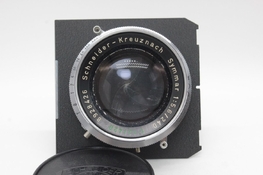
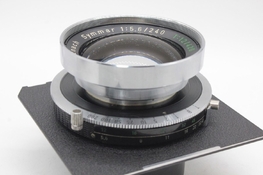
I guess I’ll see if I can snatch the Fuji 250 f6.7, if not a symmar 240 f5.6 is for sale at 150, and in case that fails see if I can get a 250 sf close to 100$, or a 300t f8 for 160 that isn’t on auction.

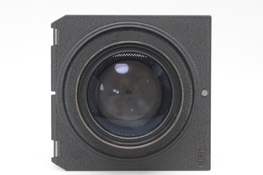
The symmar 240 is from 63 to 1965, so leaning to old. What do you think of its condition? Also, it only goes up to 1/200s.
 

Attachments

  • IMG_9166.jpeg
    IMG_9166.jpeg
    87.5 KB · Views: 47
  • IMG_9167.jpeg
    IMG_9167.jpeg
    88.9 KB · Views: 46
  • IMG_9168.jpeg
    IMG_9168.jpeg
    85.3 KB · Views: 43
Are you able to hang that 90/5.6 on a Graphic press camera. I have one and it’s huge… even a load on a monorail.

Have you had an opportunity to use the lenses you currently have? Sometimes that experience helps refine the requirements and desirements of future purchases.
 
Last edited:
It’s also worth pointing out that even though soft focus lenses were made for portraits, it is a style of portrait that may not be what you want. It has a very dated look.

For that Symmar—my understanding is the early single coated Schneider lenses had a red triangle on the info ring. Sine that one doesn’t have it that may mean it’s uncoated. If you’re shooting outdoors I’d recommend a coated lens. They can still be fine outdoors but you need to be more careful with lens hoods or keeping the sun away from the image circle. (Later multi coated lenses actually say “multi coated” on the outside barrel of the lens. )
 
Last edited:
Don't expect soft focus lenses to be versatile - certainly not for architecture!


@Capan The Fujinon SF is a triplet design lens. Without the strainers and stopped down it will be crisp but not as much as a Tessar or Plasmat lens.

For a generalist lens on a SuperGraphic: the native 135 Optar…

The super speed graphic comes with the 135. I won a 90mm f5.6 super angulon for 140$, so I want to take advantage and get another lens to complement.
In my country you only get 4 purchases per year under 400$ with shipping, so my budget is 170 max.
I guess I’ll see if I can snatch the Fuji 250 f6.7, if not a symmar 240 f5.6 is for sale at 150, and in case that fails see if I can get a 250 sf close to 100$, or a 300t f8 for 160 that isn’t on auction.

The symmar 240 is from 63 to 1965, so leaning to old. What do you think of its condition?
It’s also worth pointing out that even though soft focus lenses were made for portraits, it is a style of portrait that may not be what you want. It has a very dated look.

For that Symmar—my understanding is the early single coated Schneider lenses had a red triangle on the info ring. Sine that one doesn’t have it that may mean it’s uncounted. If you’re shooting outdoors I’d recommend a coated lens. They can still be fine outdoors but you need to be more careful with lens hoods or keeping the sun away from the image circle. (Later multi coated lenses actually say “multi coated” on the outside barrel of the lens. )

The lenses I’ve been able to find within my budget are all pre multi coated. Are you saying that this lens met have no coating at all?
In any case, my question would be if it is the same coating as those from 1970.
 
Not even if stopped to f/22? And without the strainers

The "strainers" only come into play when the lens is opened wide. By the time you are at f8, the aperture only sees through the large hole in the middle of the strainer.
 
It’s also worth pointing out that even though soft focus lenses were made for portraits, it is a style of portrait that may not be what you want. It has a very dated look.

Heavy softness certainly is dated but often subjects, especially older women, prefer a bit of softening to knock off the edges, so to speak. It’s definitely a unique look that not everyone appreciates.
 
The lenses I’ve been able to find within my budget are all pre multi coated. Are you saying that this lens met have no coating at all?
In any case, my question would be if it is the same coating as those from 1970.

Most non-multi-coatged lenses are single coated -- unless they are pre-1960.

For most situations, single coating works fine because most large format lenses have very few elements. The more glass the more benefit from MC.
 
Heavy softness certainly is dated but often subjects, especially older women, prefer a bit of softening to knock off the edges, so to speak. It’s definitely a unique look that not everyone appreciates.

It's the task of the photographer to put in the Goldilocks amount of softness.
 
Most non-multi-coatged lenses are single coated -- unless they are pre-1960.

For most situations, single coating works fine because most large format lenses have very few elements. The more glass the more benefit from MC.

Good to know.
 
For your Super Speed Graphic, 210mm might be better for portraits (esp close-up portraits) since the bellows on your camera is not that long. Also it is not relevant to translate focal length in 135 to 4x5.

Any modern 210mm Symmar, Nikkor, Fujinon, Rodenstock will work just fine, and their image quality won't be so distinguishable when you just start out.
 
A Dagor 8 1/2", Nikkor M 200, G-Claron or as Drew suggested 210 Symmar S would be a terrific lens....
 
Last edited:
The super speed graphic comes with the 135. I won a 90mm f5.6 super angulon for 140$, so I want to take advantage and get another lens to complement.
In my country you only get 4 purchases per year under 400$ with shipping, so my budget is 170 max.
I guess I’ll see if I can snatch the Fuji 250 f6.7, if not a symmar 240 f5.6 is for sale at 150, and in case that fails see if I can get a 250 sf close to 100$, or a 300t f8 for 160 that isn’t on auction.

The symmar 240 is from 63 to 1965, so leaning to old. What do you think of its condition?


The lenses I’ve been able to find within my budget are all pre multi coated. Are you saying that this lens met have no coating at all?
In any case, my question would be if it is the same coating as those from 1970.
The Symmar 240 is single coated. And it is convertible - if it is in the original shutter the shutter shows two sets of f/stops the second set is for 420mm. Usable if you have a long enough bellows which your camera does not.

It is one of the standard lenses used commercially in the 1960's and beyond. However, condition is important when considering it versus other possibilities.
 
Last edited:
@Capan A lot of good insights and commentary already given here.

To my mind, the most overlooked lens in this category is the 203mm f/7.7 Ektar. This lens pairs beautifully with 4x5 Graflex cameras and is an absolute razor sharp, coated and well corrected lens. It is also very light and small and can be left on camera when folded up.

They're available dirt cheap on the used market. I love mine so much, I spent
nearly as much having the shutter CLAed.

The only disadvantage is the relatively slow max aperture, but depending on how you shoot portraits (or anything else) it may well not be an issue.

Keep in mind that a lot of 4x5 Graflex shooters back in the day, used this as they every day carry lens.
 
@Capan A lot of good insights and commentary already given here.

To my mind, the most overlooked lens in this category is the 203mm f/7.7 Ektar. This lens pairs beautifully with 4x5 Graflex cameras and is an absolute razor sharp, coated and well corrected lens. It is also very light and small and can be left on camera when folded up.

They're available dirt cheap on the used market. I love mine so much, I spent
nearly as much having the shutter CLAed.

The only disadvantage is the relatively slow max aperture, but depending on how you shoot portraits (or anything else) it may well not be an issue.

Keep in mind that a lot of 4x5 Graflex shooters back in the day, used this as they every day carry lens.

It looks very compact, I’ll keep an eye in it. Thank you!
 
I don't have nearly the breadth of experience that many people here have with this type of lens. But for many years I have had the Fujinon 250mm/F6.3 lens (the CM-W version) that you mentioned. And it really has served me well as a portrait lens, including for tight portraits (on my Sinar F1 and later Sinar F2 cameras). At the prices you can often find them, they really are kind of a great bargain for excellent 4x5 portrait lenses.

That lens is so nice that when I had to sell my large format gear to help fund my move back from London to the US, when I started getting back into LF photography here, that's the first lens I re-bought. And for some time it was my only LF lens, as what I was shooting didn't need anything wider, I could make do with that lens alone.

Obviously, there is a variety of great choices out there. But for quality bang for buck, that lens is pretty stellar.
 
  • The usual perspective commonly associated with head & shoulders shots with 135 format is with a camera position about 8-10' from subject.
  • The FL usually for appriopriate framing of the subject with 135 format would be 85mm - 105mm, or using the most common FL available today is 100mm.
Translating that range of FL into a multiple of the short dimension of the frame, we have 3.5x - 4.4x the short dimension of the frame;
translating that into 4x5 frame dimensions, proper head & shoulders perspective would be captured with 315mm - 400mm without needing frame cropping to achieve the same tightness of framing, and mandating a telephoto optic rather than long focus optic due to bellows contraints.
Given FL availability constraints, shoot with shorter FL at a camera distance of about 10' (to achieve the right 'perspective') and crop in printing!

Perspective (driven by shooting distance) is the goal to achieve, because wrong perspective can result in facial distortion as illustrated by this comparison (using 135 format)
 
Last edited:
Photrio.com contains affiliate links to products. We may receive a commission for purchases made through these links.
To read our full affiliate disclosure statement please click Here.

PHOTRIO PARTNERS EQUALLY FUNDING OUR COMMUNITY:


Ilford ADOX Freestyle Photographic Stearman Press Weldon Color Lab Blue Moon Camera & Machine
Top Bottom